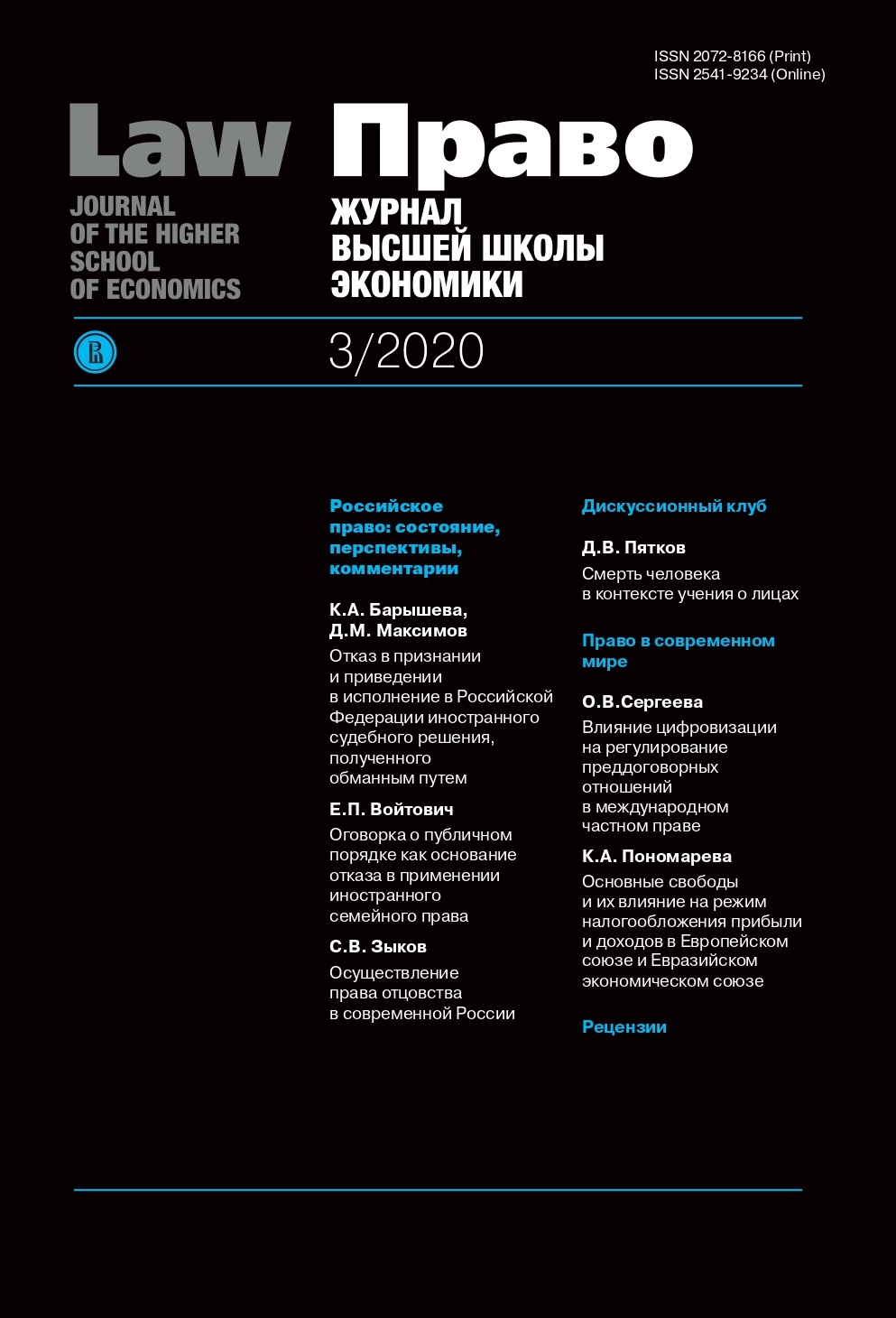
Осуществление права отцовства в современной России: правоприменительные и законодательные препятствия
Аннотация
Предметом исследования является юридический институт отцовства в системе права Российской Федерации. Целью является выявление основных проблемы осуществления права отцовства с использованием методов моделирования, а также исторического, формально-юридического, системного, статистического методов. Проблемное поле данного юридического института начинается с Конституции, которая предоставляет ему (в семейно-правовом контексте) предельно ограниченную базу, и эта ограниченность в настоящее время не восполнена правовыми позициями Конституционного Суда России. Ключевым в этой сфере (с учетом доли расторгаемых браков) является возможность постразводного воспитания отцами их детей. Дискриминационная к отцам судебная практика об определении места жительства ребенка поддерживается прежде всего благодаря незаконному применению Верховным Судом России принципа 6 Декларации о правах ребенка; изменению им нормы закона, устанавливающей иерархию критериев, подлежащих учету по делам данной категории; а также посредством подбора судебных дел определенной направленности. В отношении отдельно проживающего родителя, который может вместо воспитания ребенка претендовать лишь на суррогатное право общения с ним, судебная практика вводит обязанность доказать, что такое общение не причинит вреда ребенку. Таким образом, суды фактически вводят дополнительно к трем установленным формам не предусмотренную законом форму ответственности родителя, что является нарушением закона. Кроме того, суды существенно ограничивают время общения с ребенком, ссылаясь на обстоятельства, которые зависят исключительно от действий другого родителя, проживающего с ребенком, тем самым оставляя ему возможности злоупотреблений. Злоупотреблениям способствуют и решения судов об установлении графика общения, ставящие его в зависимость от участия родителя, с которым проживает ребенок (как правило, матери), или от желания самого ребенка, на которого может воздействовать родитель, с которым он живет. Указанные подходы, закрепленные в правовых позициях Верховного Суда, должны быть заменены правовыми, соответствующими нормам и принципам права. Одновременно следует рассмотреть возможность применения механизма проживания ребенка на паритетных началах («совместная опека») в качестве общего правила при разрешении споров родителей о месте жительстве ребенка.
Литература
Aslanov H. G. (2009). Ensuring the interests of the father in parental relations under the family law of the Russian Federation. Candidate of Juridical Sciences Summary. Moscow, 28 p. (in Russian)
Barhatova E.Yu. (2015) Commentary on the Constitution of the Russian Federation: subject to amendments to the Constitution of the Russian Federation by Federal Constitutional Laws 7-FKZ, 2-FKZ, 11-FKZ. Moscow: Prospekt, 268 p. (in Russian)
Belyasov S.N. (2016) Constitutional legal consolidation of paternity. Uchenye trudy Rossijskij akademii advokatury i notariata, no 2, pp. 68-71 (in Russian)
Borisov A. B. (2012) Commentary on the Constitution of the Russian Federation: (itemized). Moscow: Knizhny mir, 271 p. (in Russian)
Chernova Zh.V. (2011) Family policy of modern Russia: gender analysis and effectiveness assessment. Zhenshchina v rossijskom obshchestve, no 3, pp. 44-51 (in Russian)
Danilenkov A.A. (2013) Age qualification of a child as one of the ways to limit the rights of fathers in the Russian Federation. Semejnoe i zhilishchnoe pravo, no 2, pp.10-15 (in Russian)
Derevyanko P.A. (2012) Constitutional Law Institute of Paternity in the Russian Federation. Candidate of Juridical Sciences Summary. Belgorod, 22 p. (in Russian)
Eliseeva A.A. (2010) On improving family law in the field of legal regulation of personal non-property relations. Zhurnal rossijskogo prava, no 3, pp. 87-88 (in Russian)
Issers O.S. (2017) “The right to be a father”: a linguistic-cognitive analysis of the stereotypes of Russian society about the rights and obligations of fathers. Voprosy kognitivnoj lingvistiki, no 3, pp. 37-50 (in Russian)
Korolev S.V. (2015) On the causes of the crisis of the institution of fatherhood in Russia and its impact on value attitudes. Grazhdanskoe obshchestvo v Rossii: sostoyanie, tendencii, perspektivy, no 1(4), pp. 20-23 (in Russian)
Kuznetcova O.V. (2015) Protection of the rights of fathers under family law. Vestnik Chelyabinskogo gosudarstvennogo universiteta. Seriya: Pravo, no 17, pp. 89-94 (in Russian)
Maksimovich L.B. (2018) The right of the child to express his opinion: content and boundaries. Semejnoe i zhilishchnoe pravo, no 6, pp. 4-6 (in Russian)
Novoselov V.M. (2013) Problems of the institution of fatherhood in Russia. Teoriya i praktika obshchestvennogo razvitiya, no 7, pp. 45-47 (in Russian)
Orlova N.H. (2017) Restriction of rights of fathers from a post-divorce situation. Paradigma: filosofsko-kul'turologicheskij al'manah, no 26, pp. 93-104 (in Russian)
Probina S.S. (2017) Legal status of a father under Russian law. Izvestiya vysshih uchebnyh zavedenij. Povolzhskij region. Obshchestvennye nauki, no 2, pp. 49-54 (in Russian)
Sadovnikova G.D. (2013) Commentary on the Constitution of the Russian Federation (itemized). Moscow: Yurayt, 201 p. (in Russian)
Sinel'nikov A.B. (2015) Matrimony, fatherhood, motherhood in Russian society. Socio-logicheskij zhurnal, no 4, pp.132-148 (in Russian)
Smolenskiy M.B. (2012) Commentary on the Constitution of the Russian Federation (itemized). Rostov-na-Donu: Feniks, 311 p. (in Russian)
Shahova E.S. (2016) On the issue of reforming private and public principles for the protection and protection of parenthood and childhood. Semejnoe i zhilishchnoe pravo, no 4, pp. 25-29 (in Russian)
Shevchenko I.O. (2010) Institute of Paternity: Issues in the Field of Sociological Research. Vestnik Rossijskogo gosudarstvennogo gumanitarnogo universiteta. Filosofiya. Sociologiya. Iskusstvovedenie, no 3, pp. 278-286 (in Russian)
Torosyan R.A. (2018) Gender equality in family relations. Izvestiya Saratovskogo universiteta. Seriya: Ekonomika. Upravlenie. Pravo, no 3, pp. 349-356 (in Russian)
Zorkin V.D. (2012) Commentary on the Constitution of the Russian Federation. Moscow: Norma, 1007 p. (in Russian)
Copyright (c) 2020 Право. Журнал Высшей школы экономики

Это произведение доступно по лицензии Creative Commons «Attribution-ShareAlike» («Атрибуция — На тех же условиях») 4.0 Всемирная.