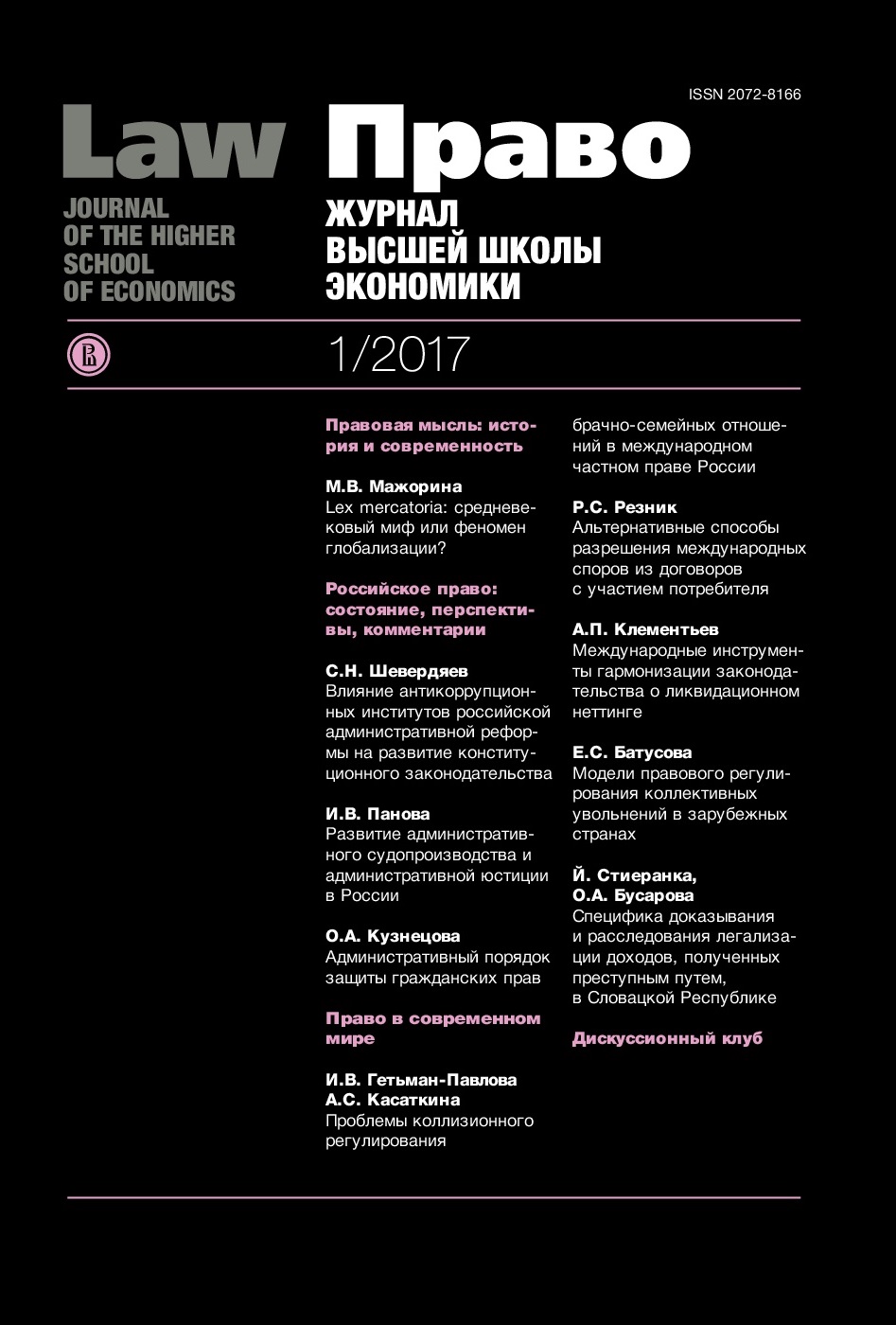
Модели правового регулирования коллективных увольнений в зарубежных странах
Аннотация
В статье рассмотрены три модели правового регулирования коллективных увольнений в зарубежных странах. Для них характерны как общие, так и особенные признаки. К общим относятся: закрепление критериев коллективных увольнений; предварительные консультации с профсоюзами или иными представительными органами работников; уведомление государственного органа о предстоящем коллективном увольнении; уведомление профсоюза о предстоящем коллективном увольнении; предложение работнику имеющихся у работодателя вакансий в порядке перевода и возможности пройти переобучение. В свою очередь, особенности определяются объемом гарантий для работников в области коллективных увольнений и варьируются от минимальных до максимальных. Для законодательства стран первой модели характерен акцент на интересы работодателя в сфере правового регулирования коллективных увольнений. Это проявляется в отсутствии законодательно установленных прав на преимущественное оставление на работе и права на повторный наем на работу. Данное обстоятельство существенно ослабляет защиту увольняемых работников, что приводит к росту социальной напряженности. Для нормативных правовых актов стран второй модели свойственно закрепление максимального количества гарантий в процессе коллективных увольнений: преимущественное право на оставление на работе для отдельных категорий работников и право на повторный наем на работу. Подобный подход имеет целью максимальную защиту трудовых прав работников в процессе коллективных увольнений. Законодательство стран третьей модели испытало на себе влияние двух концепций — гибкости и жесткости в правовом регулировании коллективных увольнений. Это проявилось в том, что оно закрепляет как гарантии для работников, так и для работодателей. Уровень гарантий для работников в сфере коллективных увольнений выше, чем в нормативных правовых актах стран первой модели, но ниже, чем в законодательстве стран второй модели. Можно сделать вывод, что трудовое законодательство о коллективных увольнениях в зарубежных странах находится в постоянной динамике и имеет целью достижение баланса интересов работников, работодателей и государства.
Литература
Bar-Niv Z., Elmann P. (eds.) (1978) International Labour Law Reports. Vol. 1. Amsterdam: Sijhoff and Noordhof, 398 p.
Bokum N., Bartelings P. (eds.) (2009) Age Discrimination Law in Europe. Amsterdam: Kluwer Law International, 401 p.
Chenerelli A. (2015) Uvol'nenie rabotnika v ital'yanskom trudovom prave [Dismissing Employee under Italian Labour Law]. Evraziyskiy yuridicheskiy zhurnal, no 11. Available at: http://www.eurasia-allnews.ru/nauchnye-stati/item/587-uvolnenie-rabotnika-v-italyanskom-trudovom-prave.html (accessed: 19.09.2016)
Gallie D. (ed.) (2004) Resisting Marginalization: Unemployment Experience and Social Policy in the European Union. N.Y.: Oxford University Press, 304 p.
Gibson D. Employment Guide to Switzerland.
Kiselev I.Ya. (1989) Trudovoy dogovor pri kapitalizme: problemy naima i uvol'neniya [Labour Agreement under Capitalism: Hiring and Dismissing]. Moscow: Nauka, 188 p. (in Russian)
Kessler F. (2014) Dismissal due to the Business Reasons in France. Available at: https://www.upf.edu/iuslabor/_pdf/2014-2/CLLD_DISMISSALS_DUE_TO_BUSINESS_REASONS.pdf (accessed: 19.09.2016).
Kohler T. (2014) Dismissal due to the Business Reasons in the USA. Comparative Labor Law Dossier. IUS Labor, no 2, pp. 95-99.
Pecinovsky P. (2014) Dismissal due to the Business Reasons in Belgium. Available at: https://www.upf.edu/iuslabor/_pdf/2014-2/CLLD_DISMISSALS_DUE_TO_BUSINESS_REASONS.pdf (дата обращения: 19.09.2016)
Pustovalova T.A. (2015) Trudovoe pravo Evropeyskogo Soyuza: teoriya i praktika [EU Labour Law: Theory and Practice]. Moscow: Prospekt, 544 p. (in Russian)
Reitz A. (2007) Labor and Employment Law in the New EU Member and Candidate States. N.Y.: American Bar Association, 402 p.
Sargeant M., Lewis D. (2008) Employment Law. Harlow: Pearson, 442 p.
Sedig R., Koivistoinen P., Viljakainen P. (2008) Finland. Redundancy Law in Europe. M. van Kempen (ed.). N.Y.: Kluwer Law International, 278 p.
Weiss M., Schmidt M. (2008) Labour Law and Industrial Relations in Germany. Amsterdam: Kluwer Law International, 271 p.
Zivs S.L. (1982) Trud, pravo, ideologiya [Labour, Law, Ideology]. Moscow: Nauka, 172 p. (in Russian)
Copyright (c) 2017 Право. Журнал Высшей школы экономики

Это произведение доступно по лицензии Creative Commons «Attribution-ShareAlike» («Атрибуция — На тех же условиях») 4.0 Всемирная.