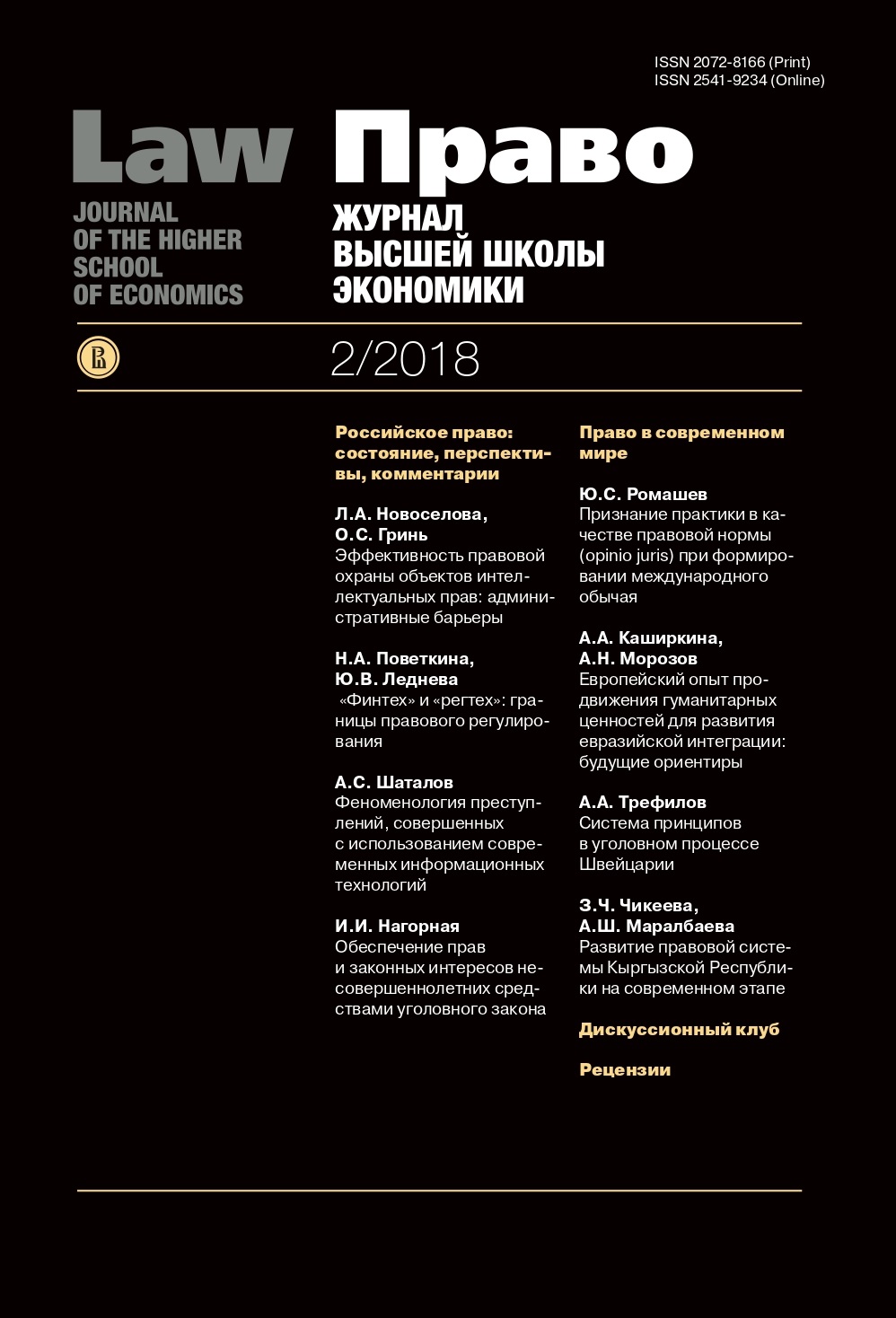
Европейский опыт продвижения гуманитарных ценностей для развития евразийской интеграции: будущие ориентиры
Аннотация
Статья посвящена анализу теоретических вопросов развития и продвижения евразийской интеграции на основе гуманистических ценностей, сформированных под эгидой Совета Европы и Европейского Союза. В центре исследования — опыт функционирования Комиссии Совета Европы за демократию через право (Венецианской комиссии) с точки зрения теоретического и международно-правового анализа ее деятельности в области толкования права в целях реализации продвижения европейских гуманистических ценностей. Целью является анализ правовых подходов, сформированных в рамках Совета Европы и Европейского Союза в сфере продвижения гуманистических ценностей, и возможности его использования с учетом необходимой адаптации для развития интеграции в рамках Евразийского экономического союза. При подготовке статьи использованы: диалектический, философский, формально-логический, системно-структурный, исторический, формально-юридический и сравнительно-правовой методы, методы толкования права, экспертного оценивания, правового моделирования и прогнозирования. При применении указанных общих методов научного познания использованы такие приемы исследования, как структурирование, описание, контент-анализ, синтез результатов работы. Делаются выводы о необходимости поступательного развития права Евразийского экономического союза не только как исключительно экономического интеграционного объединения, но и с добавлением в компетенцию Союза через международно-правовые каналы новых важнейших сфер международно-правового сотрудничества государств-членов. Анализ правового регулирования в Европейском Союзе, а также Совете Европы позволяет сделать вывод, что в сферу международно-правового регулирования Евразийского экономического союза в будущем могут быть включены вопросы защиты прав человека, расширения сотрудничества органов правосудия, разработки совместной антикоррупционной политики на основании международного документа, регламентации взаимодействия членов Евразийского экономического союза в предупреждении и ликвидации чрезвычайных ситуаций природного и техногенного характера на основе специального международного договора, создания единой экологической и природоохранной политики.
Литература
Alekseev S.S. (1982) Obshchaya teoriya prava. T. 2. [General theory of law. Vol. 2]. Moscow: Yuridicheskaya literatura, 360 p. (in Russian)
Bekiashev K.A. et al. (2017) Mezhdunarodno-pravovye osnovy sozdania I funktcionirovania Evraziyskogo ekonomicheskogo souza [International legal basics of forming and functioning of the Euroazian economic union]. Moscow: Prospekt, p. 176 (in Russian)
Erpyleva N. Yu. (2007) Mezhdunarodnyy valyutnyy fond kak institutsionnyy mekhanizm regulirovaniya mezhdunarodnoy valyutnoy sistemy [International Monetary Fund as an Institutional Mechanism of Regulating International Monetary System]. Pravo i politika, no 1, pp. 85-95.
Erpyleva N. Yu. (2010) Sovremennyy pravovoy status Evropeyskogo tsentral'nogo banka [Modern Legal Status of the European Central Bank]. Bankovskoepravo, no 5, pp. 35-43.
Fogel'son Yu. B. (2014) Myagkoe pravo i verkhovenstvo prava [Soft law and rule of law]. Zhurnal rossiyskogo prava, no 11, pp. 22-33.
Getman-Pavlova I.V., Erpyleva N. Yu. (2016) Mezhdunarodnoe pravo [International law]. Moscow: Jurayt, p. 709 (in Russian)
Kapustin A. Ya. (2014) Dogovor o Evraziyskom ekonomicheskom soyuze — novaya stranitsa pravovogo razvitia Evraziyskoi integratcii [The treaty on the Eurasian economic union — a new page in legal development of Euroazian integration]. Zhurnal rossiyskogo prava, no 12, pp. 98-105.
Khabrieva T. Ya. (1998) Tolkovanie Konstitutsii Rossiyskoy Federatsii: teoriya i praktika [Interpretation of the Constitution of the Russian Federation]. Moscow: Yurist, 245 p. (in Russian)
Khabrieva T. Ya., Lafitskiy V.I. (eds.) (2014) Venetsianskaya komissiya: sto shagov k demokratii cherez pravo [Venice Commission: one hundred of steps to democracy via law]. Moscow: Statut, 256 p. (in Russian)
Lazarev V.V. (ed.) (1994) Obshchaya teoriya prava i gosudarstva [The general theory of law and state]. Moscow: Yurist, 360 p. (in Russian)
Limonnikova M.A. (2010) Venetsianskaya komissiya Soveta Evropy: pravovye aspekty sozdaniya ideyatel'nosti: dis... kand. yurid. nauk [The Venice Commission of the Council of Europe: Forming and Activities. Candidate of Juridical Sciences Thesis]. Moscow, 146 p. (in Russian)
Nasyrova T.Ya. (1988) Teleologicheskoe (tselevoe) tolkovanie sovetskogo zakona [Teleological (intended) interpretation of Soviet law]. Kazan': University, 127 p. (in Russian)
Pigolkin A.S. (ed.) (1995) Obshchaya teoriya prava [The general theory of law]. Moscow: MGTU Press, 384 p. (in Russian)
Raevich S. I. (1924) Iz voprosov ucheniya o tolkovanii i primenenii prava [On the theory of interpretation and application of law]. Sovetskoe pravo, no 3, pp. 57-78.
Vas'kovskiy E.V. (1901) Uchenie o tolkovanii i primenenii grazhdanskikh zakonov [Theory of interpreting and applying civil laws]. Odessa: Ekonomicheskaya tipografiya, 400 p. (in Russian)
Copyright (c) 2018 Право. Журнал Высшей школы экономики

Это произведение доступно по лицензии Creative Commons «Attribution-ShareAlike» («Атрибуция — На тех же условиях») 4.0 Всемирная.