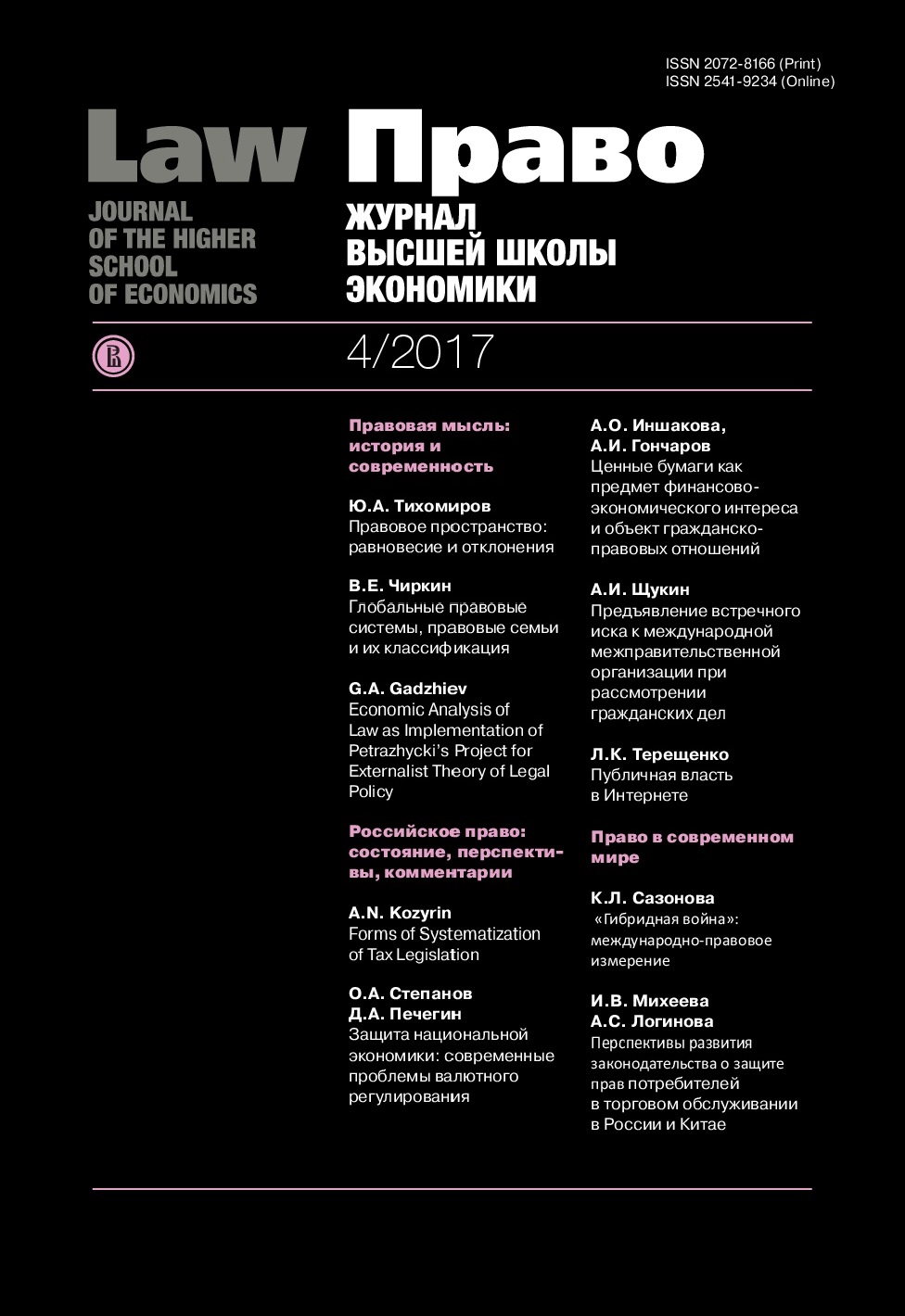
Economic Analysis of Law as Implementation of Petrazhycki's Project for Externalist Theory of Legal Policy
Аннотация
Professor Leon (Lev) Petrazycki contributed significantly to the methodology of law and economics and made Russian legal science famous in Germany with the publication Die Lehre von Eienkommen in 1893 and 1895. The book developed the idea that the influence of legal norms should be evaluated not only from the private view but from the point of national economy. Professor Petrazycki and his students Pitirim Sorokin and George Guins may be ranked among the founders of the economic analysis of law established in 20th century, which was shown earlier in the monograph Pravo i ekonomika (metodologiya) by the author of the paper. The idea of externalism is based on the principle that social and economic factors, i.e. extra scientific make a decisive influence on the development of science. Hence, in studying the history of science, the major task is reconstructing social and cultural conditions (social service) promoting to the development of ideas and theories. The opposite, internalist, approach promotes the idea that science develops only due to inner scientific factors — on the basis of objective logic and of arising and solving economic problems, thanks to the evolution of scholar traditions, create new concepts, solve problems etc. Law has developed two types of argumentation externalist and internalist. Legal positivism calls for the strict adherence to the norms of positive law and excludes other arguments — sociological, economic, moral, historical ones in resolving legal disputes. This is the internalist approach showing the separation of legal space from others (economic, moral etc.). In this regard, the politics of law is something external in terms of law, and the area is intended for politicians. The external type of argumentation allows avoiding extremes and formalism for legal concept. This area of legal science is characterized with open ways of argumentation — sociological and statistical facts, economic rationale, moral arguments. A high idealistic dream of external jurisprudence is in the following: it is necessary to achieve three criteria for legal decisions: legality, efficiency, fairness.
Литература
Avenarius M. (2014) Fremde Traditionen des römischen Rechts. Einfluß, Wahrnehmung und Argument des ‘rimskoe pravo' im russischen Zarenreich des 19. Jahrhunderts. Göttingen: Wallstein, S. 776.
Becker G. (1991) A Treatise on the Family. Cambridge (Mass.): Harvard University Press, 329 p.
Buchanan J. 2000 [1975]. The Limits of Liberty: Between Anarchy and Leviathan. Indianapolis: Liberty Fund, 261 p.
Coase R. (1960) The Problem of Social Cost. Journal of Law and Economics, no. 3, pp. 1-44.
Commons J. (1924) Legal Foundations of Capitalism. N.Y.: MacMillan, 394 p.
Dworkin R. (1980) Is Wealth a Value? The Journal of Legal Studies, no 9, pp. 191-226.
Fittipaldi E. (2009) Bonae fidei possessor fructus consumptos suos facti. Tentative Answers to One Question Left Open by Leon Petrazycki's Economic Analysis of Law. Societas/Communitas, no. 7, pp. 15-36.
Fittipaldi E. (2013) Nauka na sluzhbe u printsipa zakonnosti: kriticheskaya zashchita kontseptsii yuridicheskoy dogmatiki L'va Petrazhitskogo [Science and Legality Principle: Critical Defence of Concept of Leon Petrazycki Legal Dogma]. Pravovedenie, no. 5, pp. 48-76.
Gadzhiev G.A. (2016) Pravo i ekonomika (metodologiya) [Law and Economics: Methodology]. Moscow: NORMA, 256 p. (in Russian)
G'yaro T. (2009) Leon Petrazhitskiy — osnovopolozhnik ekonomicheskogo analiza prava [Leon Petrazycki, Founder of Economic Analysis of Law] Ekonomika. Predprinimatel'stvo. Okruzhayushchaya sreda, no. 2.
Grechenig K., Gelter M. (2008) The Transatlantic Divergence in Legal Thought: American Law and Economics vs. German Doctrinalism. Hastings International and Comparative Law Review, no. 1, pp. 295-360.
Karapetov A.G. (2016) Ekonomicheskiy analiz prava [The Economic Analysis of Law]. Moscow: Statut, 528 p. (in Russian)
Kolbinger F. (2004) Im Schleppseil Europas? Das russische Seminar für römisches Recht bei der juristischen Fakultät der Universität Berlin in den Jahren 1887–1896. Frankfurt am Main: Klostermann, 251 S.
Mathis K. (2011) Consequentialism in Law. Efficiency, Sustainability, and Justice to Future Generations. Dordrecht: Springer, 240 p.
Menger A. (1886) Das Recht auf den vollen Arbeitsertrag in geschichtlicher Darstellung. Stuttgart: Cotta, 171 p.
Muromtsev S.A. (1879) Opredelenie i osnovnoe razdelenie prava [Definition and Fundamental Separation of Law]. Moscow: Mamontov, 240 p. (in Russian)
Petrazycki L. (1893-1895) Die Lehre von Einkommen. Vom Standpunkt des gemeine Civilrechts unter Berücksichtigung des Entwurfs eines bürgerlichen Gesetzbuches für der Deutsche Reich. Berlin: Müller.
Petrazycki L. (1911) Aktsii. Birzhevaya igra i teoriya ekonomicheskikh krizisov [Shares. Stock Exchange Play and Economic Crisis Theory]. Saint Petersburg: Merkushev, 318 p. (in Russian)
Petrazycki L. (1909) Teoriya gosudarstva i prava. Teoriya prava i gosudarstva v svyazi s teoriey nravstvennosti [Theory of State and Law vs. Moral Theory]. Saint Petersburg: University, 401 p. (in Russian)
Petrazycki L. (2002) Prava dobrosovestnogo vladel'tsa na dokhody s tochek zreniya dogmy i politiki grazhdanskogo prava [Rights of Bona Fide Owner to Profits in Terms of Civil Law]. Moscow: Statut, 800 p. (in Russian)
Petrazycki L. (2010) Teoriya i politika prava. Izbrannye trudy [Theory and Polisy of Law. Selected Works]. Moscow: Yuridicheskaya kniga, 1104 p. (in Russian)
Pokrovskiy I. A. (2013) Osnovnye problemy grazhdanskogo prava [Main Issues of Civil Law]. Moscow: Statut, 563 p. (in Russian)
Posner R. (2006) Legal Reason: The Use of Analogy in Legal Argument. Cornell Law Review, vol. 91, pp. 761-774.
Posner R. (2014) Economic Analysis of Law. N.Y.: General Publishing, 311 p.
Radbruch G. (2011) [1932] Rechtphilosophie. Heidelberg: Müller, 455 S.
Weinreb L. (2016) Legal Reason: The Use of Analogy in Legal Argument. Cambridge: Cambridge University Press, 188 p.
Copyright (c) 2017 Право. Журнал Высшей школы экономики

Это произведение доступно по лицензии Creative Commons «Attribution-ShareAlike» («Атрибуция — На тех же условиях») 4.0 Всемирная.