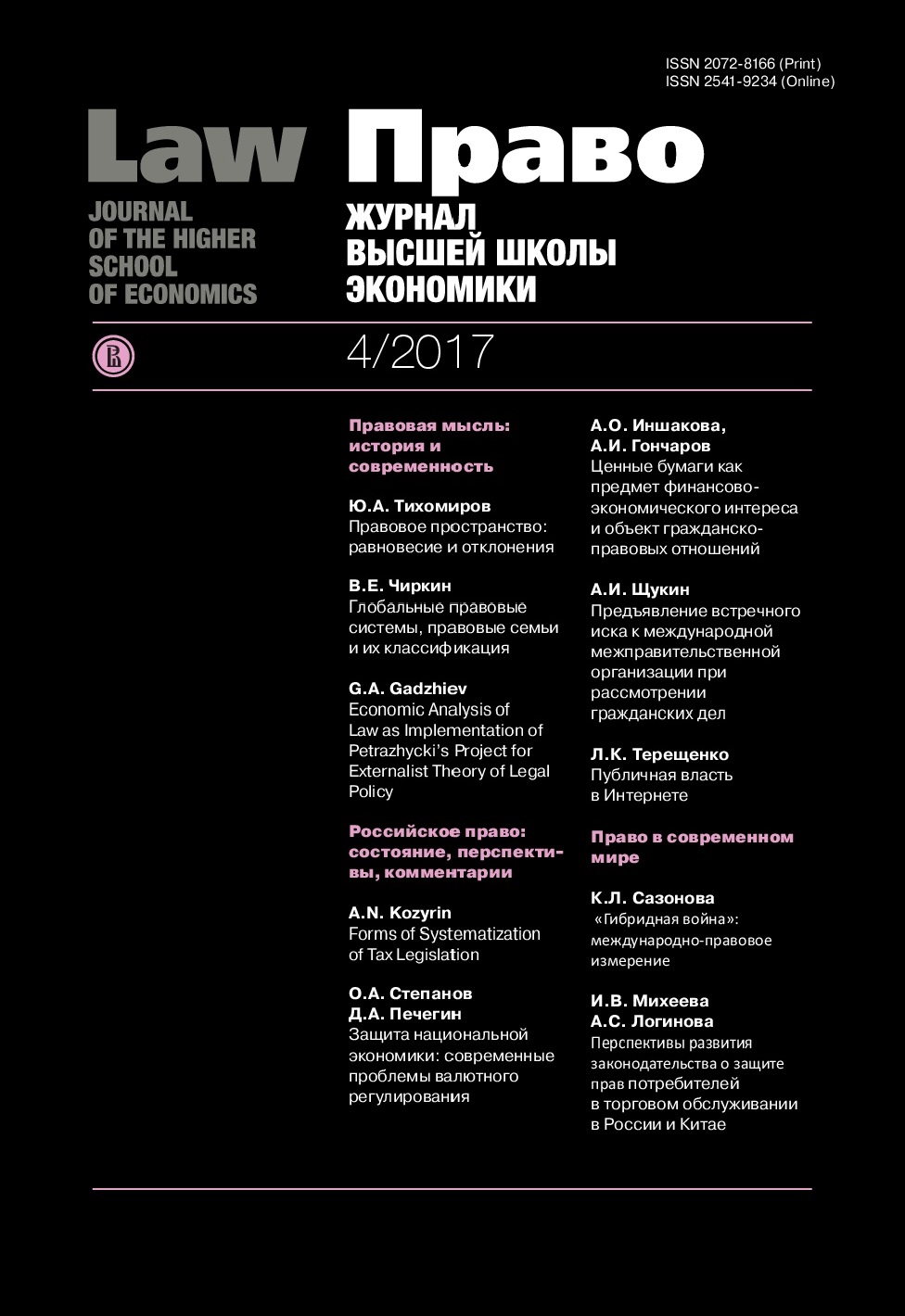
Глобальные правовые системы, правовые семьи и их классификация
Аннотация
Основоположники сравнительного системного подхода к изучению права (среди первых были американец Р. Шлезингер, французы Р. Давид и М. Ансель, итальянец Р. Сакко, канадец П. Гленн, позже немцы Х. Кётц и К. Цвaйгерт и др.) на рубеже 1960-1970-х гг. совершили прорыв в правовой науке. Они завершили создание основ нового направления сравнительно-правовых исследований, выделили и проанализировали различные правовые общности прошлых веков и современности, назвав последние семьями или системами (англо-саксонская, романо-германская, социалистическая, мусульманская и др.). Им следуют многие российские авторы. Термины «правовая система» и «правовая семья» часто используются как одинаковые, понятия системы и семьи, как правило, не даются, социальная суть основных (глобальных) правовых систем игнорируется. Англо-саксонская семья права и тоталитарная социалистическая правовая система находятся в одной и той же классификационной единице. В статье предлагаются новые подходы и иной синтез правовых систем. Автор использует методы исторического, логического, дедуктивного, индуктивного и сравнительного исследования, формационно-цивилизационный подход и на этой основе выделяет три основные правовые системы современного мира: мусульманскую систему (мусульман более 1,7 млрд. человек), либерально-полусоциальную капиталистическую систему (распространяется на 4,5 млрд. человек, включая многие развивающиеся страны) и тоталитарно-социалистическую систему (1,5 млрд. человек). При выделении правовых семей используется традиционный подход сравнительного правоведения, но с учетом социальных и культурологических правовых особенностей. На этой основе в рамках каждой из глобальных систем выделены правовые семьи. В системе мусульманского права есть фундаменталистская (радикалистская) и модернизированная (продвинутая) правовые семьи, а по другому основанию деления — суннитская и шиитская правовые семьи; в либерально-полусоциальной капиталистической системе — англо-саксонская, романо-германская и другие семьи (современные исследователи называют латино-американскую, скандинавскую и др.); в тоталитарной социалистической системе — ортодоксальная и частично модернизированная семьи.
Литература
Almond G.A., Verba S. (2010) Grazhdanskaya kul'tura. Podkhod k izucheniy politicheskoy kul'tury [Civil Culture. Approach to Political Culture]. Politiya, no. 2, pp. 122-144.
Canivet G. (2003) La convergence des systemes juridiques du point de vue privee francais. Revue international de droit compare, no. 1, pp. 7-22.
Clark D. (2012) Comparative Law and Society. Research Handbooks in Comparative Law Series. Chicago: Willamette University, 480 p.
David R., Joffre-Spinozi C. (1999) Osnovnye pravovye sistemy sovremennosti [Main Legal Systems in the World Today]. Moscow: Mezhdunarodnye otnosheniya, 400 p. (in Russian)
De Cruz P. (2006) Comparative Law in a Changing World. London: West Academic, 488 p.
Glenn P. (2003) La tradition juridique nationale. Revue international de droit comparé, no. 2, pp. 263-278.
Husa J. (2004) Classification of Legal Families Today — Is it Time for Memorial Hymn? Revue international de droit compare, no. 1, pp. 11-38.
Landskron R. (2008) Common-Law and Civil-Law Legal Families: a Misleading Categorization. Bond University, 144 p.
Lukianov D. (2015) Legal Families Approach: Consistent Patterns and Trends. European Political and Law Discourse, issue 1, pp. 189-194.
Marchenko M. N. (2016) Pravovye sistemy sovremennogo mira [Legal Systems of Modern World]. Moscow: Zertsalo, 522 p. (in Russian)
Muromtsev G.I. (2013) Pravovye sistemy i pravovye kul'tury v sravnitel'no-pravovykh issledovaniyakh [Legal Systems and Legal Cultures in Comparative Law Research]. Vestnik Rossiyskogo universiteta Druzhby narodov, no 4, pp. 158-165.
Reimann M., Zimmermann R. (eds.) (2013) The Oxford Handbook of Comparative Law. Oxford: Clarendon, 1424 p.
Supataev M.A. (2012) K problematike tsivilizatsionnogo podkhoda k pravu (ocherki obshchey teorii i praktiki) [On Civilization Approach to Law: Essays on Theory and Practice]. Moscow: Yurlitinform, 143 p. (in Russian)
Versetti A. (2010) Legal Families in the Modern World: Civil (Romano-Germanic) Law, Common Law and Other Legal Families in the World. London: Academia, 35 p.
Zweigert K., Kötz H. (2000) Vvedenie v sravnitel'noe pravovedenie v sfere chastnogo prava: Tom I. [Introduction to Comparative Private Law. Vol. 1]. Moscow: Mezhdunarodnye otnosheniya, 480 p. (in Russian)
Copyright (c) 2017 Право. Журнал Высшей школы экономики

Это произведение доступно по лицензии Creative Commons «Attribution-ShareAlike» («Атрибуция — На тех же условиях») 4.0 Всемирная.