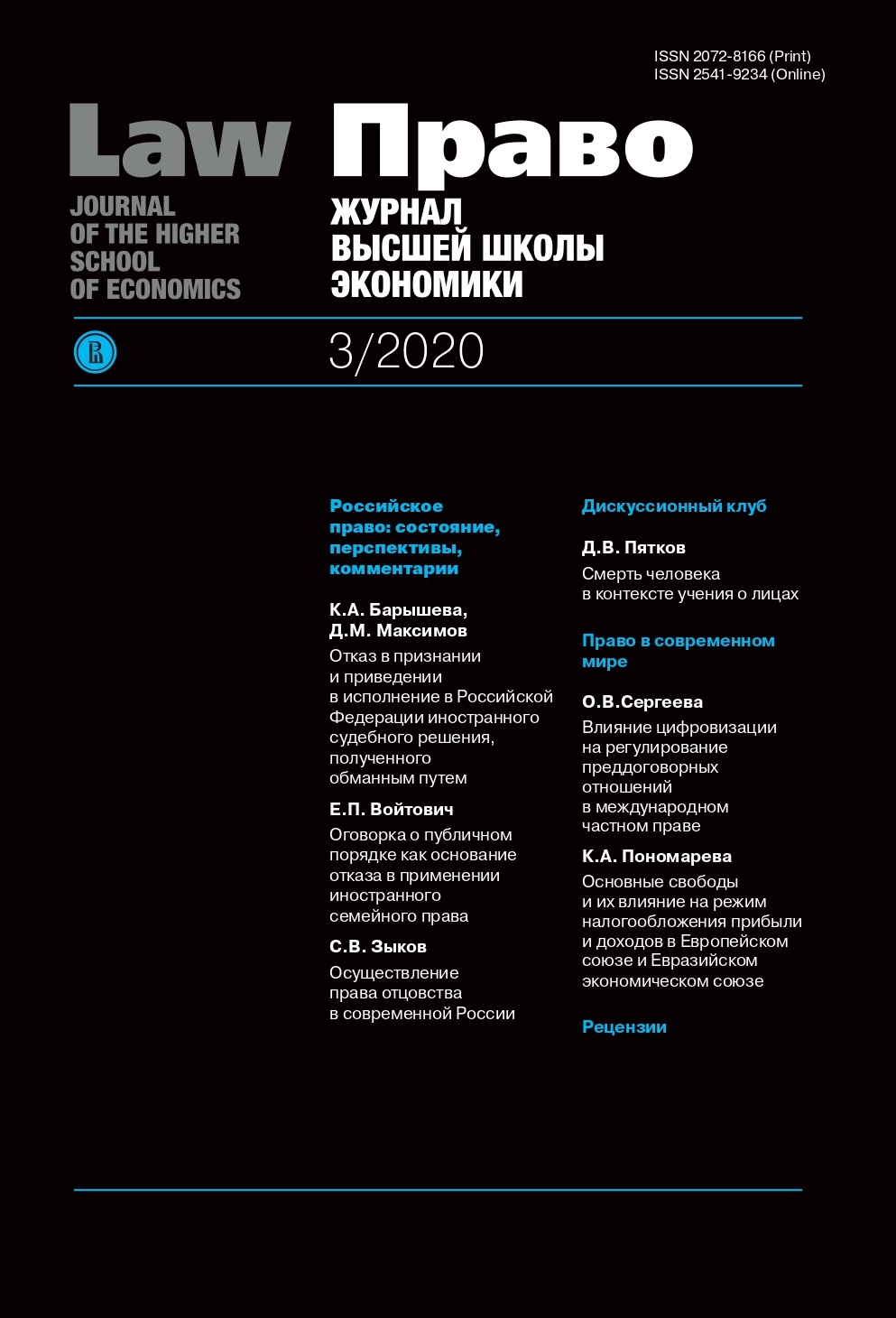
The Fundamental Freedoms and their Influence on Profit Taxation in EU and EAEU
Abstract
The article considers the role of fundamental freedoms in the mechanism of tax integration. The tax law of an integration association serves as a means of creating and proper functioning of the internal market, which is a space without internal borders, in the territory of which, in accordance with the constituent agreements, the free movement of goods, services, capital and labor is ensured. It is proved that the rules governing the action of fundamental freedoms are the rules of direct action with no harmonizing effect, but prohibit discrimination and restrictions within the association. Modern cross-border tax relations require the creation of an effective multi-level system of legal regulation based on the norms of international, supranational and national law. The study allowed to highlight the direction of the impact of fundamental freedoms on the legal regime of profit and income taxation in the European Union (hereinafter — the EU) and the Eurasian Economic Union (hereinafter — the EAEU), as well as to identify similarities and differences in the mechanisms of harmonization of profit and income taxation in the EU and the EAEU. The methodological basis of the research consists of both general scientific methods (dialectical-materialistic, systemic, induction, deduction, analysis, synthesis) and interdisciplinary research methods. The study is based on a comparative legal method that allows to compare similar legal problems existing in the legislation and international treaties of the EAEU and the EU, as well as to identify the best ways to solve them. The formal legal method and the historical legal method are also used in the article. The conceptual difference between ways of harmonization in the areas of direct and indirect taxation is substantiated: direct taxation has less impact on the functioning of the Union economy in comparison with indirect taxation. Legal regulation of direct taxation remains within the competence of Member States and is carried out at the level of integration associations only in certain areas related to the implementation of fundamental freedoms. In addition, the study revealed the specifics of the principle of tax sovereignty in the field of integration tax law: tax sovereignty causes both the problem of tax competition and its solution in the form of cooperation of Member States.
References
Adamczyk L. (2010) The Sources of EU Law Relevant for Direct Taxation. Introduction to European Tax Law: Direct Taxation. Lang P. et al (eds.). Wien: Linde, pp. 13-42.
Aujean M. (2016) Some Twenty-Seven Years After. EC Tax Review, issue 2, pp. 56-57.
Baev S.A. (2007) Double tax convention between Russia and the EU. Moscow: Wolters Kluwer, 240 pp. (in Russian)
Chetverikov A.O. (2013) The EU Court on the freedom of moment of individuals. Tsivilist, no 1, pp. 77-83 (in Russian)
Dahlberg M. (2005) Direct Taxation in Relation to the Freedom of Establishment and the Free Movement of Capital. The Hague: Kluwer Law International, 384 p.
Englmair V. (2010) The Relevance of the Fundamental Freedoms for Direct Taxation. Introduction to European Tax Law: Direct Taxation, pp. 43-92.
Kashkin S.Yu. (ed.) (2015) Integration law in the modern world. Moscow: Prospect, 416 p. (in Russian)
Knobbe-Keuk B. (1994) Restrictions on the fundamental freedoms enshrined in the EC Treaty by discriminatory tax provisions — ban and justification. EC Tax Review, vol. 3, pp. 74-85.
Kofler G. (2006) Europäische Grundfreiheiten, nationales Steuerrecht und die Rolle des EuGH. Taxlex, no 1, S. 13-20.
Kokott J. (2000) Die Bedeutung der europarechtlichen Diskriminierungsverbote und Grundfreiheiten für das Steuerrecht der EU-Mitgliedstaaten. Grundfreiheiten in Steuerrecht der EU-Mitgliedstaaten. M. Lehner (ed.). München: Beck, S. 1-23.
Kokott J., Ost H. (2011) Europäische Grundfreiheiten und nationales Steuerrecht. EuZW, no 13, S. 496-503.
The Law of the European Union and the European Communities (2008) The Hague: Kluwer Law International, 1644 p.
Merzler V. (2008) The Relevance of the Fundamental Freedoms for Direct Taxation. Introduction to European Tax Law on Direct Taxation. Wien: Linde, pp. 35-64.
Oppermann T., Classen C., Nettesheim M. (2016) Europarecht. München: Beck, 698 S.
Peeters B. (2016) Kieback: When Schumacker emigrates... EC Tax Review, issue 2, pp. 58-69.
Santiago B. (2009) Non-Discrimination Provisions at the Intersection of EC and International Tax Law. European Taxation, no. 5, pp. 248-262.
Shakhmametyev A.A. (2014) International tax law. Moscow: Mezhdunarodnye otnosheniya, 824 p. (in Russian)
Schön W. (2015) Neutrality and Territoriality — Competing or Converging Concepts in European Tax Law? Bulletin of International Taxation, vol. 69, pp. 271-293.
Schön W. (2012) Taxing Multinationals in Europe. Working Paper of the Max Planck Institute for Tax Law and Public Finance, no 11, pp. 471-499.
Schön W. (2015) Kapitalverkehrsfreiheit und Niederlassungsfreiheit. T. Ackermann, J. Köndgen (Hrsg.) Privat- und Wirtschaftsrecht in Europa — Festschrift für Wulf-Hen ning Roth zum 70. Geburtstag. München: Beck, pp. 551-581.
Shumilov V.M., Boklan D.S., Lifshits I.M. (2015) New laws in the EAEU Treaty. Rossiyskiy vneshneekonomichesky vestnik, no 4, pp. 88-100 (in Russian)
Sokolov A.A. (2003) Theory of taxes. Moscow: Yurinfopress, 506 p. (in Russian)
Teixera G. (2006) Tax Systems and Non-Discrimination in the European Union. Intertax, vol. 34, pp. 50-53.
Terra Ben J., Wattel P. (2012) European Tax Law. The Hague: Kluwer Law International, 1144 p.
Vel'yaminov G.M. (2015) International law: essays. Moscow: Statut, 1006 p. (in Russian)
Wattel P. (2000) Progressive Taxation of Non-Residents and Intra-EC Allocation of Personal Tax Allowances: Why Schumacker, Asscher, Gilly and Gschwind Do Not Suffice. European Taxation, no 6, pp. 210-223.
Yumashev Yu. M., Postnikova E.V. (2014) The economic law of the EU. Moscow: Norma, 384 p. (in Russian)
Zakharov A.S. (2010) EU tax law. Moscow: Wolters Kluwer, 672 p. (in Russian)
Copyright (c) 2020 Law. Journal of the Higher School of Economics

This work is licensed under a Creative Commons Attribution-ShareAlike 4.0 International License.