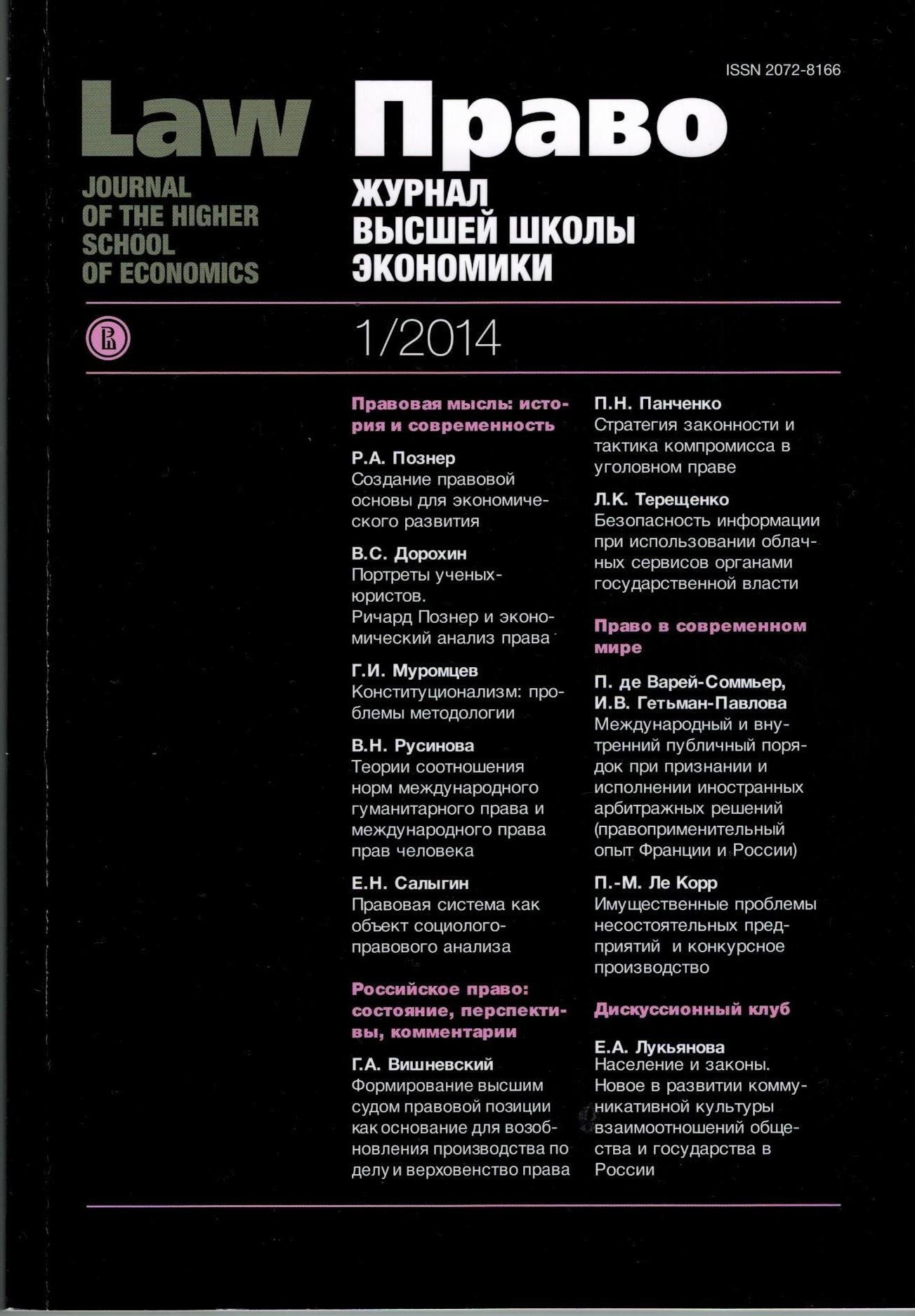
Theories of Relationship between the Norms of International Humanitarian Law and International Human Rights Law
Abstract
Relationship between two branches of Public International Law applicable in armed conflicts — International Humanitarian Law and International Human Rights Law has been described by three main theories: a competitive, complementary and integrative one. The key point of the competitive theory consists in the impossibility of the simultaneous applicability of both branches that is deduced by qualification of International Humanitarian Law as lex specialis that excludes applicability of the International Human Rights Law. The complementary theory is based on the partial overlapping and mutual complementarity. Representatives of the integrative theory recognize a possibility of a full or partial merger of norms provided by International Humanitarian Law and International Human Rights Law. This integration is understood as taking place at the level of norms and not as a mere possibility of unification of two branches under any common title. International treaties on human rights, on one side and treaties on International Humanitarian Law on the other do not contain provisions which would exclude joint application of their norms. Moreover, these treaty rules either implicitly or implicitly provide for such a possibility. Application of the lex specialis derogat legi generali principle at the level of branches of Public International Law is not correct and does not allow to deduce the inapplicability of norms belonging to International Human Rights Law in armed conflicts. The United Nations Human Rights Committee, the European Court of Human Rights, the Inter-American Court on Human Rights and the African Commission on Human and Peoples' Rights have acknowledged the mutual complementarity of International Humanitarian Law and International Human Rights Law norms in their decisions. A possibility of integration of norms belonging to both branches, firstly, derives from the ability of International Humanitarian Law norms to serve as a limit for restriction of human rights by a state in armed conflicts, and, secondly, follows from the specific nature of international law-making, as international customs cristallize outside the framework of an artificial and in many aspects a scholastic division on branches of International Law. Therefore, international treaties and customs, as well as practice of the International Court of Justice and international judicial and quasi-judicial bodies, allow to draw a conclusion on inconsistency of the competitive theory, mutual complementarity of the norms of both branches and existence of a potential for their integration.
References
Biryukov P.N. (2013) Mezhdunarodnoye pravo: Uchebnik dlya vuzov [International Law: Textbook for Universities] Moscow. (in Russian)
Kartashkin V.A. (2011) Prava cheloveka: mezhdunarodnaya zashchita v usloviyakh globalizatsii [Human Rights: International Protection in the context of Globalization] Moscow. (in Russian)
Mezhdunarodnoye pravo. Uchebnik (2014) [International Law. Textbook] Ed. by S.A. Egorov. Moscow. (in Russian)
Henckaerts J.-M., Doswald-Beck L. (2006) Obychnoye mezhdunarodnoye gumanitarnoye pravo [Customary International Humanitarian Law] Vol. 1. Normy. Cambridge (in Russian)
Crawford E. (2012) Road to Nowhere? The Future for a Declaration on Fundamental Standards of Humanity. Sydney Law School. Legal Studies Research Paper, no. 12/02 // URL: http://papers.ssrn.com/sol3/papers.cfm?abstract_id=1987842
Draper G.I.A.D. (1971) The Relationship between the Human Rights Regime and the Law of Armed Conflicts. Israeli Yearbook on Human Rights, vol. 1, p. 191-207.
Gasser H-P. (1988) A Measure of Humanity in Internal Disturbances and Tensions: Proposal for a Code of Conduct. International Review of the Red Cross, vol. 28, issue 262, p. 38-58.
Gasser H.-P. (2002) International Humanitarian Law and Human Rights Law in Non-International Armed Conflicts: Joint Venture or Mutual Exclusion? German Yearbook of International Law, vol. 45, p. 149-162.
Greenwood Ch. (2008) Scope of Application of Humanitarian Law, in: The Handbook of Humanitarian Law. Ed. by D. Fleck. 2nd ed. Oxford.
Meyrowitz H. (1972) Le droit de la guerre et les droit de l'homme. Revue du droit public et de la science politique en France et à l'étranger, no 88, p. 1059-1104.
Parks H. (2010) Part IX of the ICRC «Direct Participation in Hostilities Study»: No Mandate, No Expertise, and Legally Incorrect. New York University Journal of International Law and Politics, vol. 42, p. 769-830.
Partsch K. J. (1995) Human Rights and Humanitarian Law, in: Encyclopedia of Public International Law. Oxford.
Pictet J. (1985) Development and Principles of International Humanitarian Law. Course, given in July 1982 at the University of Strasbourg as part of the courses organized by the International Institute of Human Rights. Dordrecht, Boston, Lancaster, Geneva.
Pictet J. (1975) Humanitarian Law and the Protection of War Victims. Geneva.
Sassoli M., Olson L. (2008) The Relationship between International Humanitarian and Human Rights Law Where It Matters: Admissible Killing and Internment of Fighters in Non-International Armed Conflicts. International Review of the Red Cross, vol. 90, no 871, p. 599-627.
Schaefer B. (2006) Zum Verhaeltnis Menschenrechte und humanitaeres Voelkerrecht. Potsdam.
Copyright (c) 2014 Law Journal of the Higher School of Economics

This work is licensed under a Creative Commons Attribution-ShareAlike 4.0 International License.