Some Aspects of Legal Regulating Cross-Border Marriages
Abstract
One of the pressing problems of the modern society is the question of recognizing the legal consequences of cross-border marriages. Legal regulation of family relations with a foreign element has a complex, multilevel nature that includes material and conflict norms contained in multilateral and bilateral international treaties and in domestic law. One of the problems associated with the unification of the law in the area of marriage and family relations is the legalization of the consequences of prisoners of same-sex marriage. Now, same-sex unions are official in some countries in Europe and in many US states. The list of countries that have legalized same-sex marriages is constantly expanding. In some countries where same-sex unions are prohibited, an institution of civil partnership or civil union has been introduced. In many countries that legalized same-sex marriages, civil partnerships for same-sex couples were an intermediate step towards marital equality. The current Russian legislation does not contain special norms aimed at regulating relations in same-sex family unions. In particular, the property relations of persons who are members of such relations are regulated by the norms of Russian civil law. As a consequence, the property rights and obligations of the partners of a same-sex union are significantly different from the property rights of spouses who are in a legal, registered marriage. Thus, for example, to acquire the property of a person consisting in the specified relations, can only in the common share property. The right of common shared property between partners in same-sex unions can arise if there is a written agreement of these persons establishing common property acquired in actual relations. Finding partners in same-sex factual relationships does not create any legal obligations to keep each other's partners either during or after the relationship. The legal regulation of hereditary legal relations in same-sex unions also has its own characteristics. Thus, the prevailing situation of insufficient legal regulation of the legal consequences, of the same-sex unions concluded requires an early legislative decision. Author believes that such a decision is possible in the form of civil partnership.
References
Antokol'skaja M.V. (2001) Semeinoe pravo [The Family Law]. Moscow: Jurist, 145 p. (in Russian)
Chernova O. Yu. (2015) «Pravo» na odnopolyj brak v kontekste lichnyh prav cheloveka [A Right for the Same-Sex Marriage in a Context of Personal Human Rights]. Uchenye zapiski juridicheskogo fakul'teta, no 38, pp. 81-85.
Eger K.A. (2015) Legalizatciya odnopolyh brakov [The Legalization of Same-Sex Marriages]. Nauchnyj al'manah, no 11, pp. 418-421.
Gavina E.V. (2013) Otnoshenie rossijan i rossijskogo zakonodatel'stva k odnopolym brakam [Russians and Russian Legislation Look at the Same-Sex Marriages]. Konceptual'nye i prikladnye aspekty social'noj raboty s sem'ei i det'mi v polietnicheskoi srede. Saransk: Afanas'ev, pp. 17-22.
Get'man-Pavlova I.V., Kasatkina A.S. (2017) Problemy kollizionnogo regulirovanija brachno-semejnyh otnoshenij v mezhdunarodnom chastnom prave Rossii [Issues of Collisions in the Regulation of Marriage and Family Relations in International Private Law]. Pravo. Zhurnal Vysshey shkoly ekonomiki. no 1, pp. 92-100.
Kazanovska Yu.A. (2013) Problemy sovershenstvovanija pravovoj reglamentacii ogovorki o publichnom poriadke v mezhdunarodnom chastnom prave Rossijskoj Federactii [Issues of Improving Legal Regulating a Reservation about Public Order in International Private Law of Russia]. Nauchnye trudy SWorld, no 3, p. 68.
Kirichenko K.A. (2012) Odnopolaia sem'ia v Rossii [Same-Sex Family in Russia]. Saint Petersburg: Blagotvoritel'nyj fond social'noj i pravovoj podderzhki, 16 p. (in Russian)
Kosova O.Yu. (2001) Semeinoe i nasledstvennoe pravo Rossii [The Family and Hereditary Law of Russia]. Moscow: Statut, 178 p. (in Russian)
Makovskyi A.L. et al. (2012) Problemy unifikatcii chastnogo prava [Issues of Unifying International Private Law]. Moscow: Jurisprudentcia, 488 p. (in Russian)
Marinkin D.N. (2015) Tolerantnost' k odnopolym brakam: pravovye i social'nye problemy sovremennoj Rossii [Tolerance towards Same-Sex Marriages]. Jazykovaja tolerantnost' kak faktor effektivnosti jazykovoj politiki. Perm': Prikamskyi social'nyi institut, pp. 18-22.
Marysheva N.I. (2007) Semejnye otnoshenija s uchastiem inostrancev: pravovoe regulirovanie v Rossii [Family Relations with Participation of Foreigners: Legal Regulation in Russia]. Moscow: Wolters Kluwer, 117 p. (in Russian)
Odnopolyi brak (2015) [Same-Sex Marriage]. Available at: URL: https://ru.vikipedia.org.viki (accessed: 3.08.2016)
Shetogubova O.A., Kazanovskaja Yu.A. (2016) O nekotoryh voprosah unifikacii norm v sfere reglamentacii brachno-semeinyh otnoshenyi, oslozhnennyh inostrannym elementom [Some Issues of Unifying Norms in the Field of Marriage and Family Relations with Foreign Element]. Sovremennye tendencii razvitia nauki i tehnologii, no 7, pp. 136-141.
Trofimec I.A., Li S. Yu. (2010) K voprosu o mezhdunarodno-pravovom regulirovanii brachnyh otnoshenij s uchastiem inostrancev [To the Issue of International Legal Regulating Marriage Affairs with Foreign Element]. Semeinoe i zhilishhnoe pravo, no 6, pp. 21-26.
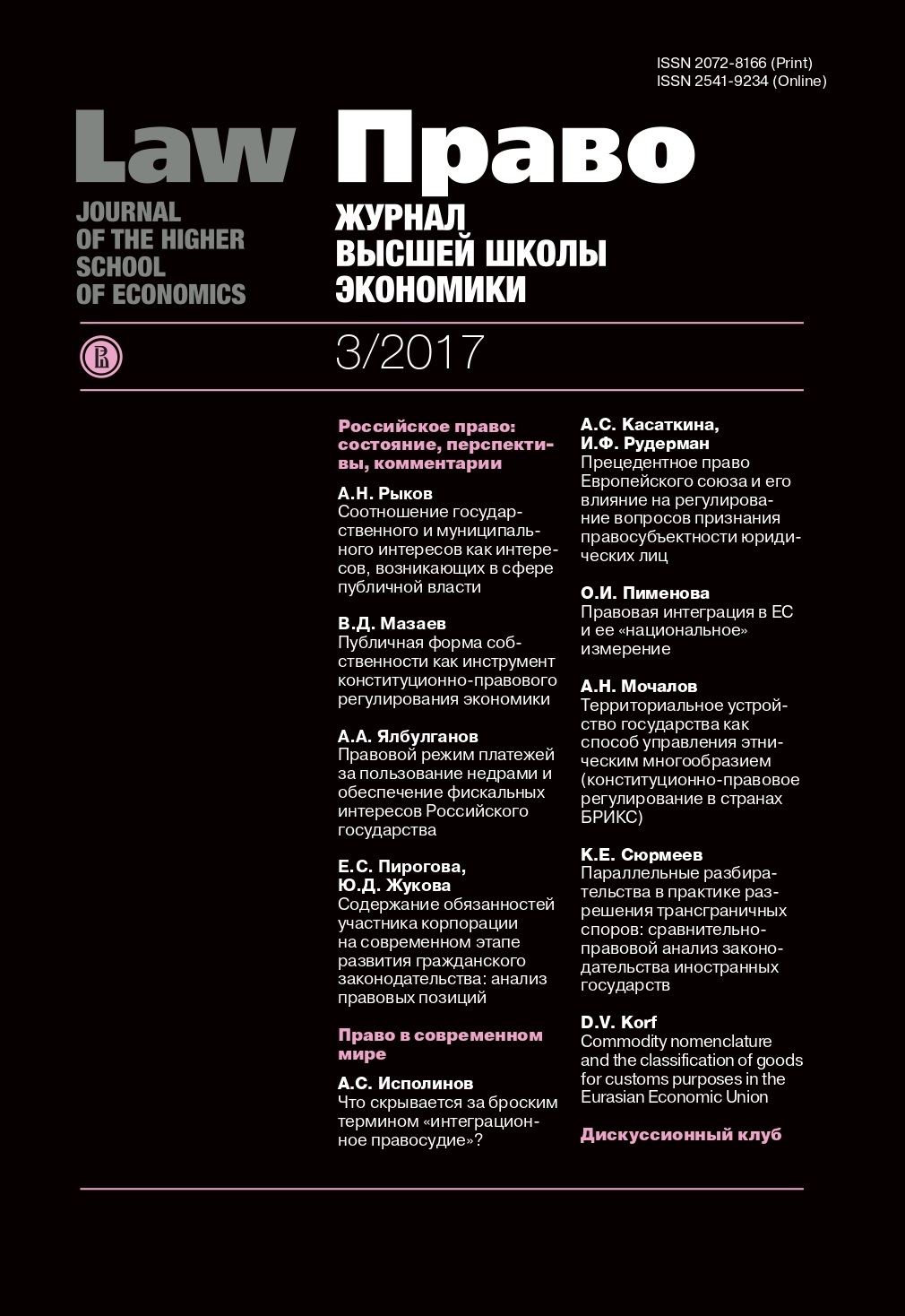
Copyright (c) 2017 Law. Journal of the Higher School of Economics

This work is licensed under a Creative Commons Attribution-ShareAlike 4.0 International License.