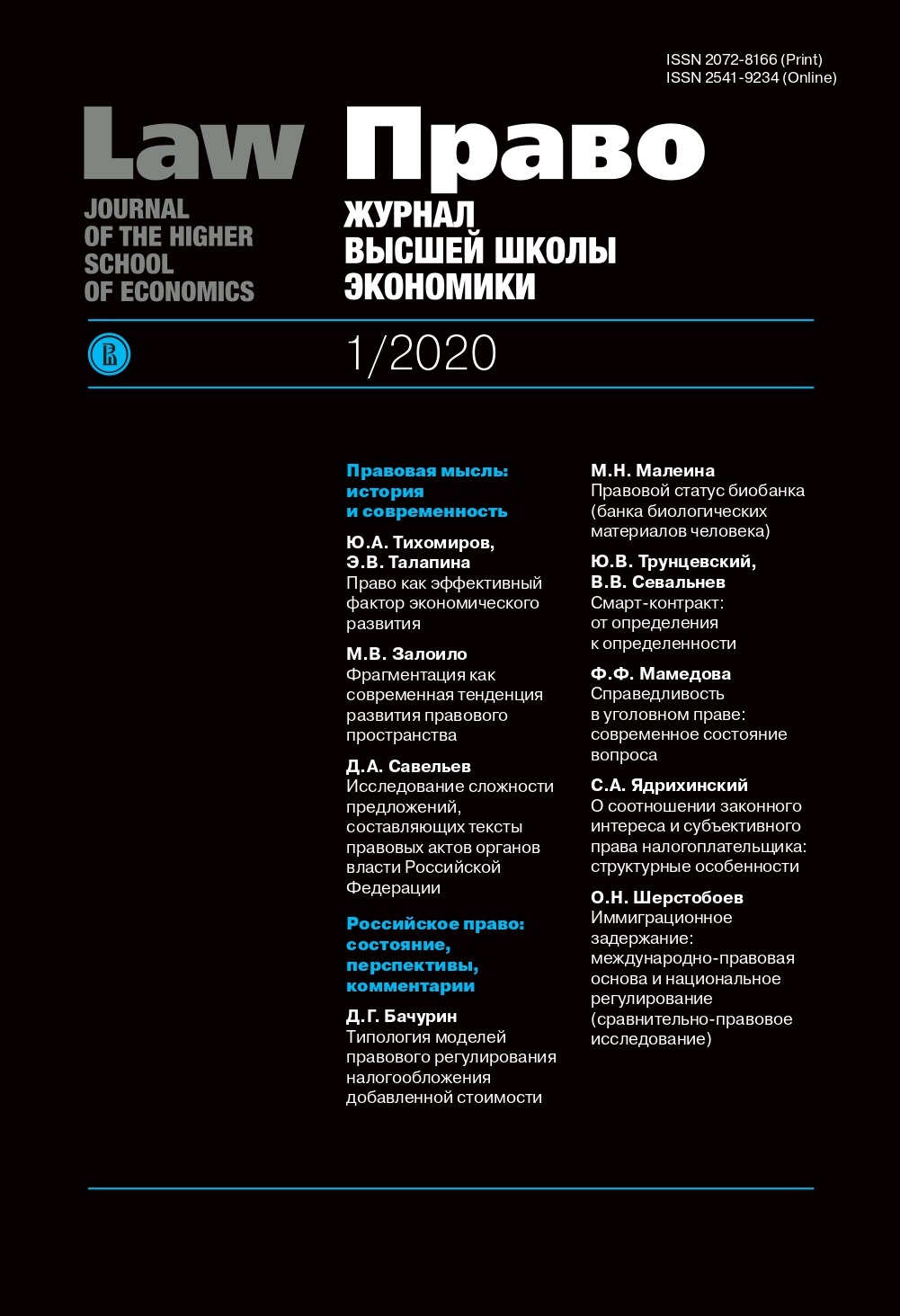
Смарт-контракт: от определения к определенности
Аннотация
Целью статьи является достижение наилучшего понимания возможностей и препятствий на пути к внедрению и совершенствованию практики применения сетевых договоров (смарт-контрактов). Методология исследования — целостный комплекс принципов и методов научного анализа, присущих современной юридической науке. В качестве основополагающего использован диалектический метод с применением общенаучных (системно-структурный, формально-логический, анализ и синтез отдельных частей, отдельных признаков понятий, абстрагирование, обобщение и др.) и частно-научных (технико-юридический метод, систематический, компаративисткий, исторический, грамматический, метод единства теории и практики и др.) методов. Проведен анализ взглядов юристов и других специалистов России и зарубежных стран, законодательных новелл в сфере цифровых технологий, применения смарт-контрактов на основе блокчейна, основных рисков внедрения смарт-контрактов в хозяйственную деятельность с последующим выделением среди них (правовые, технологические, операционные, криминогенные) факторов их возникновения. Отмечается, что в сегодняшних реалиях от юридического определения смарт-контракта, его правовых и технологических характеристик, преимуществ и недостатков необходимо переходить к реализации стартапов в широком круге жизнедеятельности, в первую очередь, в сфере бизнеса, государственного контроля и социальных отношений. Научное обеспечение и информационное сопровождение результатов таких процессов будет способствовать развитию широкого круга отраслей хозяйствования, государственного управления и внедрения цифровых технологий для улучшения качества жизни общества и отдельного гражданина. Внедрение смарт-контрактов не требует принятия новых законов или правил. Существующие правовые принципы следует адаптировать и, возможно, модифицировать как в законодательном, так и в судебном порядке для прямого обращения к смарт-контрактам и другим новым технологиям. Система договорного права более чем адекватна для того, чтобы соответствовать заключению сделок без необходимости создания новых правовых категорий. В качестве предложений разработаны подходы к правовому определению смарт-контракта, а также обоснован комплекс задач, которые необходимо решить на законодательном и технолого-правовом уровнях в целях внедрения смарт-контрактов в различные сферы общественной жизни.
Литература
Anisimov V.F. et al (2018) Robotics and automation: legal education and the profession. Yuridicheskoye obrazovaniye i nauka, no 3, pp. 11-16 (in Russian)
Bashir I. (2017). Mastering blockchain. Birmingham: Packt, 531 p.
Dolova M.O. (2019) The applicability of blockchain technology in the consideration of cases by courts. Legal regulation of contractual relations arising in connection with the development of digital technologies (smart contracts). Proceedings of the round table. Moscow: Yurist, pp. 27-36 (in Russian)
Efimova L. G., Sizemova O. B. (2019) Legal nature of smart contract. Bankovskoye pravo, no 1, pp. 23-30 (in Russian)
Gatteschi V. et al (2018) Blockchain and Smart Contracts for Insurance: Is the Technology Mature Enough? Future Internet, no 2, pp.10-20.
Golovanova N.A. et al. (2019) Criminal activity in the conditions of digitalization. Moscow: Contract, 212 p. (in Russian)
Grigg I. (2004) The Ricardian Contract. Proceedings of the First IEEE International Workshop on Electronic Contracting, pp. 25-31.
Gromova E.A. (2018) Smart contracts in Russia: an attempt to determine legal essence. Pravo i tsifrovaya ekonomika, no 2, pp. 34-37 (in Russian)
Ivanov A.Yu., Bashkatov M. L., Galkova E.V. et al. (2017). Blockchain at the peak of HYIP: legal risks and opportunities. Moscow: Higher School of Economics, 237 p. (in Russian)
Kalinina A.L. (2019). Using smart contracts. Legal regulation of contractual relations arising in connection with the development of digital technologies (smart contracts). Proceedings of the round table. Moscow: Yurist, pp. 37-45 (in Russian)
Kamalyan V.M. (2019). Concept and legal features of smart contracts. Yurist, no 4, pp. 20-27 (in Russian)
Khabrieva T.Ya. (2018). Law and challenges of digital reality. Zhurnal rossijskogo prava, no 9, pp. 5-16 (in Russian)
Khabrieva T. Ya., Chernogor N.N. (2018). Law in digital reality. Zhurnal rossiyskogo prava, no 1, pp. 85-102 (in Russian)
Makarchuk N.V. (2019). Public law restrictions on the use of digital assets and technologies. Predprinimatel'skoye pravo, no 1, pp. 40-43 (in Russian)
Navarro N. et al (2017) Inteligencia artificial. Valencia: Tirant, 293 p.
Navrodska V.B. (2019) New technologies (blockchain / artificial intelligence) at the service of law. Moscow: Prospect, 128 p. (in Russian)
Nosov S.I. (2019) Law and Informatization. Yurist, no. 4, pp. 6-13 (in Russian)
Parfenov A.V., Shapovalov I.M., Valko D.V., Kirillov A.A. (2015) Logistics of e-Commerce. Saint Petersburg: University, 79 p. (in Russian)
Perov V.A. (2017) Identification, qualification and organization of investigation of crimes committed with the use of cryptocurrency. Moscow: Yurlitinform, 197 p. (in Russian)
Popova E.M., Popov N.V. (2016). Blockchain as a driver of changes in the banking sector. Bankovskiye uslugi, no. 12, pp. 9-14 (in Russian)
Rassolov I.M. et al (2006). Legal issues of Internet relations. Moscow: Unity, 34 p. (in Russian)
Ream J., Chu Y., Schatsky D. (2016) Upgrading blockchains: Smart contract use cases in industry. Deloltte University papers, no 2, pp. 1-11.
Savelyev A.I. (2016) Contract law 2.0: “smart” contracts as the beginning of the end of classical contract law. Vestnik grazhdanskogo prava, no 3, pp. 32-60 (in Russian)
Savelyev A.I. (2017). Some legal aspects of the use of smart contracts and blockchain technologies under Russian law. Zakon, no 5, pp. 94-117 (in Russian)
Shaidullina V. K. (2019). Smart contracts in the financial market: research results. Sud'ya, no 2, pp. 21-23 (in Russian)
Sinitsyn S.A. (2019) Agreement: new facets of legal regulation and legal issues. Zhurnal rossiyskogo prava, no 1, pp. 45-61 (in Russian)
Volos A.A. (2018) Smart contracts and principles of civil law. Rossiyskaya yustitsiya, no 12, pp. 5-7 (in Russian)
Wattenhofer R. (2016) The science of the blockchain. Create Space Independent Publishing Platform, 123 p.
Yanenko M.B., Yanenko M.E. (2015). Methodology of formation of marketing strategies in the conditions of introduction of information and digital technologies. Saint Petersburg: University, 226 p. (in Russian)
Zemtsov A. N. (2016) Blockchain for all. Open system. SUBD, no 4, pp. 24-26 (in Russian)
Copyright (c) 2020 Право. Журнал Высшей школы экономики

Это произведение доступно по лицензии Creative Commons «Attribution-ShareAlike» («Атрибуция — На тех же условиях») 4.0 Всемирная.