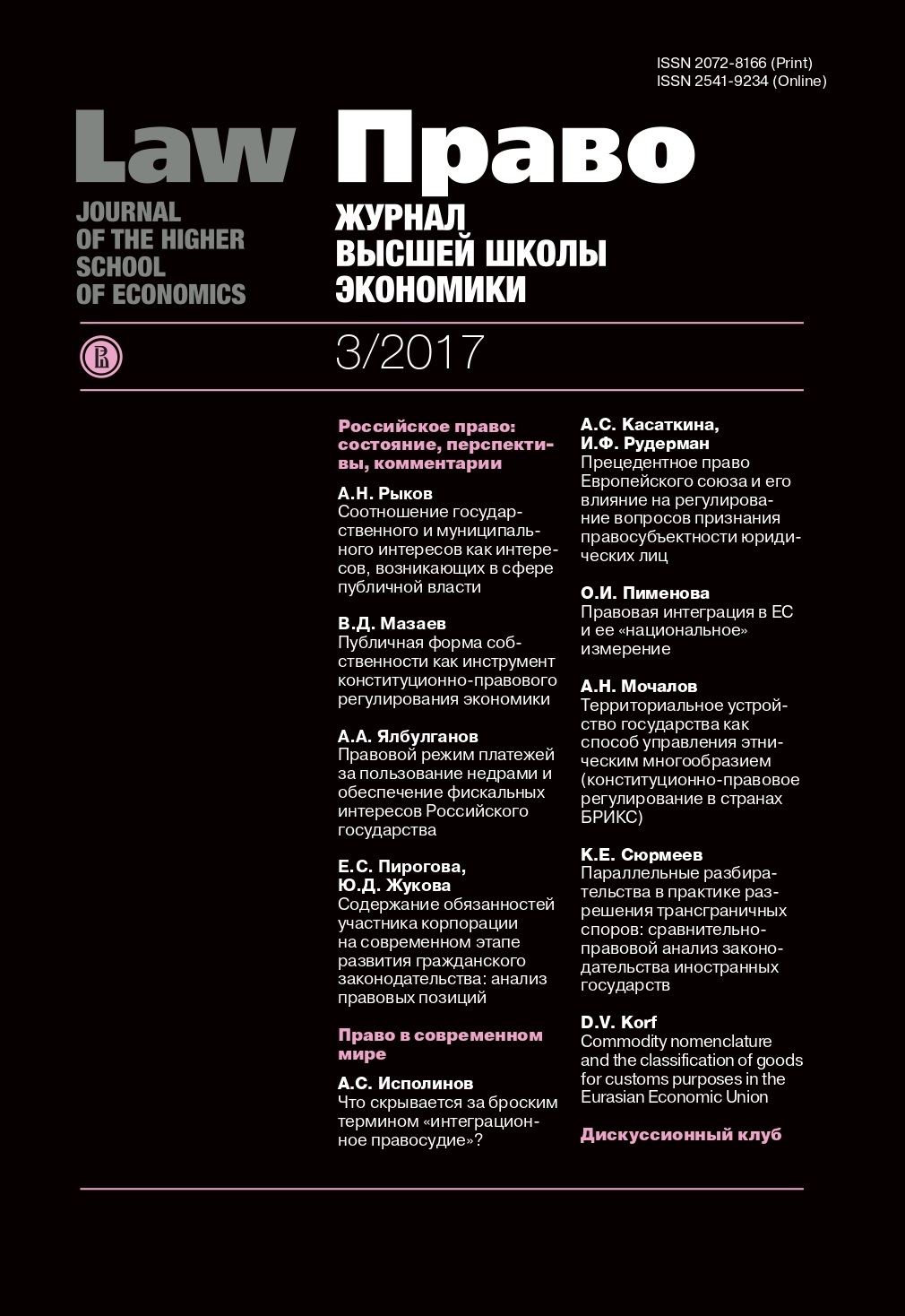
Commodity Nomenclature and Classification of Goods for Customs Purposes in the Eurasian Economic Union
Abstract
The article presents one of the key customs law features — the customs nomenclature and classification of goods. The study demonstrates its multifunctional nature: its value for customs tariff regulation and the calculation of customs duties, its use for statistical purposes, and for the identification of goods when they are subject to non-tariff regulation. 181 million people living in the Eurasian Economic Union (EAEU) generated over 4.3 trillion U.S. dollars of yearly PPP-based gross domestic product as of 2015150 151. Within the customs union in the EAEU, members use a common external tariff to impose import customs duties on goods entering the union from the outside, and customs nomenclature used to build an external customs tariff serves also as the basis for trade negotiations amongst the EACU member states. The research examines the concepts of the Commodity Nomenclature of Foreign Economic Activity (CNFEA), its international standardization, the Harmonized Commodity Description and Coding System, the basic rules of customs classification, the legal organizational aspects of maintaining the CNFEA and the adoption of provisional decisions on the classification of goods. The history of the development of the international basis for nearly all customs nomenclatures known as the harmonized system is viewed as a continuous process in response to the sophistication of the structure of international trade. The massive growth in turnover of international goods is also considered as a driver for international negotiations on common unified customs nomenclature. However, the structure and volume of international trade turnover are constantly changing in a changing world. That is why maintaining and regularly updating the harmonized system is one of the main goals of the World Customs Organization (WCO) in its role as an intergovernmental organization designed to facilitate the free movement of goods and improve customs procedures among all of its members (individual states and the EU).
References
Berlin E.A., Ivanov N.A. (1996) Tovarnaia nomenklatura vneshneekonomicheskoi deiatelnosti SNG [Commodity Nomenclature of Foreign Economic Activity of the CIS]. Moscow: Rossiyskaia tamozhennaya akademia, 288 p. (in Russian)
Berr C. (2008) Introduction au droit douanier. Paris: Economica, 73 p.
Cabello Perez M., Cabello Gonzale J. (2012) Lasaduanasyelcommercio international. Madrid: Editorial, 255 p.
Customs Modernization Handbook (2005) Ed. by L. De Wulf and J. Sokol. Washington: The World Bank, 302 p.
Fabio M. (2010) Customs Law of the European Union. Kluwer Law International, 725 p.
Giffoni M. (2012) La reglamentation douaniere de 1'Union europeenne. Bruxelles: Anthemis, 407 p.
Kozyrin A.N. (2014) Tamozhennoe zakonodatelstvo Tamozhennogo soiuza EvrAzES [Customs Legislation of the EurAsEC Customs Union]. Zakony Rossii: opit, analiz, praktika, no. 4, pp. 3-7.
Kozyrin A. N. (2013) Mezhdunarodnii dogovori i natcionalnoe zakonodatelstvo v pravovom mekhanizme Tamozhennogo soiuza EvrAzES [International Treaties and National Legislation in the Legal Mechanizm of the EurAsEC Customs Union]. Reformy i pravo, no. 2, pp. 29-36.
Lebedev V.I. (1937) Reformy Petra I [Reforms of Peter I]. Moscow: Gosudarstvennoie izdatelstvo, 379 p. (in Russian)
Masco B. (2013) Tratado de Aduanas e Impuestos Especiales. Madrid: Bosch, 319 p.
Sandrovskiy K.K. (2002) Mezhdunarodnoe tamozhennoe pravo [International Customs Law]. Kiev: Znania, 461 p. (in Russian)
Shokhin S.O. (2014) Mezhdunarodno-pravovii sapekti finansovoj deiatelnosti tamozhennih organov [International-law Aspects of Financial Activities of Customs Agencies]. Juridicheskij mir, no 5, p. 11-13.
Theule-Martin C. (1995) La douane: Instrument de la strategie internationale. Paris: Economica, 111 p.
Udovenko S.P. (2006) Tamozhenni tarif sovremennoj Rossii (1993—2005) [Customs Tariff of Contemporary Russia (1993—2005)]. SPb.: Arkhej, 402 p.
Viner J. (2014) The Customs Union Issue. Oxford: OUP, 185 p.
Copyright (c) 2017 Law. Journal of the Higher School of Economics

This work is licensed under a Creative Commons Attribution-ShareAlike 4.0 International License.