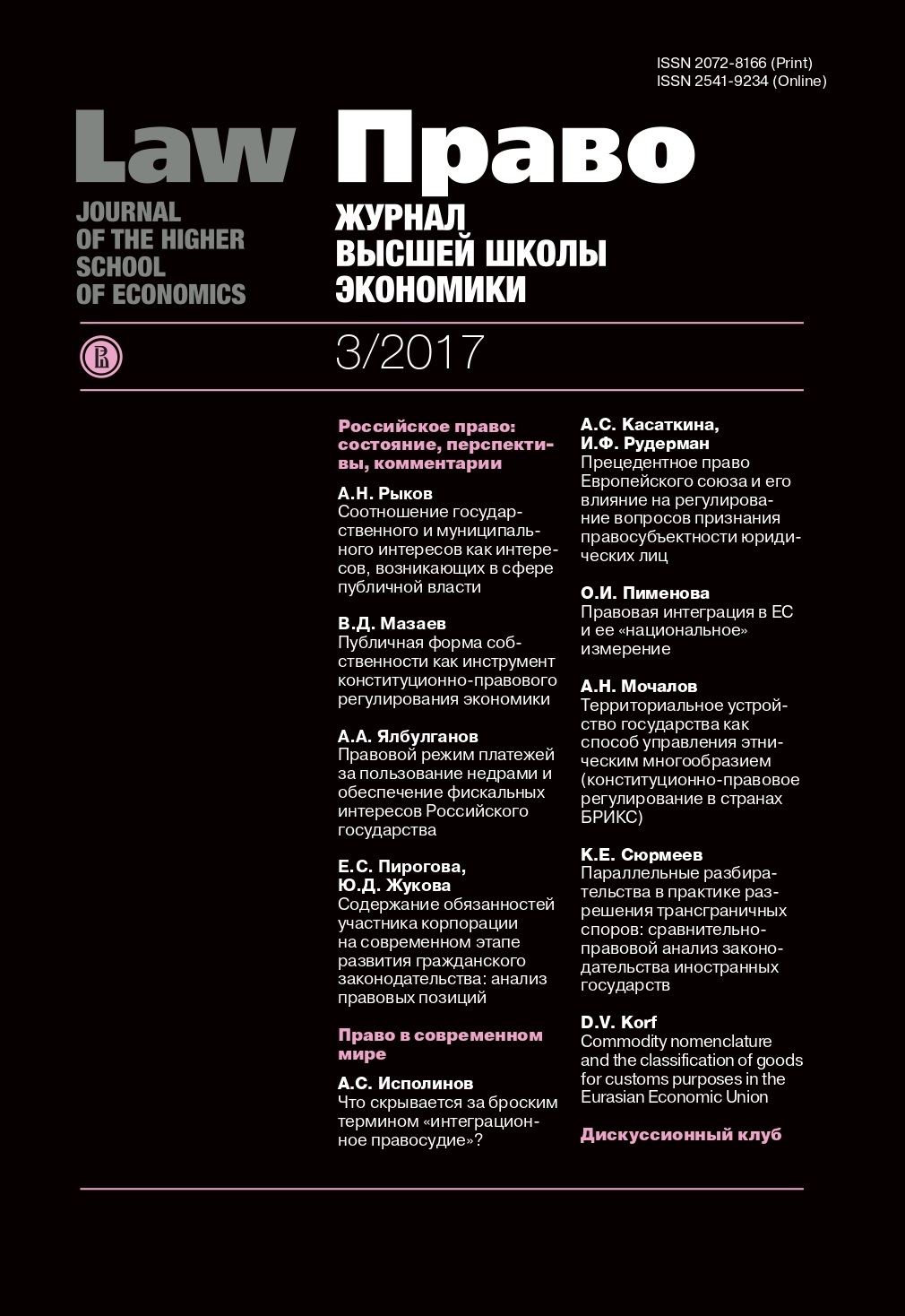
Case Law of European Union and its Impact on the Regulation of Recognizing Legal Capacity of Legal Persons
Abstract
Nowadays, the European Union has faced significant difficulties associated with the creationof a uniform mechanism for determining the personal law (Statute) of legal entities, i.e. singlecollision bindings to the personal statutes of companies. Attempts to achieve convergence andharmonization of national legislations in this matter have not yet been crowned with success. Thepurpose of this study is to analyze the provisions applied in the countries of the Union, the criteriafor determining the personal law of legal persons, as well as judicial practice aimed at the gradualapproximation, harmonization and leveling of contradictions in various legal systems. In the article,using a comparative method of research, a detailed analysis of the norms of international treatiesand the case law of the Court of the European Union regulating the recognition of legal personalityof legal persons was carried out. The following conclusions are drawn as a result of the developmentof the case law of the Union: the movement of both the statutory and actual location of the companyis allowed under law of the Union; establishing company in a state with a more liberal corporateregime is not an abuse of the institution’s freedom, even if it serves to circumvent the norms ofanother member state in which all the company’s activities will be carried out; is also not an abuse ofthe performance of activities not at the place of registration but at the location of the branch of thecompany; the receiving state is obliged to recognize that a foreign company conducts its activitieson its territory, to recognize its legal personality, the settlement theory in this case does not work; thehost State can not prohibit a transnational merger and its registration in its registry, if such registrationis allowed when merging national companies; the company may move its statutory or actual locationto another state without loss of legal personality under the law of the state of creation; the issue ofthe possibility of maintaining legal capacity and the law applicable to the company (state of creation)when moving to a foreign state is decided by the state of creation itself, which in this case has theright to prohibit or restrict such movement; if the company intends to change the applicable law andtake the legal form of the company provided in the receiving state, the state of establishment cannotprohibit the migration of the company and oblige it to be liquidated, provided that such a migration isallowed by the receiving state.
References
Andenas M., Woolbridge F. (2012) European Comparative Company Law. Cambridge: Cambridge University Press, pp. 447-453.
Asoskov A.V. (2003) Pravovye formy uchastia juridicheskih lits v mezhdunarodnom kommercheskom oborote [The Legal Forms of Legal Entities Participation in International Trade Activity]. Moscow: Statut, 219 p. (in Russian)
Azencot M. (2011) Le transfert international de siege social.Theses de doctorat. Available at: URL: https://docassasu-paris2.fr/nuxeo/site/esurperversions/ae00c60b—a69a-48-d8—9776—91eo46e67e (accessed: 24.06. 2017)
Behrens P. (2009) From Real Seat to Legal Seat. Germany‘s Private International Company Law Resolution. Resolving International Conflicts. Budapest: Korvina, pp. 45-66.
Dubrovitskaya E.A. (2008) Evropeiskoe korporativnoe pravo [European Corporate Law]. Moscow: Wolters Kluwer, 261 p. (in Russian)
Grundmann S. (2012) European Company Law: Organization, Finance and Capital Market. Antwerp: Intercentia, 984 p.
Hansson E. (2012) Discussia v nemetskomprave o vvedenii novogo juridicheskogo litsa, edinogo evropeiskogo obschestva s ogranichennoi otvetstvennostiu [The Debates in German Doctrine about Imposing a New Legal Entity, Unified European Company Limited]. Zhurnal zarubezhnogo zakonodatelstva i sravnitelnogo pravovedenia, no 3, pp. 86-91.
Hirte H. et al. (2012) The European Private Company. European Company and Financial Law Review, vol. 3, p. 508.
Kondratiev A.V. (2005) Kategoria juridicheskogo litsa v prave evropeiskogo souza [The Category of Legal Entity in the Law of the European Union]. Zhurnal zarubezhnogo zakonodatelstva i sravnitelnogo pravovedenia, no 3, pp. 52-63.
Kuleshova I.A. (2008) Kollizionnyi i materialno-pravovoi metody regulirovania juridicheskih lits v mezhdunarodnom chastnom prave [The Collision and Material Ways of Regulating Legal Entities in International Private Law]. International Public and Private Law, no 4, pp. 29-31.
Navez E.-J. (2013) La transformation transfrontaliere des societes est desormais pleinement consacree par le droit de l'U.E.: qu'attend encore le legislateur pour mettre en re Livre cette prerogative... Revue pratique des societes, pp. 243-270.
Osipov D. (2012) Evropeiskaya kompania: deciatiletie regulirovania i praktiki [The European Company: Decade of Regulation and Practice]. Zhurnal mezhdunarodnogo chastnogo prava, no 3, pp. 19-30.
Vermelyen J. (2012) Arret “VALE Epitesi”: la mobilite transfrontalietre du sigeest-elle un droit? Journal de droit europeen, no 9, pp. 276-280.
Yerpulyova N. Yu., Klevchenkova M.N. (2012) Pravovoi regim funktcionirovania juridicheskih lits v evropeiskom souze [Legal Regime of Legal Entities Functioning in the EU]. Registatcia subiectov predprinimatelskoi deiatelnosti: zarubezhnyi opyt. R.A. Adelhanian, ed. Moscow: Statut, pp. 12-49.
Yuriev M.E. (2006) Novaya organizatcionno-pravovaya forma yuridicheskogo litsa po pravu evropeiskogo souza v bankovskoi sfere [A New Organizational Form of Legal Entity according to the Law of EU within Banking Sphere]. Bankovskoe pravo, no 5, pp. 56-60.
Copyright (c) 2017 Law. Journal of the Higher School of Economics

This work is licensed under a Creative Commons Attribution-ShareAlike 4.0 International License.