Functions of Moral Rights in the Modern Information Society
Abstract
Moral rights are often analyzed in the context of protection of author's personal interests only and, as result, this theme attracts attention of researchers quite rarely. However, in the modern information society moral rights perform number of important roles. The basic moral right function is identification of a person as a creator of certain work. This acknowledgement is very important for an author, because it influence on his social status, profit, etc. On the other hand, the author's identification is necessary for normal use of a work, because any economic turnover requires identification of object involved in it. On this basic function, some additional functions are based, in particular, stimulation creative activity, identifying of characteristics of the work, prevention of unauthorized changes of the work, protection of culture heritage. At the same time, implementation of these functions in different countries depends strongly on traditions and peculiarities of the legislation development in this country. For example, in continental system of law “romantic” conception of copyright was implemented, which was based on relation to an author as a creator “inspired by the heaven”, while in anglo-saxon system of law copyright was an instrument for organization of economic exploitation of works. In the article functions of moral rights and their place in the modern information society, as well as peculiarities of implementation in different countries, are discussed. Moral rights became a guaranty that new ways of use of works will not be performed in the form that will break the author and his work completely where he is not able to influence to conditions of use of his work and to control correct identification of the title of the work, his name, prevent distortions of his work, etc. In the modern society, the role of state authorities increases as well, they should protect works which are in the public domain, provide possibility of use of “orphan works”, etc. Regrettably, currently in the legal doctrine there is no clear understanding of new role of copyright and place and role of moral rights, in particular.
References
Cornish C. (1996) Intellectual Property. London: Sweet and Maxwell, 722 p.
Dozortev B.A. (2000) Ponyatie iskluchitelnogo prava [Concept of Exclusive Copyright]. Yuridicheskiy mir, no 4, pp. 4-9.
Garnett K., James J.R., Davies G. (1999) Copinger and Skone James on Copyright. London: Sweet and Maxwell, 1149 p.
Gordon M.V. (1955) Sovetskoye avtorskoe pravo [Soviet Copyright Law]. Moscow: Gosyurizdat, 232 pp. (in Russian)
Green Paper on Copyright and Related Rights in the Information Society (1995). Commission of the European Communities, p. 67. Available at: http://aei.pitt.edu/1211/1/copyright_info_society_gp_COM_95_382.pdf (accessed: 17.09.2016)
Heidi G. (1998) Novoye tolkovanie prava na neprikosnovennost proizvedenia v st. 6 Bernskoi konventsii [New Understanding of Exclusive Copyright in the Art. 6 of Bern Convention] Bulleten po avtorskomy pravu, no 3, pp. 5-23.
Holderness M. (1998) Moral Rights and Authors' Rights: The Keys to the Information Age. The Journal of Information Law and Technology, no 1. Available at: https://www2.warwick.ac.uk/fac/soc/law/elj/jilt/1998_1/holderness/ (accessed: 9.10.2016)
Khabibullin A.G., Rachimov R.A. (2000) Gosudarstvennaya identichnost kak element pravovogo statusa lichnosti [State Identity as Element of Legal Status of a Person]. Gosudarstvo I pravo, no 5, pp. 5-11.
Patterson L.R. (1987) Free Speech, Copyright and Fair Use. Vanderbilt Law Review, no 2, pp. 1-66.
Rajan M.T.S. (2002) Moral Rights in the Digital Age: New Possibilities for Democratization of Culture. International Review of Law, Computers and Technology, vol. 16, no 2, pp. 187-197.
Rajan M.T.S. (2011) Moral Rights. Oxford: Oxford University Press, 2011. 549 p.
Rose M. (1993) Authors and Owners. Invention of Copyright. Cambridge: Cambridge University Press, 190 p.
Samuelson P. (2006) Challenges in Mapping the Public Domain / The Public Domain of Information. B. Hugenholtz & L. Guibault, eds. The Hague: Kluwer Law International, pp. 7-26.
Standler R.B. (2012) Moral Rights of Authors in the USA. Available at: http://www.rbs2.com/moral.pdf (accessed: 3.09.2016)
Woodmansee M. (1984) The Genius and the Copyright: Economic and Legal Conditions of the Emergence of the “Author”. Eighteenth-Century Studies, vol. 17, pp. 425-448.
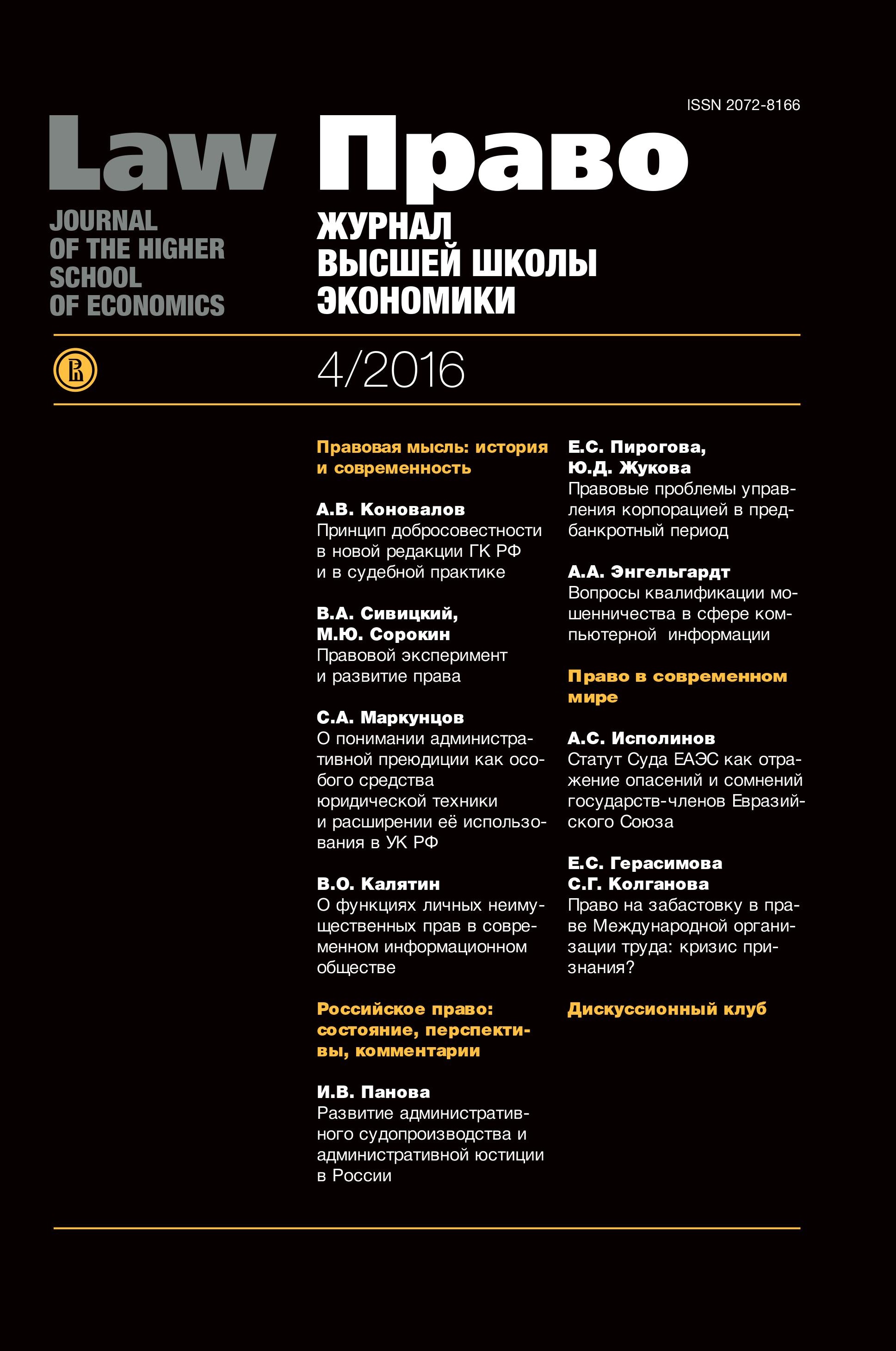
Copyright (c) 2016 Law. Journal of the Higher School of Economics

This work is licensed under a Creative Commons Attribution-ShareAlike 4.0 International License.