Synergetic Paradigm of International Law Studies
Abstract
The relevance of the topic is determined by the necessity in realizing current changes in legal science. The essence of the changes is explained by the fact that our perception of reality is based on different scientific paradigms. The world is represented as a place full of contradictions and disorder, and we are looking for a framework that will fill it with sense. Many researchers are widely using concepts and methods of synergetrics, which is usually referred to as the theory of chaos in American scientific literature. Synergetrics helps to study a certain aspect, connection of a legal phenomenon. Therefore, this approach can be applied not in any research, but only in those requiring studying certain aspects and features of a phenomenon. The synergetic paradigm allows revealing such new characteristics of legal systems as: openness, self-organization, nonlinearity in the development of social and legal phenomena. At the time when the harmonization of the Russian and international legal systems is a priority, the transformations in the sphere of international relations are being taken into account. The knowledge of legal entropy will give a chance not only to explain many features of self-organization, disorganization and self-government of legal systems, but to develop the approaches, techniques allowing influencing the choice of the alternative ways of their development. Laws of the chaos theory can help while studying the dynamics of the modern civilization processes. At the same time, the complexity of the environment means a number of factors, influencing the work of various social organisms. This complexity also includes variability of these factors. Nowadays, hardly any country does not depend on the global informational, financial, economic, technological systems. A similar situation influences economy, political decisions and the system of legal regulation. At the same time there is an issue with the legitimacy of applying characteristics disorder, uncertainty, disorganization to the law, which, as a tool, provides the balance in social relations, adding essential certainty. This question is quite legitimate since there is no current solution in the modern legal science.
References
Barker J. (2007) Paradigmy myshleniya. Kak uvidet' novoe i preuspet' v menyayushchemsya mire [Shifting the Paradigm: Giving Up Old Mental Models]. Moscow, Al'pina Biznes Buks.
Chernavskiy D.S. (2013) Sinergetika i informatsiya: dinamicheskaya teoriya khaosa [Synergetics of Information: Dynamic Chaos Theory]. Moscow, Librokom.
Fedotova V Upravlyaemyy khaos [Controlled Chaos]. Available at http: spkurdyumov.ru>what/upravlyae-myj-haos/ (accessed 12.09.2014)
Gobozov I.A. (2012) Revolyutsiya ili upravlyaemyy khaos? [Revolution or Controlled Chaos]. Filosofiya i Obshchestvo, no 1, pp. 5-25.
Khaken G. (2003) Tayny prirody. Sinergetika: nauka o vzaimodeystvii [Mysteries of Nature. Synergetics; Science on Interaction]. Moscow, Izhevsk: Institut kompyuternykh issledovaaniy, 320 p.
Kortunov S.V. (2011) Rossiya v mirovoy politike posle krizisa [Russia in International Politics after the Crisis]. Moscow, Krasnaya Zvezda.
Kun T. (2009) Struktura nauchnykh revolyutsiy [Structure of Scientific Revolutions]. Moscow, AST, 310 p.
Yuliya Erokhina. Synergetic Paradigm of International Law Studies. p. 19-29.
Magnitskiy N.A. (2011) Teoriya dinamicheskogo khaosa [Theory of Dynamic Chaos]. Moscow, LENAND, 320 p.
Pavlova Yu.V. (2005) Pravovaya entropiya [Legal Enthropy]. Vladimir, VYuI FSIN Rossii, 114 p.
Metelev S.E. (Ed.) (2011) Teoriya khaosa v banke [Chaos Theory in Banking]. Omsk, Izdatel'stvo Omskogo universiteta, RGTEU, 173 p.
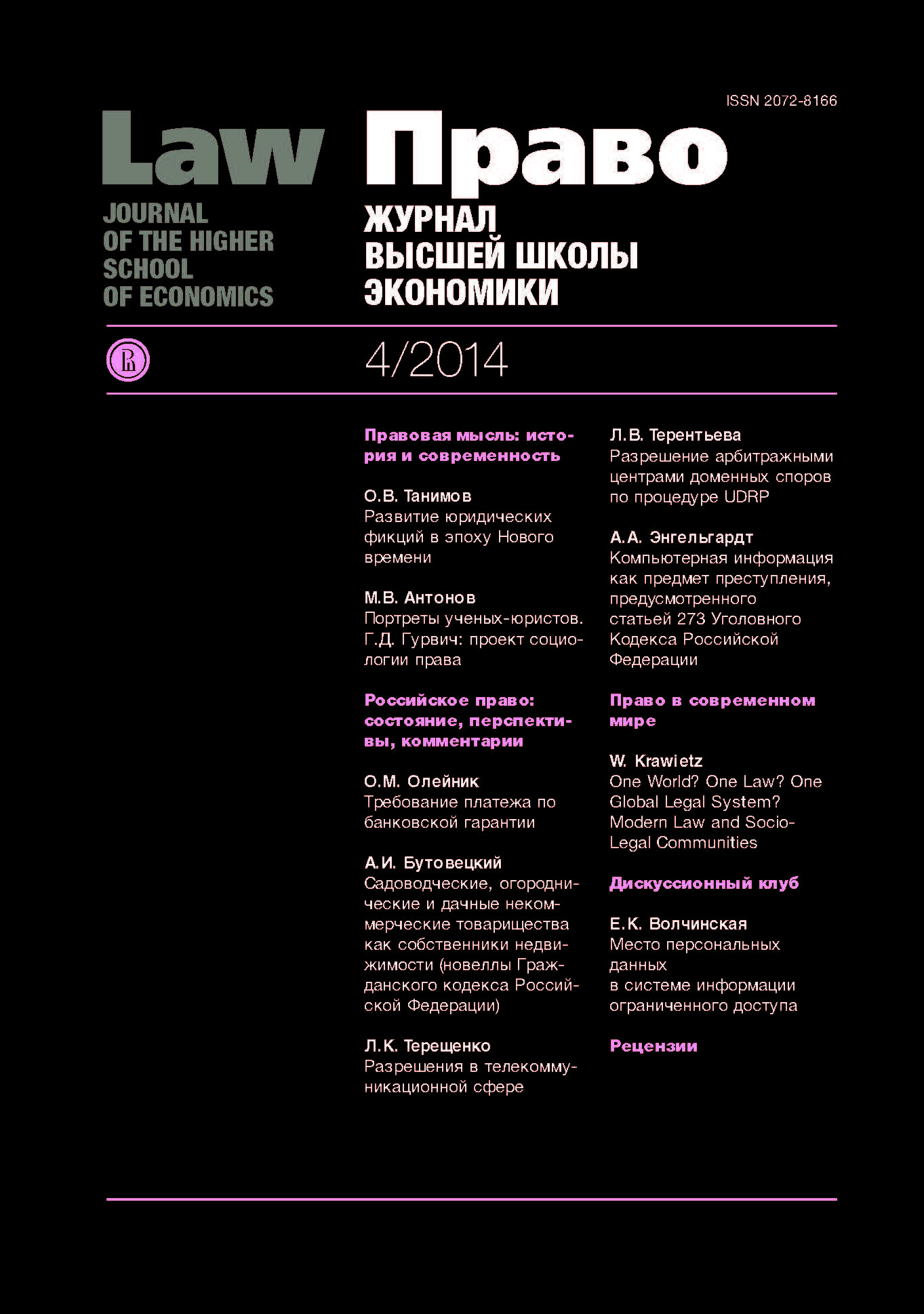
Copyright (c) 2014 Law Journal of the Higher School of Economics

This work is licensed under a Creative Commons Attribution-ShareAlike 4.0 International License.