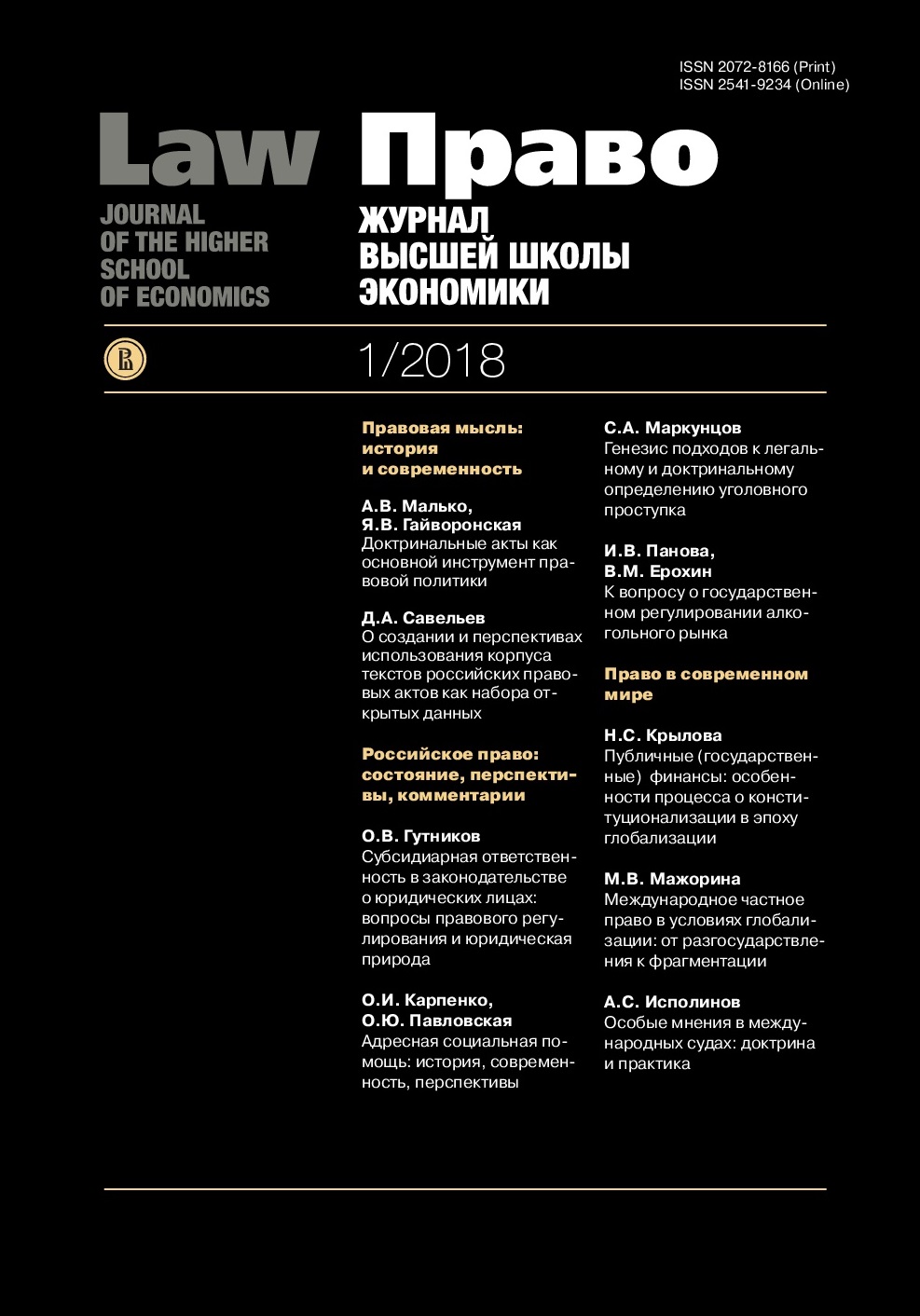
Генезис подходов к легальному и доктринальному определению уголовного проступка
DOI:
https://doi.org/10.17323/2072-8166.2018.1.112.132Ключевые слова:
уголовное право, уголовный проступок, категории преступлений, уголовно-противоправное деяние, непреступное правонарушение, подкатегория преступлений небольшой тяжести, Кодекс уголовных проступковАннотация
Понятие уголовного проступка известно отечественному законодателю и правоприменителю примерно три столетия. В дореволюционный период понятие проступка наряду с понятием преступления было закреплено в Своде законов уголовных (1832), во всех редакциях Уложения о наказаниях уголовных и исправительных (1845), в Уголовном уложении (1903). В этих нормативно-правовых актах проступки, как и преступления, рассматривались в качестве разновидности уголовно-противоправных деяний. В уголовных кодексах РСФСР (1922, 1926, 1960) понятие уголовного проступка закреплено не было. В проекте Кодекса уголовных проступков (1973), который не был принят, уголовный проступок предлагалось рассматривать как непреступное правонарушение. В 1977 г. в Основах уголовного законодательства СССР и союзных республик (1958) и УК РСФСР (1960) были введены положения о преступлениях, не представляющих большой общественной опасности. В 1990-х гг. введение уголовных проступков в качестве самостоятельной группы преступных деяний предлагалось в ряде проектов Уголовного кодекса. Проблема уголовного проступка не является новой для отечественной науки уголовного права. В уголовно-правовой доктрине дореволюционного периода выделение уголовных проступков обосновывалось делением «по роду неправды». В советской период проблема уголовного проступка стала активно обсуждаться с 1960-х гг. Большинство ученых рассматривали уголовный проступок в качестве разновидности преступления, обладающего определенной степенью общественной опасности. Распространен был подход, согласно которому под уголовным проступком понималась разновидность общественно опасного деяния, запрещаемого уголовным законом наряду с преступлением. Некоторые ученые рассматривали его в качестве деяния, вообще не являющегося уголовно-противоправным и уголовно наказуемым. В современной российской доктрине уголовного права в сущности сохранились те же три базовые позиции в вопросе определения сущности уголовного проступка. В случае реализации законодательной инициативы, оформленной в виде Постановления Пленума Верховного Суда Российской Федерации от 31.10.2017, в действующий Уголовный кодекс будет введено понятие уголовного проступка, под которым будет пониматься разновидность (подкатегория) преступлений небольшой тяжести.
Библиографические ссылки
Akutaev R.M. (2013) Ob ugolovnykh prostupkakh i kategorizatsii prestupleniy v svete Postanovleniya Konstitutsionnogo Suda RF ot 14.02.2013 g. [On criminal actions and categories of crimes under the decision of RF Constitutional Code of 14 February 2013]. Rossiyskaya yustitsiya, no 5, p. 41-45.
Esakov G.A. (2013) Ot administrativnykh pravonarusheniy k ugolovnym prostupkam, ili o sushchestvovanii ugolovnogo prava v «shirokom» smysle [From administrative offences to crimes, or On criminal law in a broader sense]. Biblioteka kriminalista, no 1, p. 37-45.
Geta M.R. (2016) Ugolovnoe pravo: predely, ob”ekty i sredstva vozdeystviya v bor'be s prestupnost'yu v sovremennoy Rossii [Criminal law: limits and controls in tackling crime in modern Russia]. Moscow: Norma, 336 p. (in Russian)
Gordienko V.V. (2010) Zakonodatel'noe ustanovlenie ugolovnogo prostupka i isklyuchenie instituta otkaznykh materialov [Concept of criminal act and excluding the institute of negative materials]. Rossiyskiy sledovatel', no 15, p. 11-13.
Korobov P.V. (1990) Ugolovnyy prostupok: «za» i «protiv» [Crime: for and against]. Pravovedenie, no 5, p. 90-96.
Krivochenko L.N. (1982) K diskussii ob ugolovnom prostupke [On the discussion of crime]. Problemy sotsialisticheskoy zakonnosti, no 9, p. 105-110.
Kuznetsova N.F. (2010) Znachenie obshchestvennoy opasnosti deyaniy dlya ikh kriminalizatsii i dekriminalizatsii [On the significance of dangerous actions in criminalization and décriminalisation]. Gosudarstvo ipravo, no 6, p. 67-75.
Logetskiy A.A. (2003) Prestuplenie i prostupok v ugolovnom prave XIX — nachala XX vekov: avtoref. diss. ... kand. yurid. nauk [Crime as a concept in criminal law at the turn of 19th and 20th centuries. Summary of the Candidate of Juridical Sciences Thesis]. Moscow, 35 p.
Makhotkin V.P. (1992) Prestupleniya, ne predstavlyayushchie bol'shoy obshchestvennoy opasnosti: Avtoref. diss. ... doct. yurid. nauk [Crimes without serious public danger. Summary of Doctor of Juridical Sciences Thesis]. Moscow, 29 p.
Mikhal' O.A., Vlasov Yu.A. (2014) Ob ugolovnom prostupke v rossiyskom ugolovnom prave [Crime in Russian criminal law]. Sovremennoe pravo, no 3, p. 111-115.
Razgil'diev B.T. (2013) Obshchestvennaya opasnost' prestupleniy i inykh pravonarusheniy [Public danger of crimes and offences]. Biblioteka kriminalista, no 2, p. 214-224.
Rogova E.V. (2012) Ponyatie i sushchnost' ugolovnogo prostupka [Concept and nature of crime]. Trudy Akademii upravleniya MVD Rossii, no 3, p. 7-9.
Rogova E.V. (2011) Ugolovnyy prostupok v istorii otechestvennogo zakonodatel'stva [Crime in the history of Russian legislation]. Vestnik Vostochno-Sibirskogo instituta MVD Rossii, no 3, p. 101-109.
Tagantsev N.S. (1902) Russkoe ugolovnoe pravo: Chast' obshchaya. T. 1 [Russian criminal law: general part. Vol. 1]. Saint Petersburg: Gosudarstvennaya tipografia, 823 p. (in Russian)
Zhuk M.S. (2013) Uchenie ob institutakh rossiyskogo ugolovnogo prava: kontseptual'nye osnovy i perspektivy razvitiya: monografiya [Institutes of Rusian criminal law: concepts and prospects]. Moscow: Yurlitinform, 304 p. (in Russian)
Загрузки
Опубликован
Выпуск
Раздел
Лицензия
Copyright (c) 2018 Право. Журнал Высшей школы экономики

Это произведение доступно по лицензии Creative Commons «Attribution-ShareAlike» («Атрибуция — На тех же условиях») 4.0 Всемирная.