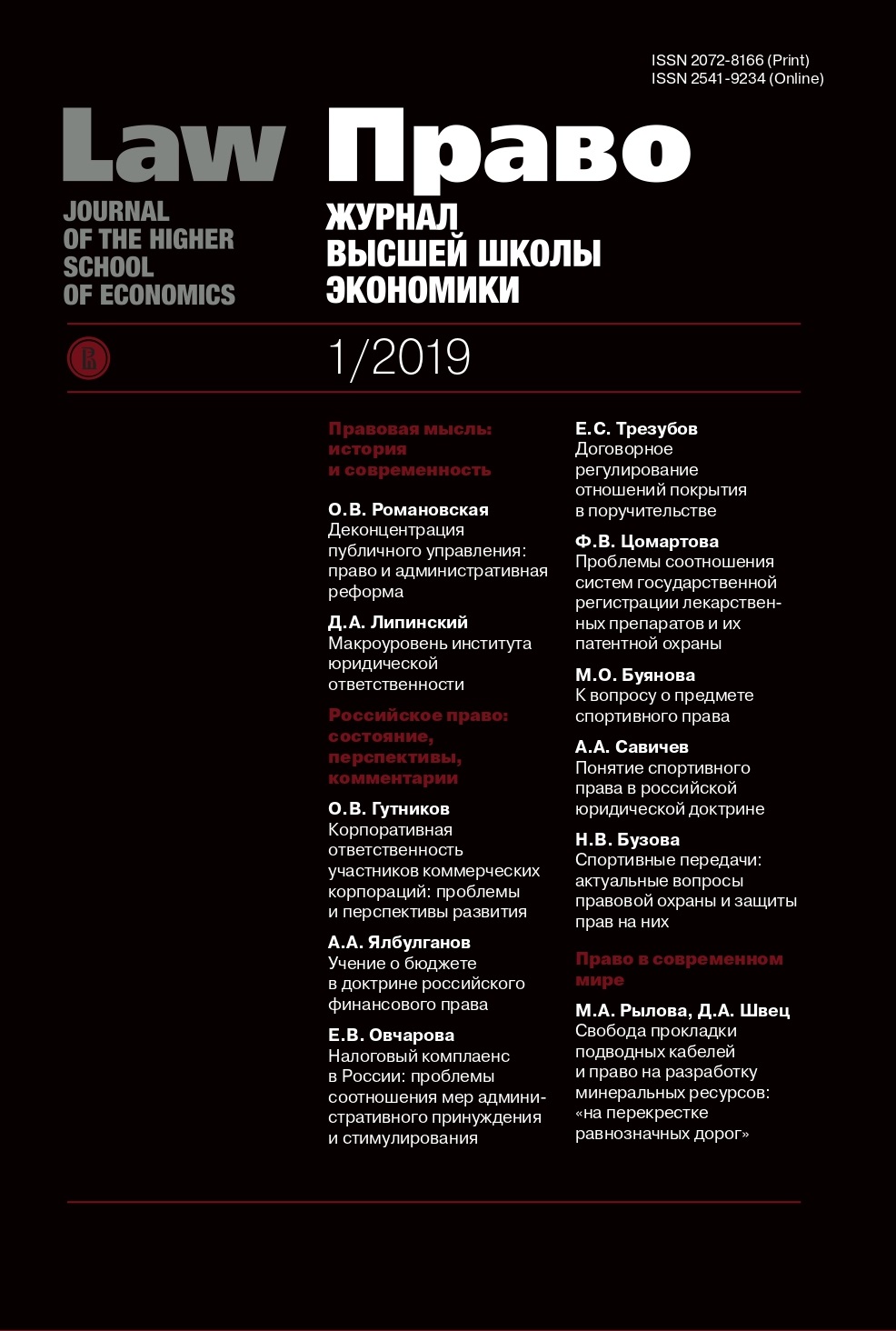
Деконцентрация публичного управления: право и административная реформа
Аннотация
Развитие государственных институтов происходит под давлением многих факторов, среди которых — глобализация экономики, интернационализация права, информатизация общественной и личной жизни. Они заставляют государство заниматься поиском новых моделей публичного управления. Либертарианство, разработанное известными учеными-экономистами Ф. Хайеком, М. Фридманом, Р. Талером и другими, предлагает уйти от классического понимания роли государства и сосредоточиться на активном внедрении некоторых форм деконцентрации власти: дерегулировании, сорегулировании, саморегулировании, квази-регулировании. Административная реформа, проводимая в Российской Федерации, использует практически все названные формы. В статье показан опыт их применения в правотворческой и правоприменительной практике. Доказано, что многие выводы, сформулированные в зарубежной юридической науке о сорегулировании и саморегулировании, могли быть использованы в российском законодательстве. Выделены критерии, которым должен отвечать процесс деконцентрации государственной власти: предъявление требований к институциональной основе форм деконцентрации; субсидиарность на всех стадиях управленческого процесса, включающая свободу и ответственность обеих сторон; транспарентность системы, обеспечивающая общественный контроль; индикативность всех участников управленческого процесса: каждый должен понимать последствия той или иной формы деконцентрации власти; идеологическое сопровождение (обоснование деконцентрации и пропаганду ее достижений). Сделан вывод об отсутствии системности административной реформы в России. Ее основой служит Указ Президента России 2003 г., не нашедший развития в последующих базовых актах. Государство сделало попытку создания квазиминистерства в виде государственной корпорации «Росатом», последовательно критикуя при этом форму, однако одновременно создавая публично-правовые и публичные компании. Государство экспериментирует со внедрением преференциальных административных режимов, используя индивидуальный подход при принятии законов об отдельных участниках управленческого процесса (медицинский кластер, порт «Владивосток» и др.). Каждый такой опыт не подтвержден продуманной концепцией реформы государственного управления, адаптированной к меняющейся экономической ситуации.
Литература
Algazina A.F. (2016) [Self-regulation in the system of management practices]. Administrativnoe pravo i protsess, no 6, pp. 78-81 (in Russian)
Belitskaia A.V. (2009) [Legal forms of public-private partnership in Russia and foreign countries]. Predprinimatel'skoe pravo, no 2, pp. 6-11 (in Russian)
Bulgakova L.I. (2005) [Audit in Russia: the Mechanism of Legal Regulation]. Moscow: Wolters Kluver, 256 p. (in Russian)
Chirkov A.V. (2017) [On self-regulating activities of microfinance entities]. Predprinimatel'skoe pravo, no 1, pp. 50-56 (in Russian)
De Jasay A. (1998) The State. Indianapolis: Liberty Fund, 238 p.
Egorova M.A. (2017) [The Concept of Improving Mechanisms of Self-regulation: Pro et Contra]. Moscow: Justitsinform, 180 p. (in Russian)
Egorova M.A. (2016) [Role of national associations of self-regulating bodies in regulating business]. Pravo i ekonomika, no 10, pp. 4-7 (in Russian)
Gaines S., Kimber C. (2001) Redirecting self-regulation. Journal of Environmental Law. 2001. №2. Available at: http://oxfordindex.oup.com/view/10.1093/jel/13.2.157 (accessed: 12.12.2018)
Grachev D.O. (2008) [The legal status of self-regulating organizations. Candidate of Juridical Sciences Thesis]. Moscow, 141 p. (in Russian)
Grachev D.O. (2004) [Self-regulating organizations: determining legal status]. Zhurnal rossiyskogo prava, no 1, pp. 121-126 (in Russian)
Hayek F. (2006) [Law, Legislation and Freedom]. Moscow: IRISEN, 644 p. (in Russian)
Hmelev V.V. (2009) [Service Culture: Innovation]. Moscow: Marketing, 159 p. (in Russian)
Kruss V.I. (2014) [Public services in context of Russian constitutionalism]. Konstitutsionnoe i munitsipal'noe pravo, no 5, pp. 59-70 (in Russian)
Martynova S.E. (2013) [Concept of a service state in the post-industrial paradigm of social management]. Vestnik Tumenskogo gosudarstvennogo universiteta, no 8, pp. 165-173 (in Russian)
Martinez M. et al. (2007) Co-regulation as a possible model for food safety governance: Opportunities for public-private partnerships. Available at: http://www.eng.auth.gr/mattas/foodima/pdf2.pdf (accessed: 12.12.2018)
Mohov A.A. (2017) [Pharmaceutical clusters: theory, legislation, practice]. Yurist, no 10, pp. 41-46 (in Russian)
Nozdrachev A.F. (2017) [Current content of the concept of administrative and legal regime]. Zhurnal rossiiskogo prava, no 2, pp. 98-110 (in Russian)
Petrov D.A. (2016) [The Legal Status of a Self-regulatory Business Entity. Doctor of Juridical Sciences Thesis]. Saint Petersburg, 433 p. (in Russian)
Petrov M.P. (2016) [Perfection of methods of administrative and legal regulation of innovation activity]. Aktual'nye problem rossiyskogo prava, no 10, pp. 54-62 (in Russian)
Ponomarenko V.A. (2016) [Civil proceedings as a service in an electronic service state]. Lex russica, no 2, pp. 49-61 (in Russian)
Putilo N.V. (2017) [Public services: between doctrinal understanding and practice of normative consolidation]. Zhurnal rossiyskogo prava, no 8, pp. 81-92 (in Russian)
Romanikhin A.V. (2004) [Self-regulation in Russia]. Zakonodatel'stvo i ekonomika, no 3, pp. 32-36 (in Russian)
Rotbard M. (2009) [Toward a New Freedom]. Moscow: Novoe izdatel'stvo, 398 p. (in Russian)
Van Creveld M. (1999) The Rise and Decline of the State. Cambridge University Press, 436 p.
Van Gestel R. Self-regulation and environmental law. Available at: https://www.ejcl.org/91/art91-4.html (accessed: 10.12.2018)
Vlasenko N.A. (2015) [Individualization as the law of development of modern Russian legislation]. Zhurnal rossiiskogo prava, no 12, pp. 11-17 (in Russian)
Voinikanis E.A. (2013) [The Law of IP in the Digital Age]. Moscow: Jurisprudentsiia, 552 p. (in Russian)
Zaikovskii V.N. (2014) [«Service state»: a new paradigm or modern technology of public administration?]. Daidzhest-Finansy, no 3, pp. 35-45 (in Russian)
Copyright (c) 2019 Право. Журнал Высшей школы экономики

Это произведение доступно по лицензии Creative Commons «Attribution-ShareAlike» («Атрибуция — На тех же условиях») 4.0 Всемирная.