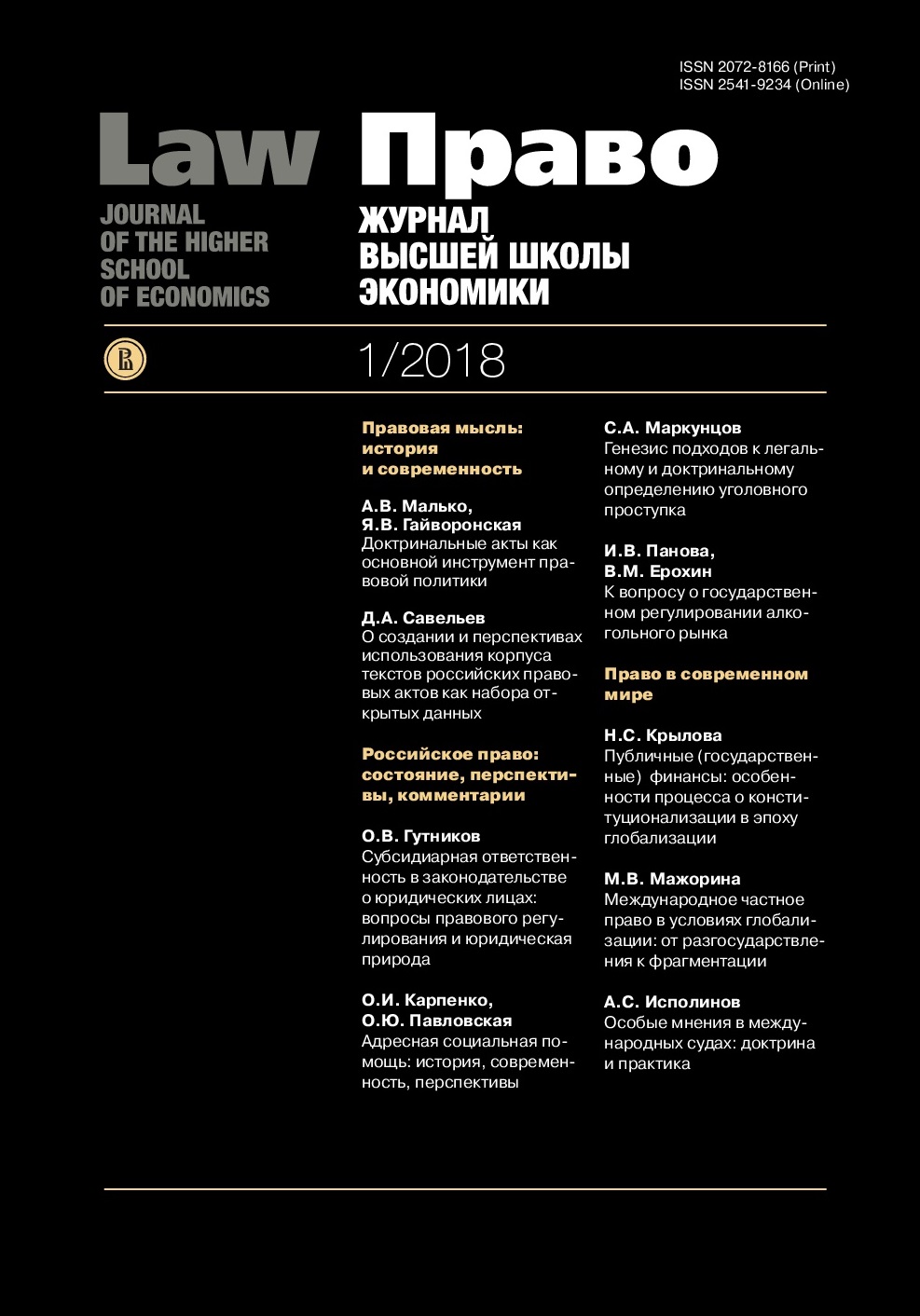
Публичные (государственные) финансы: особенности процесса конституционализации в эпоху глобализации
Аннотация
Предмет исследования — процессы конституционализации и институционализации публичных (государственных) финансов. Деятельность современного государства в сфере регулирования финансовых и бюджетных отношений, использования и расходования денежных средств осуществляется в конституционно-правовых формах. Фундаментальные принципы закреплены в конституциях большинства стран. Конституционализация финансово-бюджетного регулирования — исторический процесс. Ее итогом явилось установление принципиально новых правил и норм организации и функционировании государства. Она знаменовала переход от абсолютизма к системе конституционного (ограниченного) правления. Процесс конституционализации выявил тенденцию к расширению рамок конституционного регулирования финансовых отношений. Некоторые конституции называют сегодня «финансовыми» или «налоговыми» (ФРГ, Швейцария). Конституционализация — непрерывный процесс. Вместе с тем в нем отмечается неравномерность конституционного развития отдельных стран. Она проявляется как в воплощении фундаментальных принципов в текстах конституции, так и в их реализации деятельности органов государства. Особенностями характеризуется процесс конституционализации в России. Тенденция к интернационализации (глобализации) приобретает универсальный характер. В сфере финансового регулирования она проявляется в разнообразных формах. Прежде всего это рост роли международных и наднациональных финансовых стандартов. Интернационализация влияет также на механизмы и институты взаимодействия международных объединений и национальных государств. Наиболее яркий пример воздействия глобализации на сферу бюджетного урегулирования — Европейский союз. Общая эволюция объединения идет в направлении постоянного расширения сферы его деятельности в этой области. В ЕС создана собственная бюджетная система. Договоры о ЕС и функционировании ЕС содержат подробный перечень общих и специальных принципов, определяющих деятельность в бюджетной сфере. Новая тенденция к расширению сферы бюджетного регулирования проявилась в реорганизации финансового механизма объединения в 2012 г. и в установлении в Фискальном пакте «бюджетного правила» — принципа сбалансированного бюджета. Это правило перенесено в конституционное право некоторых стран-членов ЕС.
Литература
Andreeva G.N. (2013) Rol' finansovoy konstitutsii v sozdanii i raspredelenii finansovykh potokov v gosudarstve. Problemy konstitutsionnogo razvitiya v Rossiyskoy Federatsii [Role of financial constitution in creating and distributing financial flows in the state]. Moscow: MGUA press, p. 338-354.
Filosofiya prava cherez prizmu konstitutsionalizma i konstitutsionnoy ekonomiki [Filosophy of law through the prism of constitutionalism and constitutional economy]. Moscow: Letniy sad, 2010. 322 p. (in Russian)
Gorbunova O.N. (2017) Problemy zakona o finansakh i proekt zakona «O finansakh» [The issues of the law on finances and the draft of the law On finances]. Gosudarstvo i pravo, no 5, p. 69-74.
Kashkin S.Yu. (ed) (2013) Evropeyskiy Soyuz. Osnovopolagayushchie akty v redaktsii Lissabonskogo dogovora s kommentariyami [European Union. Fundamental acts of the Lisbon treaty with comments]. Moscow: Norma, 696 p. (In Russian)
Kashkin S.Yu. (ed.) (2014) Pravo Evropeyskogo Soyuza [EU law]. Moscow: Yurayt, 1119 p. (in Russian)
Konstitutsiya v XXI veke: sravnitel'no-pravovoe issledovanie (2017) [Constitution in 21 Century: a Comparative Study]. Moscow: Norma, 656 p. (in Russian)
Kozyrin A.N. (1996) Kharakteristika osnovnykh finansovykh institutov zarubezhnykh stran [The major financial institutes of foreign countries]. Finansovoe pravo [Financial law]. Moscow: Yurist, p. 75-98.
Metodologiya sovremennogo konstitutsionalizma (2017) [Methodology of modern constitutionalism]. Saint Petersburg: Fond Universiteta, 343 p. (in Russian)
Nobel' P. (2012) Shveytsarskoe finansovoe pravo i mezhdunarodnye standarty [Swiss financial law and international standards]. Moscow-Berlin: Infotropik Media, 1058 p. (in Russian)
Pushkareva V.M. (1996) Istoriya finansovoy mysli i politika nalogov [History of financial thought and tax policy]. Moscow: Infra-M, 191 p. (in Russian)
Tosunyan G.A., Vikulin A.Yu. (1999) Den'gi i vlast' [Money and power]. Moscow: IGPAN, 191 p. (in Russian)
Varlamova N.V., Vasil'eva T.A. (eds.). (2017) Internatsionalizatsiya konstitutsionnogo prava: sovremennye tendentsii [Internationalization of constitutional law: modern trends]. Moscow: IGP RAN, 224 p. (in Russian)
Vasyanina E.L. (2015) Fiskal'nye dokhody gosudarstva: pravovoy analiz [Fiscal revenues: legal analysis]. Moscow: Kontrakt, 264 p. (in Russian)
Yutkina C.T. (1998) Nalogi i nalogooblozhenie [Taxes and taxation]. Moscow: Yurayt, 139 p. (in Russian)
Zlatopol'skiy S.V. (ed.) (2017) Upravlenie byudzhetnymi resursami i dokhodami (pravovye voprosy) [Administration of budgetary resources and revenues: legal aspects]. Moscow: Prometey, 392 p. (in Russian)
Copyright (c) 2018 Право. Журнал Высшей школы экономики

Это произведение доступно по лицензии Creative Commons «Attribution-ShareAlike» («Атрибуция — На тех же условиях») 4.0 Всемирная.