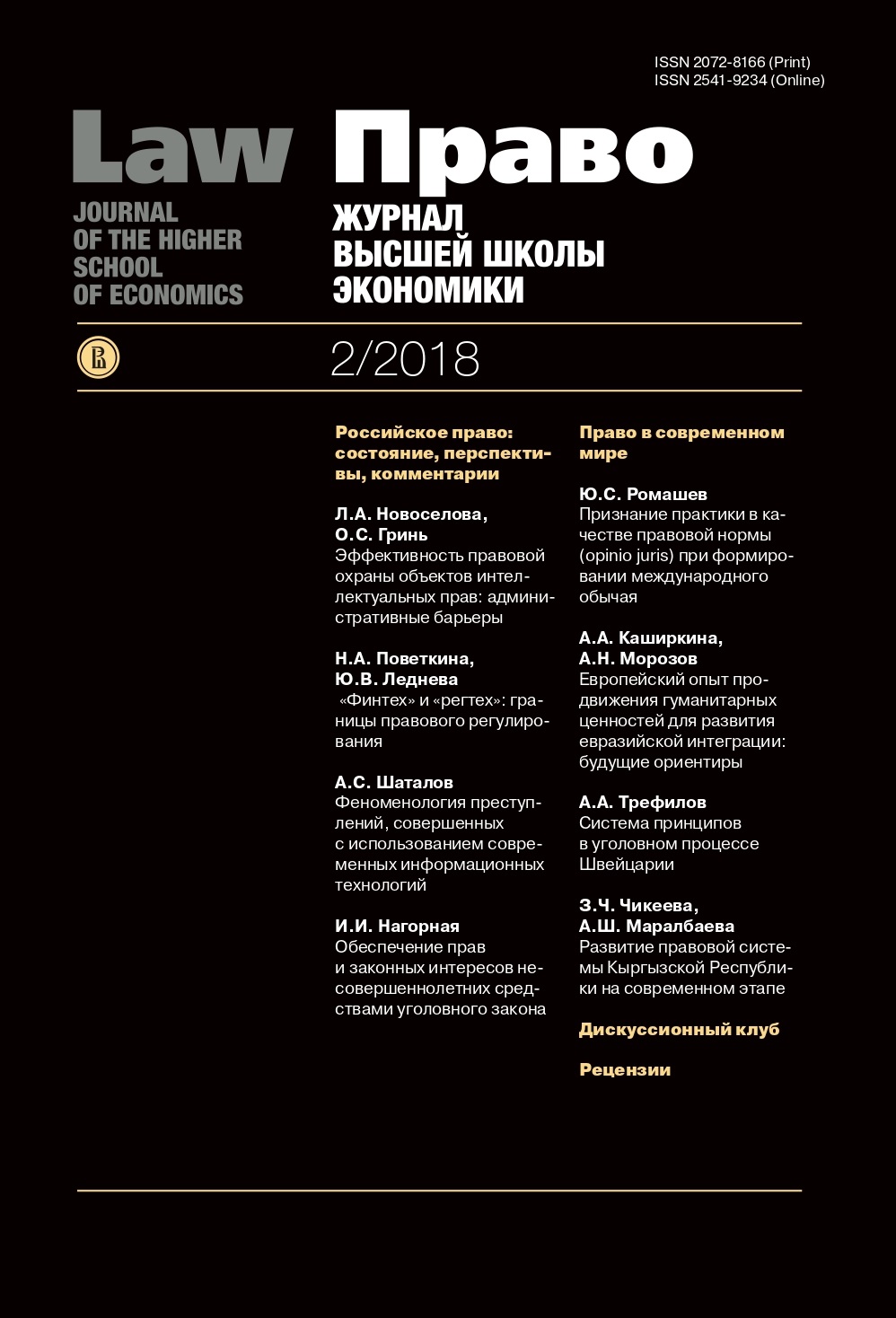
Система принципов в уголовном процессе Швейцарии
DOI:
https://doi.org/10.17323/2072-8166.2018.2.170.192Ключевые слова:
уголовный процесс, законность, уважение человеческого достоинства, презумпция невиновности, справедливость, гласность, принцип независимости, разумные сроки, принцип обвиненияАннотация
Принципы уголовного процесса представляют собой фундаментальные начала, отражающие его построение, структуру, сущность, движение дела по стадиям, систему уголовно-процессуальных функций и мер принуждения. В 2007 году в Швейцарии был принят исторически первый, единый Уголовно-процессуальный кодекс, который заменил 26 ранее действовавших кантональных уголовно-процессуальных кодекса. Работа над ним велась более 30 лет; его разработкой занимались как теоретики, так и практики, а также иностранные эксперты. В новом УПК Швейцарии отражены самые современные подходы ко многим институтам уголовного судопроизводства, в том числе к его основополагающим принципам, исследованию которых посвящена настоящая статья. Показано, что среди них имеются такие, которых российский УПК не выделяет: добросовестность, принцип обвинения, независимость органов уголовного судопроизводства, запрет повторного уголовного преследования и др. Вместе с тем в УПК Швейцарии не закреплены некоторые принципы, предусмотренные в российском уголовном процессе: неприкосновенность личности, охрана прав и свобод человека и гражданина, неприкосновенность жилища, тайна переписки, телефонных переговоров, почтовых, телеграфных и иных отправлений, состязательность, обеспечение права на защиту, право на обжалование процессуальных действий и решений. Автор анализирует закрепленные в УПК Швейцарии принципы законности, публичности, уважения человеческого достоинства и принцип справедливости, запрет злоупотребления правом, принцип независимости, требование ускорения, принцип обвинения, презумпцию невиновности, свободную оценку доказательств. Проанализированные принципы подтверждают ярко выраженный континентальный характер швейцарского уголовного судопроизводства. Многие из них обусловлены следственной максимой (необходимостью установления объективной истины), определяющей важнейшие функции суда, прокуратуры, полиции. Автор показывает, какие именно актуальные подходы и правовые принципы, нашедшие отражение в рассматриваемом кодексе, могут быть использованы российским законодателем при дальнейшем реформировании Уголовно-процессуального кодекса, а также при разработке концепции развития отечественного уголовного судопроизводства.
Библиографические ссылки
Aleksandrov A.S. (2012) Sostyazatel'nost' i ob’yektivnaya istina [Competitiveness and objective truth]. Biblioteka kriminalista, no 3, pp. 142-157.
Brester A.A. (2013) Nachalo ugolovnogo protsessa i yego vliyaniye na ugolovno-processual'nuyu formu [Basics of criminal proceedings and its impact on forms]. Tomsk: Izdatel'stvo nauchno-tekhnicheskoy literatury, 279 p. (in Russian)
Fayzrakhmanov N.F. (2015) Zloupotreblenie pravom uchastnikov ugolovnogo processa [Abuse of right by participants in criminal proceedings]. Bulletin of Kazan Law Institute of the Ministry of Internal, no 4, pp. 87-93.
Golovko L. et al. (2017) Kurs ugolovnogo processa [The course of criminal procedure]. Moscow: Statut, 1267 p. (in Russian)
Hartmann A., Schmidt H. (2008) Straftprozessrecht. Bremen: Bremen Verlag, 574 S.
Przevalskyi V.V. (1894) Obiedonemie uholovnogo zakonodatelstva v Schveycarii [Unification of criminal legislation in Switzerland]. Saint Petersburg: Wolf, 79 p. (in Russian)
Royer K. (1995) Schvetcarskyi federalnyi sud I nadzor za konstitutcionnostiu zakonov [The Swiss Federal Court and constitutional control over legality of laws]. Gosudarstvo i pravo, no 12, pp. 45-61.
Serebrennikova A.V. (2013) Ugolovnyi kodeks Avstrii [The Criminal Code of Austria]. Moscow: Max-Press, 188 p. (in Russian)
Serebrennikova A.V. (2001) Ugolovnyi kodeks Lictensteina [The Criminal Code of Lichtenstein]. Moscow: Zertsalo, 133 pp. (in Russian)
Serebrennikova A.V. (2002) Ugolovnyi kodeks Shveytzarii [The Criminal Code of Switzerland]. Saint Petersburg: Yuridicheskyi Center Press, 348 p. (in Russian)
Schweitzer R. (2004) Sudebnaya sistema federativnogo gosudarstva: vzglyad iz Schveycarii [Judicial system of federal state: a view from Switzerland]. Federalism: rossiyskoye I miezhdumarodnoye izmerenie. R.Hakimov, ed. Kazan: University press, pp. 1-231. (in Russian)
Smirnov G.K. (2012) Vosstanovlenie ob'ektivnoy istiny kak tceli dokazuvania v ugolovno-processualnom kodekse Rossii [Restoration in the Russian Code of Criminal Procedure the objective truth as the purpose of proof]. Ugolovnyi process, no 4, pp. 67-84.
Thommen M. (2010) Art. 3 / Niggli M., Heer M., Wiprächtiger H. Schweizerischen Strafprozessordnung. Jugendstrafprozessordnung. Basel: Basler, S. 33-50.
Ugolovnyi kodeks Germanii (2010) [The Criminal Code of Germany]. Moscow: Prospekt, 279 p. (in Russian)
Voenno-sudebmoe zakonodatelstvo zapadno-evropeyskih gosudarstv: Germania i Schweycaria (1901) [Military Judicial Legislation of the Western states: Germany and Switzerland]. Saint Petersburg: Typograsphia Generalnogo Shtaba, pp. 1-152 (in Russian)
Загрузки
Опубликован
Выпуск
Раздел
Лицензия
Copyright (c) 2018 Право. Журнал Высшей школы экономики

Это произведение доступно по лицензии Creative Commons «Attribution-ShareAlike» («Атрибуция — На тех же условиях») 4.0 Всемирная.