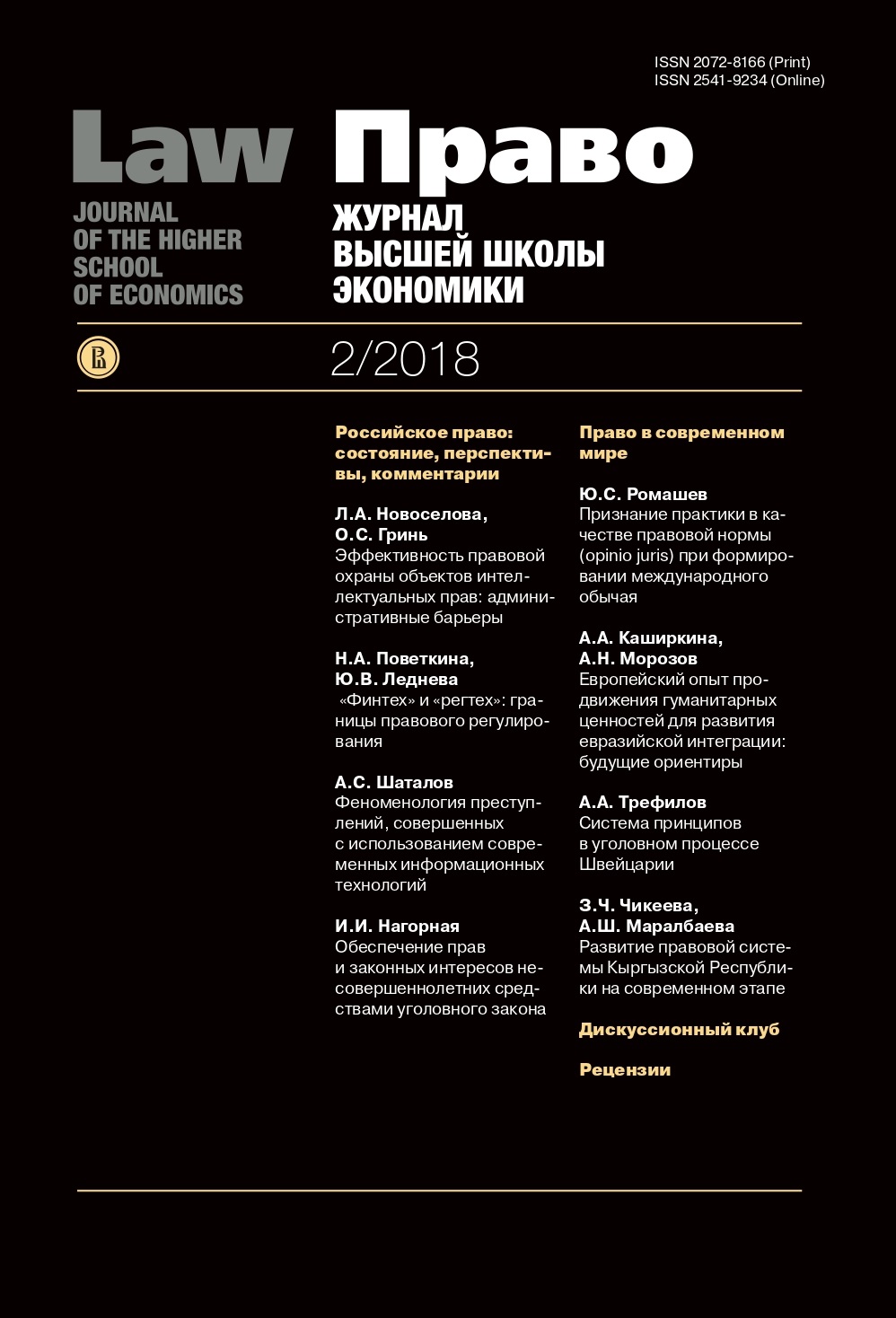
Признание практики в качестве правовой нормы (opinio juris) при формировании международного обычая
Аннотация
Одним из самых важных вопросов в праве международных обычаев является признание всеобщей практики в качестве правовой нормы (opinio juris). Отсутствие единого мнения по данному вопросу на международном уровне и общей позиции в науке приводит к низкой эффективности правового регулирования межгосударственных отношений. В научных трудах нередко используются не основанные на объективных реальностях подходы. Статья содержит отдельные важные теоретические положения и предложения по решению этой проблемы. Так, наличие opinio juris является неотъемлемым субъективным элементом обычной нормы международного права, как и практика, отвечающая необходимым требованиям обычного нормообразования. Субъектами признания могут быть государства и иные субъекты международного права, участвующие в международном нормообразовании. Такие действия могут проявляться в действиях государственных органов и их должностных лиц, которые в соответствии с международным правом и (или) законодательством государств могут выступать от их имени. Opinio juris со стороны государств, как правило, осуществляется в ходе становления всеобщей практики. Признание должно осуществляться правовыми способами и быть легитимным согласно законодательству государства, его международным обязательствам. К основным формам признания наряду с молчаливым согласием можно относить: одностороннее заявление главы государства (правительства), другого уполномоченного государством должностного лица, руководителя международной межправительственной организации, иного субъекта международного права; включение правила поведения в внутригосударственный нормативный правовой акт; включение правила поведения в международный договор или иной основанный на нем юридически обязательный международный нормативный правовой акт, принятый его участниками, если рассматривать эти документы как акты одностороннего признания; при определенных условиях — судебное решение в государстве. Основным условием общепризнанности нормы международного права является ее признание большинством государств (значение которого установлено и формально закреплено мировым сообществом), интересы которых в наибольшей мере затрагиваются применением этой нормы. Это требует правовой формализации и даже кодификации качественных и количественных критериев и соответствующих им показателей формирования обычной нормы международного права. Устранению разногласий в позициях субъектов международного права, выработке единого подхода к вопросу будет способствовать разработка и принятие универсальной конвенции о праве международных обычаев
Литература
Cheng B. (1983) Custom: The future of general state practice in a divided world. The structure and process of international law. The Hague: Kluwer, p. 531.
Chernichenko S.V. (2014) Kontury mezhdunarodnogo prava [The contours of international law]. Moscow: Nauchnaya Kniga, 592 p. (in Russian)
Dahlman C. (2012) The Function of Opinio Juris in Customary International Law. Nordic Journal of International Law, vol. 81, pp. 327-339.
Danilenko G.M. (1988) Obychay v sovremennom mezhdunarodnom prave [Custom in contemporary international law]. Moscow: Nauka, 192 p. (in Russian)
Elias O. (1995) The Nature of the Subjective Element in Customary International Law. International and Comparative Law Quarterly, vol. 44, pp. 501-520.
Il'inskaya O.I. (2012) Voprosy primeneniya mezhdunarodnykh obychno-pravovyh norm [Application of customary international law.]. Zhurnal rossiyskogo prava, no 11, pp. 114125.
Lukashuk I.I. (1997) Normy mejdunarodnogo prava v mejdunarodnoy normativnoy sisteme [Norms of international law in international normative System]. Moscow: Spark, 223 p. (in Russian)
Tunkin G.I. (ed.) (1994) Mezhdunarodnoe pravo [International law]. Moscow: Jurist, 512 p. (in Russian)
Henckaerts J.-M. et al. (2006) Obychnoe mezhdunarodnoe gumanitarnoe pravo [Customary international humanitarian law]. Moscow: Mezhdunarodny Komitet Krasnogo Kresta, 818 p. (in Russian)
Taki H. (2008) Opinio Juris and the Formation of Customary International Law: A Theoretical Analysis. German Yearbook of International Law, vol. 51, pp. 447-466.
Tolstykh V.L. (2017) O pravovoy prirode mezhdunarodnogo obychaya [Legal nature of international custom]. Evraziyskiy juridicheskiy zhurnal, no 7, pp. 17-20.
Tunkin G.I. (2000) Teoriya mezhdunarodnogo prava [Theory of international law]. Moscow: Zertsalo, 111 p. (in Russian)
Shammasova L.R. (2006) Mezhdunarodno-pravovoy obychay v sovremennom mezhdunarodnom prave: Diss. ... kand. yurid. nauk [International custom in contemporary international law (Candidate of Juridical Sciences Thesis)]. Moscow, 214 p.
Visscher de C. (1955) Coutume et traité en droit international public. Paris: Institut des haute études internationals, pp. 353-369.
Vylegzhanin A.N., Kalamkarjan R.A. (2013) Rol' mezhdunarodnogo obychaja v pravovom obespechenii politiki gosudarstva. Mezhdunarodnoe pravo i sovremennye teorii mezhdunarodnykh otnoshenii: aspekty sochetaemosti. [The role of international custom in the legal protection of state policy. International law and modern theories of international relations: compatibility aspects]. Moscow: MGIMO, pp. 38-56.
Copyright (c) 2018 Право. Журнал Высшей школы экономики

Это произведение доступно по лицензии Creative Commons «Attribution-ShareAlike» («Атрибуция — На тех же условиях») 4.0 Всемирная.