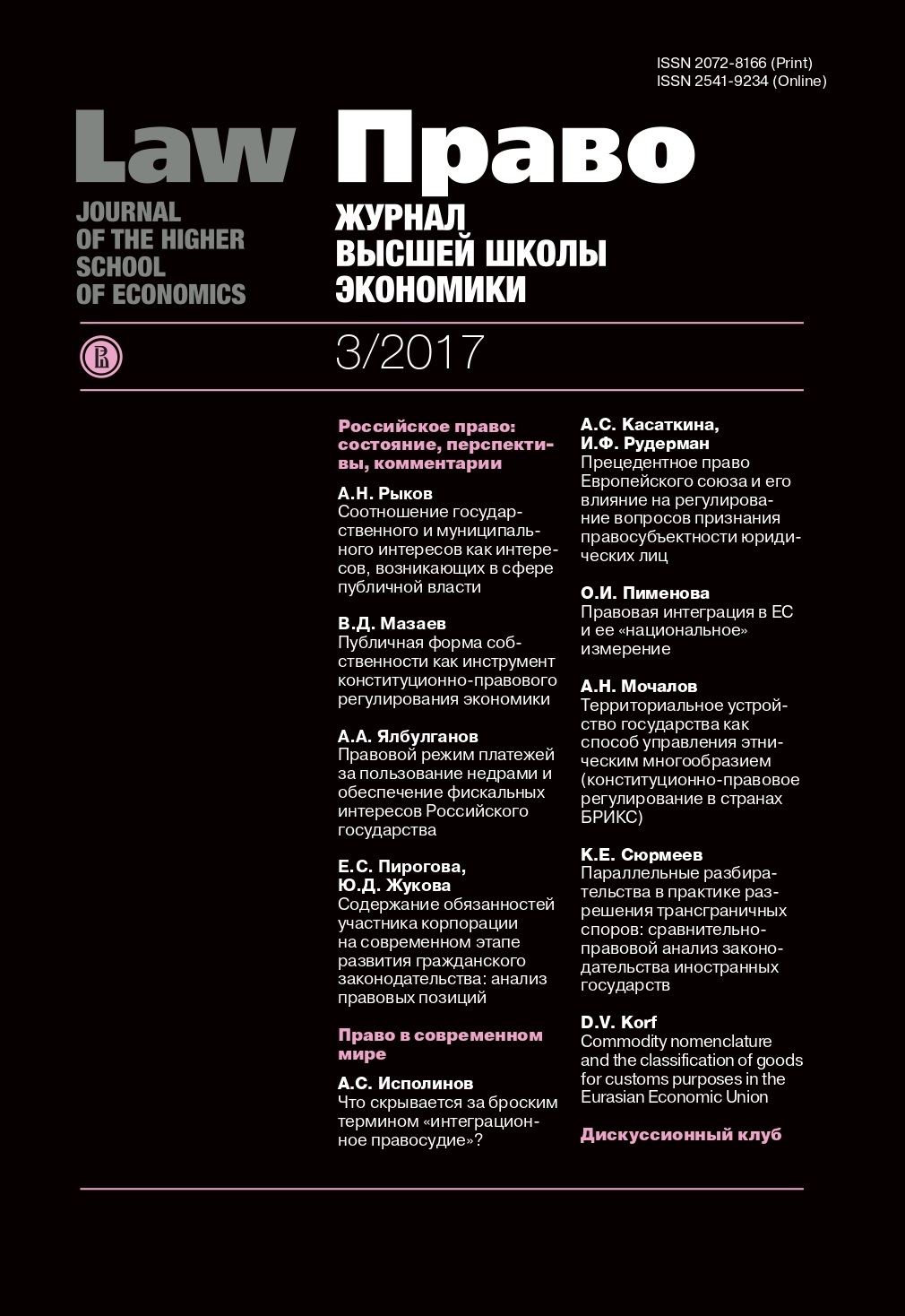
Territorial Structure of State as a Tool of Ethnic Diversity Management (Constitutional Law Regulation in the BRICS Countries)
Abstract
A large number of modern states are characterized by ethnic-territorial fractionalization. It means that separate regions of a state might be territories of concentration of ethnic groups which constitute a significant part or a local majority of population within these territories but have a position of national minorities within the state as a whole. The article discusses the ways in which the ethnic structure of population is reflected in constitutional-law regulation of territorial structure of a state. The comparative law analysis of the ‘ethnic' factor in the constitutional rulings concerning territorial structure is represented in the article. The author has studied constitutions of the BRICS countries (Brazil, Russia, India, China, and South Africa) to demonstrate that all these states despite of their geographical positions and historical backgrounds take into consideration ethnic-territorial fractionalization in organization of the territories and choice of an appropriate constitutional form of such structurization. In the article the distinctions between the approaches in different states are described and explained. In the author's opinion, a state territory serves as a tool of ethnic diversity management. A state's constitution can give a special legal status to a region inhabited by an ethnic minority and stipulate self-government (or self-administration) for such regions (so-called territorial accommodation of ethnic groups). Conversely, internal borders can be drawn in a manner to prevent domination of an ethnic minority in a region. Self-government, in turn, can be exercised within different constitutional-law frameworks such as federalism, territorial autonomy and creation of special territories under constitutional protection. The author shows different approaches and mechanisms implemented in the BRICS countries and concludes that a mechanism of territorial accommodation of an ethnic group in a particular case depends on political demands of the group with respect to ‘its' territory. At the same time, self-government of ‘ethnic' regions not always leads to deepening cleavages between ethnic groups. The opposite is true: it can contribute social integration.
References
Anderson L. (2013) Federal Solutions to Ethnic Problems. Abingdon: Routledge, 321 p.
Benedikter T. (2009) The World's Modern Autonomy Systems. Bozen/Bolzano: EURAC Research, 306 p.
Brand D. (2009) Asymmetry in Federal Systems — Constitutional Arrangements in South Africa. Palermo F., Zwilling C., Kossler K. (eds.) Asymmetries in Constitutional Law. Recent Developments in Federal and Regional Systems. Bozen/Bolzano: EURAC Research, pp. 117-131.
Burgess M. (2012) Multinational Federalism in Multinational Federations. Seymour M., Cagnon A.-G. (eds.) Multinational Federalism. London: Palgrave Macmillan, pp. 23-44.
Chertkov A.N. (2009) Territorial'noe ustroistvo Rossiiskoi Federatsii. Pravovye osnovy [Territorial Structure of the Russian Federation: The Legal Grounds]. Moscow: Kontrakt, 344 p. (in Russian)
Choudhry S. (2008) Bridging Comparative Politics and Comparative Constitutional Law: Constitutional Design in Divided Societies. Choudhry S. (ed.) Constitutional Design for Divided Societies: Integration or Accommodation? New York: Oxford University Press, pp. 3-40.
Dhar I. (2011) Assam through the Prism of Reorganisation Experience. Sarangi A., Pai S. (eds.) Interrogating Reorganisation of States. New Delhi: Routledge, p. 282-301.
Dobrynin N.M. (2005) Rossiiskii federalizm. Stanovlenie, sovremennoe sostoyanie i perspektivy [The Russian Federalism. The Origin, Current Situation, and Perspectives]. Novosibirsk: Nauka, 429 p. (in Russian).
Erk J., Anderson L. (eds.) (2010) The Paradox of Federalism: Does Self-Rule Accommodate of Exacerbate Ethnic Divisions? Abingdon: Routledge, 132 p.
Filippov V.R. (2003) Kritika etnicheskogo federalizma [The Critics of Ethnic Federalism]. Moscow: RAN, 379 p. (in Russian).
Gligich-Zolotareva M.V. (2006) Pravovye osnovy federalizma [The Legal Grounds of Federalism]. Moscow: Yurist, 422 p. (in Russian).
Haiting Z. (2012) The Laws about Ethnic Minority Autonomous Regions in China. Loyola University Chicago International Law Review, vol. 9, issue 2, pp. 249-264.
Howland D. (2011) The Dialectics of Chauvinism: Minority Nationalities and Territorial Sovereignty in Mao Zedong's New Democracy. Modern China, no 2, pp. 170-201.
Leksin I.V. (2014) Territorial'noe ustroistvo Rossii. Konstitutsionno-pravovye problemy [The Territorial Structure of Russia: Constitutional Problems]. Moscow: Lenand, 432 p. (in Russian)
McGarry J., O'Leary B. (2007) Federation and Managing Nations. Burgess M., Pinder J. (eds.) Multinational Federations. Abingdon: Routledge, pp. 180-211.
McGarry J., O'Leary B., Simeon R. (2008) Integration or Accommodation? The Enduring Debate in Conflict Regulation // Choudhry S. (ed.) Constitutional Design for Divided Societies: Integration or Accommodation? New York: Oxford University Press, pp. 41-88.
Murray C., Simeon R. (2008) Recognition without Empowerment: Minorities in a Democratic South Africa // Constitutional Design for Divided Societies: Integration or Accommodation? pp. 409-437.
Oliveira Neves L. (2007) The Struggle for Land Demarcation by the Indigenous Peoples of Brazil. Sousa S. (ed.) Another Knowledge Is Possible: Beyond Northern Epistemologies. London: Verso, pp. 105-119.
Pinder J. (2007) Introduction. Burgess M., Pinder J. (eds.) Multinational Federations. Abingdon: Routledge, pp. 1-16.
Sonoda J. (ed.) (2016) Indigenous Rights in South America: FPIC and Other Key Issues for Natural Resource Development. New Westminster (B.C.): Rocky Mountain Mineral Law Foundation, 252 p.
Souza S. (2002) Brazil: The Prospects of a Center-Constraining Federation in a Fragmented Polity. Publius: The Journal of Federalism, vol. 32, no 2, pp. 23-48.
Watts R. (2008) Comparing Federal Systems. Montreal-Kingston: Queen's University Press, 206 p.
Copyright (c) 2017 Law. Journal of the Higher School of Economics

This work is licensed under a Creative Commons Attribution-ShareAlike 4.0 International License.