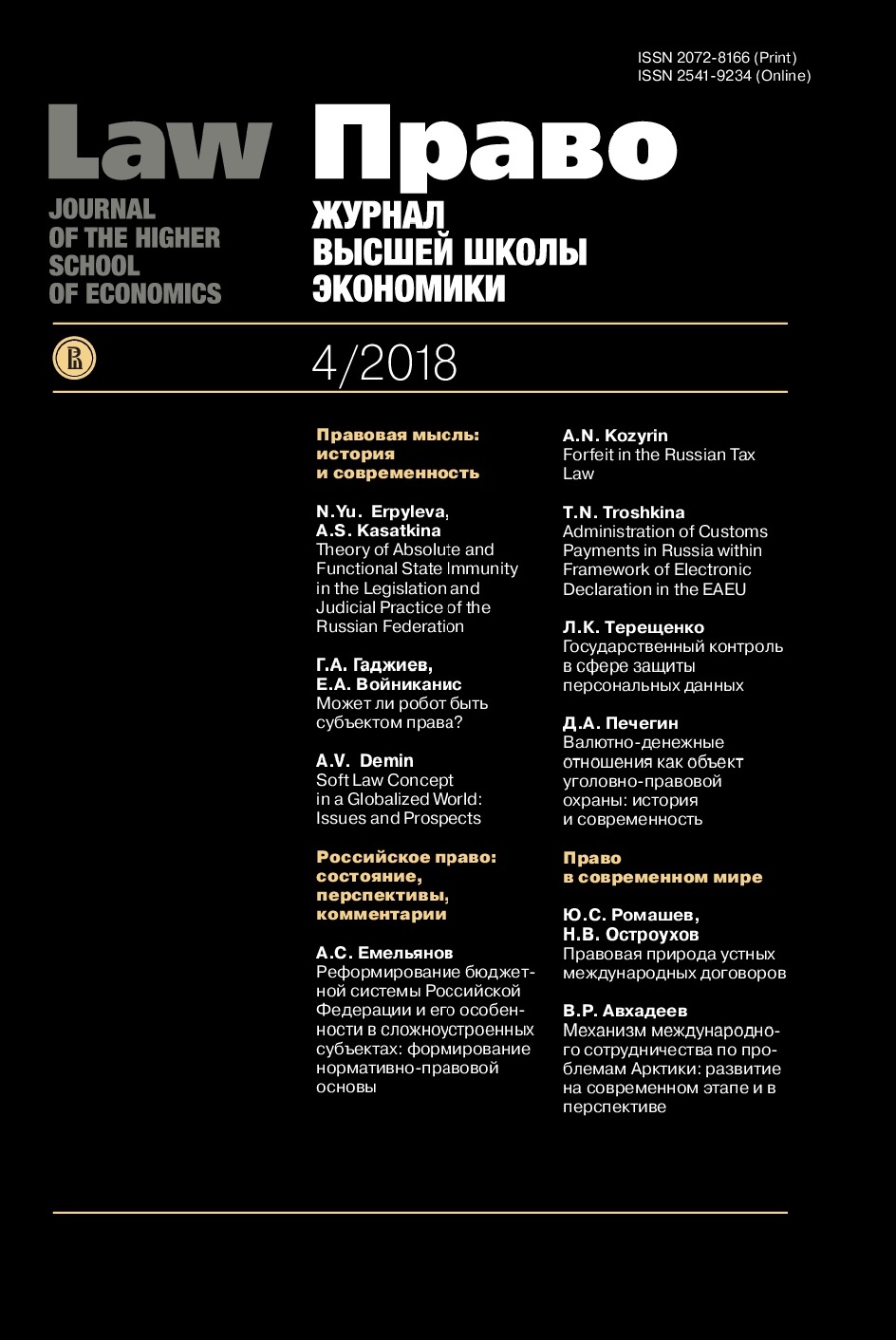
Forfeit in the Russian Tax Law
Аннотация
This article examines one of the issues of the Russian tax law, namely, the issue of accurate definition of forfeit under the legislation on taxes and charges. The paper analyses the change in the legal nature of forfeit under the Russian tax legislation, from the measure of responsibility for violation of tax legislation in the 1990s to the means of securing discharge of tax duty (with the entry into force of the Tax Code of the Russian Federation in 1999). The research identifies the reasons of the alteration of the forfeit definition under Russian tax law and assesses their consequences for maintaining the balance of public and private interests in tax law. In accordance with current tax legislation the forfeit is charged with the goal of securing the performance of tax duty, which it (the forfeit) cannot fulfill due to the lack of appropriate material resources. Unlike bank guarantee, a suretyship and pledge of property, the forfeit does not guarantee compensation of the potential amount of the tax arrears, and as defined by the Constitutional Court of Russia, the forfeit is a restorative measure of a compulsory nature, which compensates to the budget system of the Russia untimely and incomplete payment of taxes. With the change in approaches to the definition of forfeit in tax law, there is a situation where three branches of legislation — tax, budget and customs — provide different definitions of forfeit. Obviously, this circumstance in Russian legislation cannot be considered satisfactory. The article addresses matters related to the novel legislations, which amended the rules of calculation of forfeit for the taxpayers — organizations and individuals. The new rules for calculation of forfeit for tax arrears created by the organizations are aimed at making the long delay with the payment of taxes as unfavorable as possible. The changes that took place in 2017 in the system of public finance management in Russia and the establishment of a single fiscal channel that combined taxes, customs payments and insurance contributions make it necessary to take a fresh look at the relationship between the institute of securing the performance of tax duty and the institute of securing payment of customs duties and taxes in accordance with the customs legislation of the EAEU. On the base of a comparative method, author compares the means of securing payment of customs duties and approaches on defining the forfeit charged for untimely payment of customs duties and taxes in all EAEU member states. The research formulates proposals on improving legislation regarding tax relations for the computation and payment of forfeit.
Литература
Batalova L. (2010) Primemenie grazhdansko-pravovykh kategorii v nalogooblozhenii [Using the civil law concept in tax legislaton]. Korporativnyiyurist, no 12, pp. 23-25.
Bogdanovskaya G.N. (2009) Mezhotraslevaya adaptatsiya chastnopravovykh konstruktsiyi [Inter-branch adaptation of private law constructions]. Vestnik Vysshego arbitrazhnogo suda, no 6, pp. 48-56.
Demin A.V. (2010) Obshchaya teoria nalogovo-pravovykh norm [General theory of tax norms]. Moscow: INFRA-M, 266 p. (in Russian)
Grosclaude J., Marchessou P. (2007). Droit fiscal général. Paris: Dalloz, 608 p.
Lukyanova A.P. (2015) Penya v nalogovom zakonodatelstve Rossiyskoy Federatsii i zarubezhnykh stran [Forfeit in tax legislation in Russia and foreign countries]. Publichno-pravovye issledovania: elektronny zhurnal, no. 3, pp. 142-155.
Nalogovoe pravo stran vostochnoy Evropy. obshchaya chast (2009) [Tax law of the Eastern European countries: General part]. M.V. Caraseva (ed.) Moscow: Wolters Kluver, 336 p. (in Russian)
Ovsyannikov S.V. (2009) Formy i predely vzaimodeystvia grazhdanskogo i nalogovogo prava [Forms and limits of interaction between tax law and civil law]. Vestnik VAS RF, no 1, pp. 83-100.
Ryabov A.A. (2014) Vliyanie grazhdanskogo prava na nalogovye otnoshenia: doktrina, tolkovane, praktika [The influence of civil law on tax relations: doctrine, interpretation, practice]. Moscow: NORMA, 224 p. (in Russian)
Sadikov O.N. (2011) Grazhdansko-pravovye kategorii v publichnom prave [Civil law conceptions in public law]. Zhurnal rossiyskogo prava, no 9, pp. 19-28.
Smolitskaya E.E. (2018) Grazhdansko-pravovye instituty, terminy i ponyatia v nalogovom prave [Civil law institutes, terms and notions in the tax law]. Moscow: Prospect, 176 p. (in Russian)
Soloviev V.A. (2007) Penya v nalogovom zakonodatelstve [Forfeit in tax law] Zakony Rossii: opyt, analiz, practica, no. 12, pp. 10-16.
Strelnikov V.V. (2003) Pravovoy rezhim peni v nalogovom prave [Legal regime of the forfeit in the tax law]. Moscow: Statut, 155 p. (in Russian)
Thuronyi V. (2003) Comparative Tax Law. Deventer: Kluwer Law International, 373 p.
Volkova N.N. (2010) Retseptsia grazhdansko-pravovykh norm v nalogovom zakonodatelstve [Reception of civil-law norms n tax legislation]. Moscow: Yurlitinform, 160 p. (in Russian)
Vorobyeva E.M. (2013) Peni v nalogovykh otnosheniyakh: doktrina i zakonodatelnoe regulirovanie [Forfeit n tax relations: doctrne and legal regulation]. Vestnik Permskogo universiteta: yuridicheskie nauki, no. 4, pp. 68-81.
Yakovlev V.F. (2006) Grazhdansko-pravovoy metod regulirovania obshchestvennykh otnosheniy [Civil legal method of the regulation of social relations]. Moscow: Statut, 240 p. (in Russian)
Copyright (c) 2018 Право. Журнал Высшей школы экономики

Это произведение доступно по лицензии Creative Commons «Attribution-ShareAlike» («Атрибуция — На тех же условиях») 4.0 Всемирная.