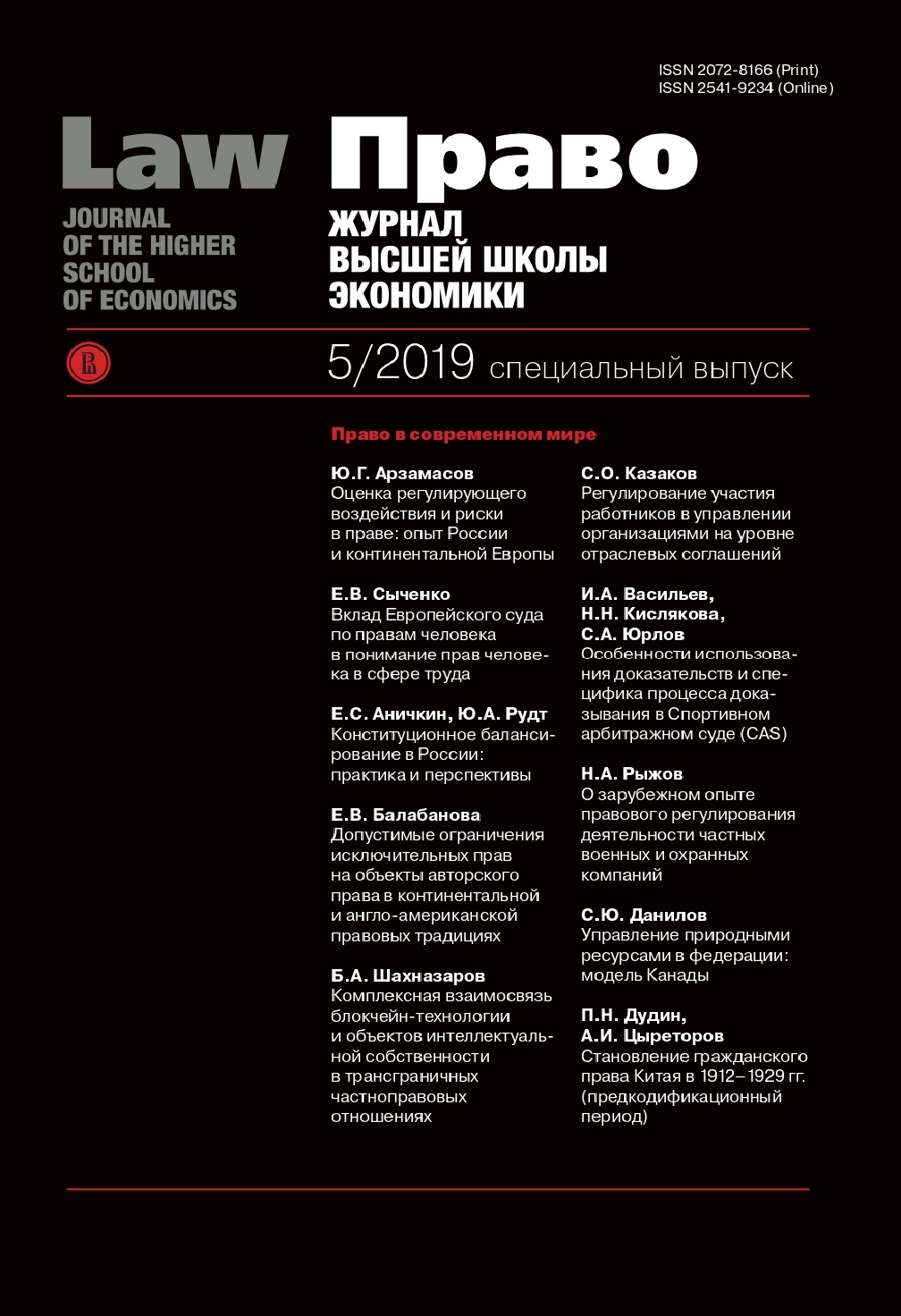
Оценка регулирующего воздействия и риски в праве: опыт России и континентальной Европы
Аннотация
В статье исследован опыт внедрения и проведения оценки регулирующего воздействия (ОРВ) в современной России. Вскрыты причины популярности ОРВ и причины ее внедрения в нормотворческую деятельность. Отмечено, что главными факторами столь активного введения института ОРВ в России является низкое качество нормативных правовых актов и политика бережного расходования средств как федерального, так и региональных бюджетов. Осуществлен критический анализ заключений ОРВ, сделанных Минэкономразвития России и региональным министерством с позиции выявления правовых рисков. Сделан вывод, что в современной России начинает уже просматриваться тенденция повышения не только законодательной культуры, но и правовой культуры социума, поскольку в проведении публичных консультаций при осуществлении ОРВ принимают участие различные институты гражданского общества. Исследованы понятие, виды, причины генезиса правовых рисков. Предложено авторское понятие правовых рисков. Определена роль правового моделирования в выявлении правовых рисков и предложено авторское понятие модели правового регулирования. Изучен опыт выявления правовых рисков посредством ОРВ в ЕС и таких странах континентальной Европы, как ФРГ, Франция и Италия. Сделан вывод, что наметилась тенденция сближения целей проведения ОРВ, поскольку многие государства континентальной Европы в национальном законодательстве закрепляют определение социальных и экологических последствий при перспективной оценке проектов нормативных правовых актов. Отмечено, что в современной России наметилась тенденция, направленная на выявление социальных рисков при осуществлении ОРВ, однако к решению данной проблемы следует подходить комплексно, выявляя не только правовые риски, направленные на ограничение социальных прав, но и криминологические риски, что является более значимым на современном этапе развития социума. Обосновано предложение об изменении подходов к оцениванию законодательства, применяемых в России, предложено включить финансово-экономическое обоснование в структуру ОРВ. Также предложено проводить ОРВ всех без исключения проектов нормативных правовых актов и государственных программ.
Литература
Analysis of Corruption in Legislation: Memo to Expert (2004) V. Yuzakov, ed. Moscow: Statute, 64 p. (in Russian)
Arkhipov D.A. (2012) Distribution of contractual risks in civil law. Economic and legal study. Moscow: Statute, 112 p. (in Russian)
Babaev M.M. (2018) Risks as a component of crime determination complex. Vestnik Nizhegorodsckoi akademii MVD, no 1, pp. 104-110 (in Russian)
Bezrukov A.S. (2008) Legal model as a tool of legal science and practice. Candidate of Juridical Sciences Thesis. Vladimir, 151 p. (in Russian)
Belyaev A.N., Derman D.O., Tsygankov D.B. (2011) Methodical approaches to the metaevaluation of the quality of opinions on regulatory impact assessment. Proiektirovanie, monitoring i otsenka, no 1, p. 24 (in Russian)
Böhret C., Konzendorf G. Handbuch Gesetzesfolgenabschätzung (GFA). Gesetze, Verordnungen, Verwaltungsvorschriften Taschenbuch 2001. Baden-Baden: Nomos, 355 S. (in German)
Cherdantsev A.F. (2012) Logical and linguistic phenomena in jurisprudence. Moscow: Norma, 320 p. (in Russian)
Didikin A.B. (2018) Introduction. Regulatory Impact Assessment and Norms-Norms: collection of articles. Ekaterinburg: Solution, 50 p. (in Russian)
Eltsov V.N. (2009) Legal experiment in modern Russia: problems of efficiency. Candidate of Juridical Sciences Thesis. Tambov, 163 p. (in Russian)
Golodnikova A.E., Tsygankov D.B. (2018) “Targeting” of the regulatory impact assessment: international approaches and Russian practice. Voprosy gosudarstvennogo i municipalnogo upravlenia, no 4, p. 40 (in Russian)
Golodnikova A.E., Efremov A.A. et al (2018) Regulatory policy in Russia: main trends and architecture of the future. Moscow: Center for Strategic Research, 192 p. (in Russian)
Ivanov A.Yu., Bashkatov M.L. et al (2017) Blocky at the peak of HYIP: legal risks and opportunities. Moscow: HSE Publishers, 237 p. (in Russian)
Karpen U. (2008) Gesetzgebundlehre-neuevaluirt. Baden-Baden. p. 255. (in German)
Knight F. (2003) Risk, uncertainty and profit. Moscow: Delo, 360 p. (in Russian)
Krysin L.P. (2011) Illustrated Dictionary of Foreign Words. Moscow: Eksmo, 864 p. (in Russian)
Kryuchkov R.A. (2015) Legal risk management: the concept and essence of the phenomenon. Vestnik KSU, no 6, pp. 153-156 (in Russian)
Lukyanova Ye. A. (2015) Constitutional risks. Moscow: Kuchkovo Pole, 448 p. (in Russian)
Kuzmin A., Tsygankov D. B. (2014) Emerging field of evaluation and the growth of the evaluation profession: the Russian experience. Canadian Journal of Program Evaluation, no 3, pp. 87-101 (in English)
Mader L. (2002) Assessment of legislation — a contribution to improving the quality of laws. Evaluation of laws and the efficiency of their adoption. Papers of the international seminar. Moscow: State Duma Press, 152 p. (in Russian)
Mamay E.A. (2012) Efficiency of law enforcement procedures (theory, practice, technology). Moscow: Yurlitinform, 224 p. (in Russian)
Mamchun V.V. (2016) Risk Culture in Legal Activities. Yuridicheskaya tekhnika, no 10, pp. 400-406 (in Russian)
Martirosyan A.G. (2009) The issue of risk in civil law of the Russian Federation. Sovremennoye pravo, no 9, p. 64 (in Russian)
Oygenzikht V.A. (1972) The risk in civil law. Dushanbe: Irfon, p. 225 (in Russian)
Ozhegov S.I. (1978) Dictionary of Russian language. Moscow: Russian Language Press, 846 p. (in Russian)
Pashkov A.S., Yavich L.S. (1970) The effectiveness of the law. Sovetskoye gosudarstvo i pravo, no 3, p. 41 (in Russian)
Pletnikov V.S. (2016) Concept and types of models in modern domestic jurisprudence: theoretical legal study. Yearbook of Institute of Physics and Ural Studies, issue 2, pp. 121-135 (in Russian)
Rogacheva O.S. (2011) Efficiency of the rules of administrative and tort law. Voronezh: University, 356 p. (in Russian)
Salygin E.N. (2013) Modeling in law: issues and prospects. Pravo. Zhurnal Vysshey shkoly economiki, no 3, pp. 13-35 (in Russian)
Sidorenko E.L. (2017) Criminological risks of cryptocurrency turnover. Ekonomika, nalogi, pravo, no 6, p. 154 (in Russian)
Shahbazyan A.A. (2011) Concept and significance of legal risks in civil law and ways to minimize them. Rossiyskiy yuridicheskiy zhurnal, no 5, pp. 128-136 (in Russian)
Tikhomirov Yu.A., Lapina M.A. et al (2014) The risk in the field of public and private law. Moscow: Ot i do press, 310 p. (in Russian)
Tikhomirov Yu. A. (2010) Legal regulation: theory and practice. Moscow: Formula law, 400 p. (in Russian)
Voronin V.N. (2018) Criminal law risks of digital technology development: problem statement and methods of research. Bulletin of Kutafin University, no 12, pp. 73-80 (in Russian)
Zakharova M.V. (2017) French legal system: theoretical analysis. Moscow: Prospect, 284 p. (in Russian)
Copyright (c) 2019 Право. Журнал Высшей школы экономики

Это произведение доступно по лицензии Creative Commons «Attribution-ShareAlike» («Атрибуция — На тех же условиях») 4.0 Всемирная.