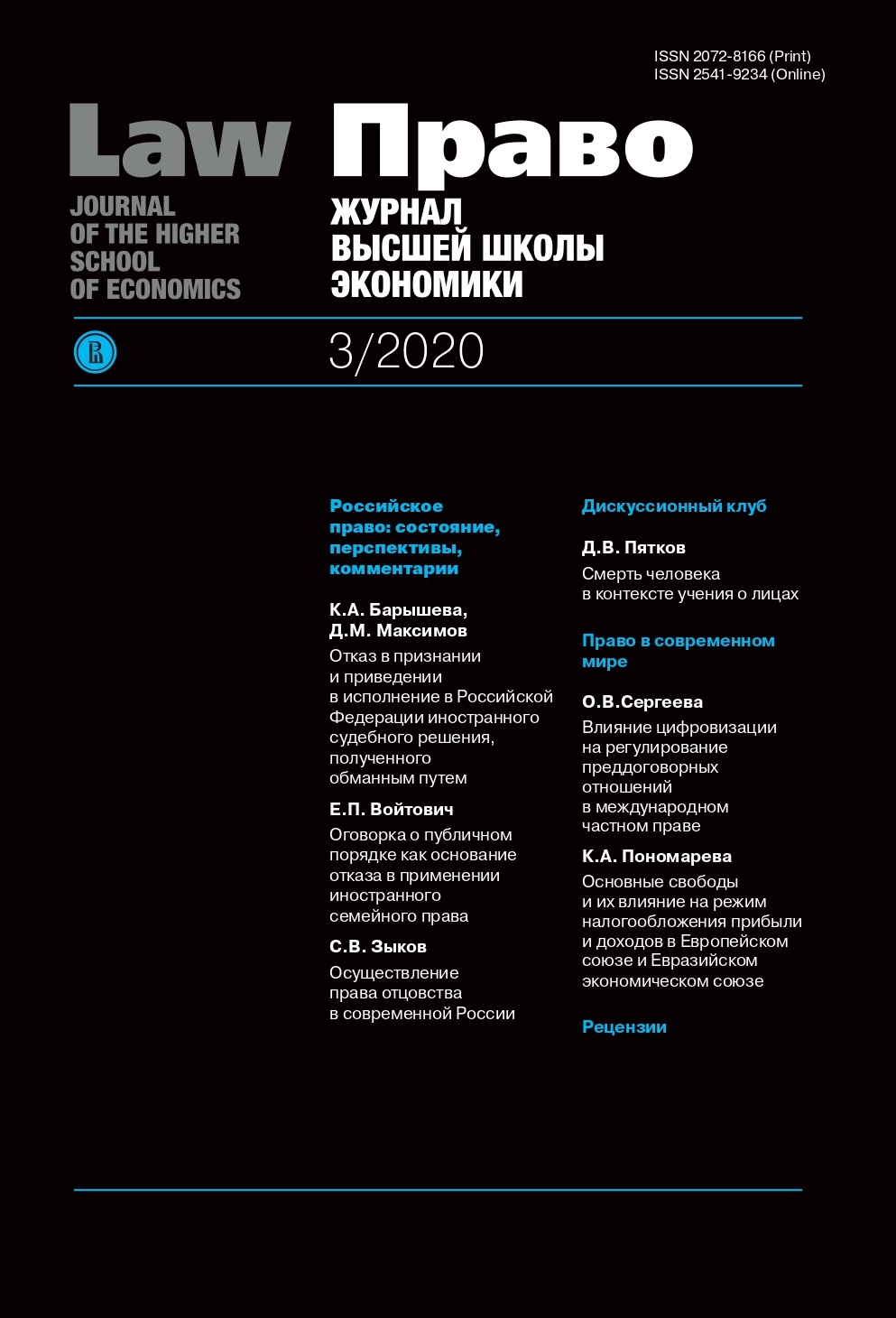
Отказ в признании и исполнении в Российской Федерации иностранного судебного решения, полученного обманным путем
Аннотация
В июле 2019 года в международном частном праве произошло знаковое событие, связанное с утверждением окончательного текста Конвенции о признании и приведении в исполнение иностранных судебных решений по гражданским или торговым делам. Уже более 10 лет Гаагская конференция по международному частному праву не представляла новых конвенций. Россия активно участвовала в завершающих процедурах и направила правительственную делегацию на 22-ю дипломатическую сессию Гаагской конференции по международного частному праву для подписания завершающего акта сессии. Перспективы подписания и ратификации Конвенции ключевыми участниками международной торговли пока являются вопросами будущего. В статье дан анализ положений Конвенции и возможности имплементации норм международного права в национальное законодательство. В российском праве отсутствует эффективная система распознавания и противодействия обману суда со стороны участвующих в гражданском или арбитражном процессе лиц. Термин «fraud», используемый в Конвенции, не имеет аналогов в российском законодательстве и правоприменительной практике, если мошеннические действия стороны процесса привели к неправильному судебному решению, которое вступило в силу. Отмена или пересмотр такого судебного решения практически невозможны. Особенно болезненно проявляется данный недостаток российского права в отношении признания иностранных судебных решений, полученных обманным путем. Вакуум правового регулирования возникнет в случае присоединения России к Конвенции, которая признает возможность такого порока судебного решения, но у российского суда нет возможности идентификации порочных судебных решений. Это ставит под сомнение всю процедуру и результат признания и приведения в исполнение иностранных судебных решений в России. В данной статье авторы ставят перед читателями базовые вопросы, связанные с окончательностью судебных решений и возможностями их пересмотра в будущем, указывают на неготовность российского права к участию в Конвенции и на важность данного института Конвенции об обманных решениях, на недопустимость оговорки при принятии государствами Конвенции в этой части.
Литература
Brand R. (2013) Federal Judicial Center International Litigation Guide: Recognition and Enforcement of Foreign Judgments. University of Pittsburgh Law Review, vol. 74, pp. 494-549.
Branovitsky K.L., Alenkina N.B. (2018) Legal regime of recognition and enforcement of foreign court decisions in the Eurasian economic Union. Vestnik grazhdanskogo protcessa, no 6, pp. 168-192 (in Russian)
Dikarev I. S. (2012) Implementation of the principle of presumption of innocence in the review of legal decisions entered into force in the criminal process. Vestnik Volzhskogo universiteta. Jurisprudencia, no 1, pp. 110-114 (in Russian)
Fellmeth A., Horwitz M. (2009) Guide to Latin in International Law. Oxford: University Press, 298 p.
Haines A. (2002) Why is it so difficult to construct an international legal framework for e-commerce? The Draft Hague Convention on Jurisdiction and the Recognition and Enforcement of Foreign Judgments in Civil and Commercial Matters: A Case Study. European Business Organization Law Review, issue 1, pp. 157-194.
Ignatieva Yu. A. (2017) Recognition and enforcement of decisions of foreign state courts in Russia: normative grounds and law enforcement. Problemy sovremennoi nauki i obrazovania, no 14, pp. 65-71 (in Russian)
Kulikova D.S. (2014) Concepts of recognition and enforcement of judgments in foreign countries. Vestnik rossiyskogo humanitarnogo universiteta, no 9, pp. 145-152 (in Russian)
Paul S. (2014) Courts on Courts: contracting for engagement and indifference in international judicial encounters. Virginia Law Review, no 1, pp. 17-109.
Petrov S.A. (2013) Deception of the court as a method of fraud. Ugolovnoe pravo, no 6, pp. 40-43 (in Russian)
Sheeley A. (2019) Supreme Court judgment offers reassurance to fraud victims. Out-Law News. Available at: https://www.pinsentmasons.com/out-law/news/supreme-court-judgment-reassurance-to-fraud-victims (accessed: 23.12.2019)
Smolin S.V. (2015) Deception of the court: a method of fraud or a crime against justice. Ugolovnoe pravo, no 1, pp. 91-95 (in Russian)
Sviridov M.K. (2012) Ensuring stability of the sentence. Vestnik Tomskogo universiteta, no 3, pp. 139-142 (in Russian)
Sycheva O.N. (2008) Presumption of the truth of the sentence in the modern criminal process. Candidate of Juridical Sciences Thesis. Nizhny Novgorod, 2008. 182 p. (in Russian)
Terekhov V.V. (2014) Concept and content of the category “res judicata” in the Russian and foreign civil process. Rossiyskyi yuridicheskyi zhurnal, no 5, pp. 203-209 (in Russian)
Zvonova E.A. (2019) Features of interaction of the Russian and European financial market. Economica, nalogi, pravo, no 3, pp. 134-143 (in Russian)
Copyright (c) 2020 Право. Журнал Высшей школы экономики

Это произведение доступно по лицензии Creative Commons «Attribution-ShareAlike» («Атрибуция — На тех же условиях») 4.0 Всемирная.