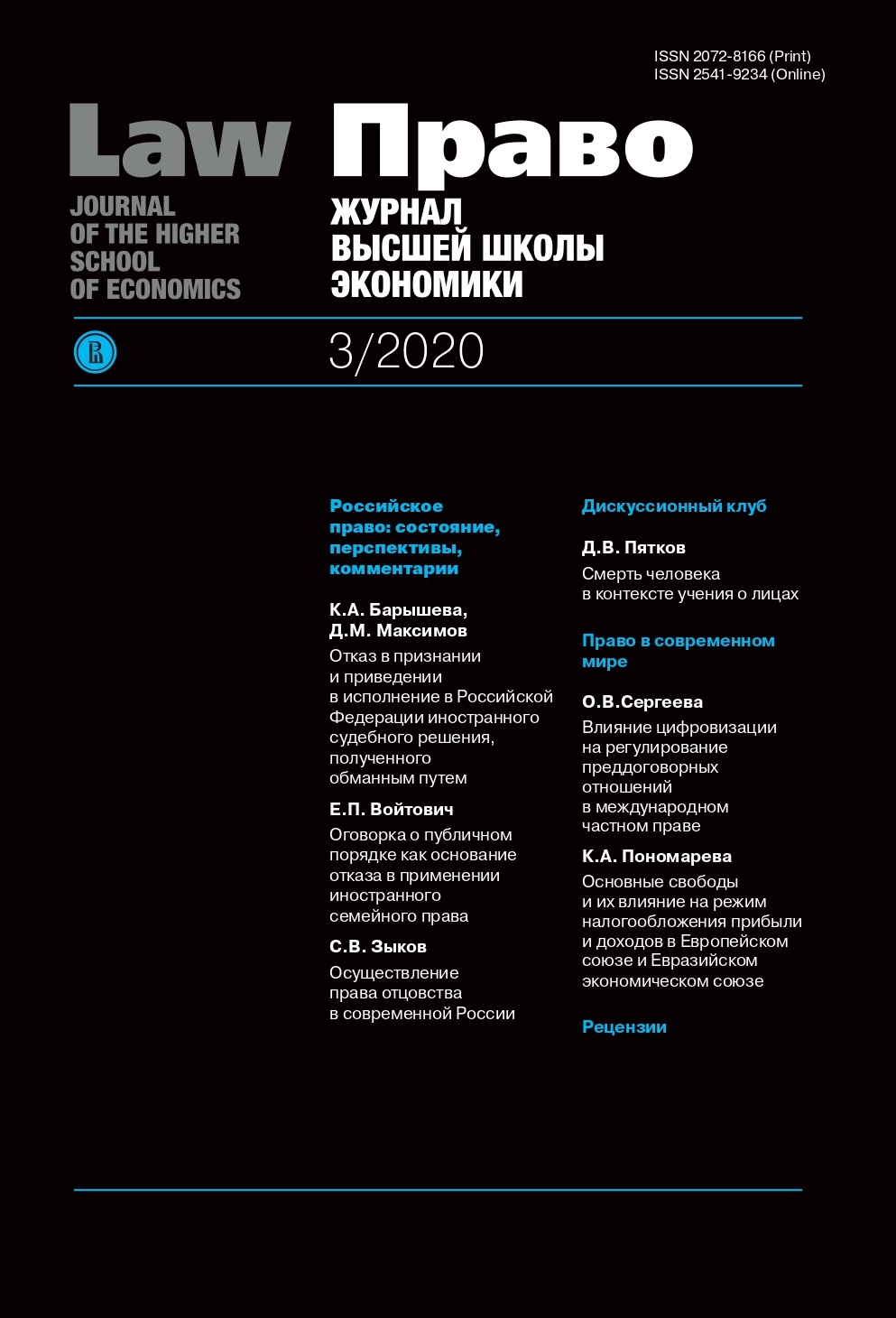
Влияние цифровизации на регулирование преддоговорных отношений в международном частном праве
Аннотация
Цифровизация общественной жизни оказала качественное влияние на установление трансграничных договорных связей, с одной стороны, упростив процесс взаимодействия потенциальных контрагентов, с другой — поставив вопрос о пригодности традиционных инструментов в качестве основы регламентации трансграничных отношений, осложненных «цифровым элементом». В статье анализируются основные изменения, которые внесла цифровизация в порядок заключения трансграничных контрактов. Подробно исследуются способы заключения онлайн-контрактов различными методами; дается оценка соответствия указанных способов заключения онлайн-контрактов требованиям актов Европейского союза в сфере электронной коммерции и защиты прав потребителей; исследуются подходы, воспринятые судебной практикой США. В статье поднимаются вопросы о предмете пользовательского соглашения и моменте его вступления в силу; проводится различие между практикой заключения традиционных и онлайн-контрактов на аукционах и электронных площадках в аспекте квалификации действия потенциального контрагента как направившего оферту или лишь сделавшего приглашение к оферте; уделяется внимание проблеме действительности онлайн-контрактов, заключенных несовершеннолетними, и практике применения «доктрины младенчества». Делается вывод о появлении в условиях цифровизации нового инструмента регулирования трансграничных преддоговорных и договорных отношений — пользовательского соглашения. Действие пользовательского соглашения не ограничивается посетителями сайта, принявшими его условия, но в части правил использования веб-сайта распространяется на всех пользователей. «Доктрина младенчества» в целях признания онлайн-контракта недействительным может не приниматься судом во внимание, если преимуществом договора воспользовался несовершеннолетний. На практике владельцы агрегатора, действуя в рамках национального и международного права, опираясь на принцип диспозитивности и пользуясь автономией воли, диктуют потенциальным участникам онлайн-сделок свои правила заключения и исполнения контрактов, по сути устанавливая особый торговый режим. Пользовательское соглашение в этом случае — зачастую массив документов, имеющих сложную архитектуру и регулирующих различные аспекты отношений между оператором веб-сайта, предоставляющим доступ к нему, и пользователями, по вопросам использования сервисов сайта, заказа услуг и товаров.
Литература
Al-Bayati M. (2014) Reform of the Iraqi Private International Law on Transnational Online Contracting: Lessons from the EU and the USA. PhD thesis. Bangor University, 300 p.
Belli V.B. (2012) ECJ Rules that Information Provided via Website or Hyperlink Does Not Meet Requirements of Consumer Distance Contracts. Mondaq, 6 August. Available at: http://www.mondaq.com/x/190226/Consumer+Law/Van+Bael+ (accessed: 25.02.2019)
Cavna M. (2013) “Nobody knows you're a dog”: As Iconic Internet Cartoon Turns 20, Creator Peter Steiner Knows the Joke Rings as Relevant As Ever. Available at: http://www.washingtonpost.com/blogs/comic-riffs/post/nobody-knows-youre-a-dog-as-iconic-internet-cartoon-turns-20-creator-peter-steiner-knows-the-joke-rings-as-relevant-as-ever/2013/07/31/73372600-f98d-11e2-8e84-c56731a202fb_blog.htm (accessed: 25.02.2019)
Daniel J. (2007) Virtually Mature: Examining the Policy of Minors' Incapacity to Contract Through the Cyberscope. Gonz. Law Review, vol. 43, pp. 240-269.
Farnsworth E. (2004) Contracts. New York: Aspen, 2004. 940 p.
Hayes D. (1997) The Enforceability of Shrink-wrap License Agreements On-Line and Off-Line. Fenwick & West LLP. Available at: http://euro.ecom.cmu.edu/program/law/08-732/Transactions/ShrinkwrapFenwick.pdf (accessed: 25.02.2019)
Hill J. (2008) Cross-Border Consumer Contracts. Oxford: University Press, 466 p.
Kanashevskiy V.A. (2016) Conflicts-of-law regulation of contracts with participation of consumers. Mezhdunarodnoe publichnoe i chastnoe pravo, no 4, pp. 22-25 (in Russian)
Little L. (2012) Internet Choice of Law Governance. Temple University Legal Studies Research Paper Series, no 20, pp. 1-24.
Mann R., Siebeneicher T. (2008) Just One Click: The Reality of Internet Retail Contracting. Columbia Law Review, no 4, pp. 984-1012.
Mazhorina M.V. (2018) Private International Law in Context of Globalization: from Privatization to Fragmentation. Pravo. Zhurnal Vysshey shkoly ekonomiki, no 1, pp. 193-217 (in Russian)
Melnik T. (2008) Can We Dicker Online or is Traditional Contract Formation Really Dying — Rethinking Traditional Contract Formation for the World Wide Web. Michigan Telecommunications and Technology Law Review, issue 1, pp. 315-333.
Micklitz H-W., Stuyck J., Terryn E., Droshout D. (2010) Cases, Materials and Text on Consumer Law. Oxford: Hart, 598 p.
Moringiello J., Reynolds W. (2013) From Lord Coke to Internet Privacy: The Past, Present, and Future of the Law of Electronic Contracting. Maryland Law Review, issue 2, pp. 452-500.
Preston C., Crowther B. (2012) Infancy Doctrine Inquiries. Santa Clara Law Review, no 1, pp. 47-80.
Rojkova M.A. et al. (2018) Law in the sphere of Internet. Moscow: Statut, 528 p. (in Russian)
Rojkova M.A. (2018) Aggregators, platforms, «owners of aggregators»: several comments to the Act concerning aggregators. Zakon.ru. Available at: https://tinyurl.com/bdhattky (accessed: 25.02.2019)
Savelyev A.I. (2014) Electronic commerce in Russia and in foreign countries: legal regulation: study guide. Moscow: Statut, 543 p. (in Russian)
Svantesson D. (2012) Private International Law and the Internet. Wolters Kluwer, 567 P.
Terentieva L.V. (2017) Concept of Sovereignty in the Conditions of Global and Information Communication Processes. Pravo. Zhurnal Vysshey shkoly ekonomiki, no 1, pp. 187-200 (in Russian)
Terentieva L.V. (2018) The concept of cyberspace and outlining its territorial contours. Pravovaya informatika. no 4, pp. 66-71 (in Russian)
Young J. (2010) From the Mouths of Babes: Protecting Child Authors from Themselves. West Virginia Law Review, vol. 112, pp. 431-467.
Copyright (c) 2020 Право. Журнал Высшей школы экономики

Это произведение доступно по лицензии Creative Commons «Attribution-ShareAlike» («Атрибуция — На тех же условиях») 4.0 Всемирная.