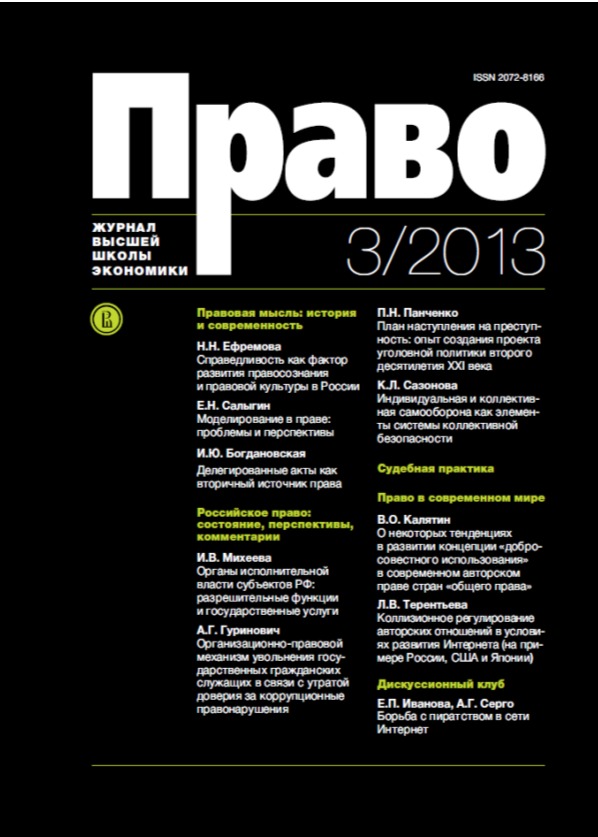
Индивидуальная и коллективная самооборона как элементы системы коллективной безопасности
Аннотация
Неотъемлемое право государств на индивидуальную и коллективную самооборону является одним из фундаментальных прав, закрепленных в Уставе Организации Объединенных Наций. Наряду с санкционированной Советом Безопасности ООН миротворческой деятельностью, данное право является исключением из принципа неприменения силы в международном праве. Сложность явления самообороны состоит в том, что ее реализация на практике представляет собой фактическое применение силы, которое порой чревато злоупотреблениями и превышением пределов самообороны. Именно поэтому чрезвычайно важно четкое формальное определение оснований и пределов самообороны. В настоящий момент и в отечественной, и в западной доктрине международного права отсутствует единство по данному вопросу. Очевидно, что правовое закрепление ключевых параметров самообороны позволит определить границы, в пределах которых самооборона является правомерной реализацией законного права государства, а также выявить возможные случаи злоупотребления данным правом. Данный шаг позволил бы значительно усилить нормативно-правовую базу института ответственности государств за неправомерное применение силы в рамках права международной ответственности. Однако анализ международно-правовой доктрины свидетельствует о том, что в настоящее время даже сам термин «самооборона» трактуется весьма по-разному, и единства во мнении теоретиков пока не предвидится. Рассматриваемая проблема также важна в контексте того, что право государств на индивидуальную и коллективную самооборону играет важную роль в упрочении действующей системы как универсальной коллективной безопасности, фундаментом которой является Организация Объединенных Наций, так и региональных систем коллективной безопасности. Именно поэтому одна из задач, которые ставил перед собой автор при написании данной статьи – это анализ той позиции, которую занимает право государств на индивидуальную и коллективную самооборону в современной системе коллективной безопасности. Поскольку система коллективной безопасности призвана минимизировать применение силы в международных отношениях, чрезвычайно важно в дальнейшем исключить все спорные с правовой точки зрения аспекты, связанные с реализацией права государств на индивидуальную и коллективную самооборону, с тем, чтобы реализация данного права не подрывала основы системы коллективной безопасности.
Литература
Dogovor ob otkaze ot voyni v kachestve orudiya natsional'noy politiki (Pakt Briana — Kelloga). Parizh, 27 avgusta 1928 g. [General Treaty for Renunciation of War as an Instrument of National Policy. The Kellogg-Briand Pact]. Available at: http://zaki.ru/pagesnew.php?id=1500 (accessed 09.09.2013)
Diplomaticheskii slovar' [Diplomatic dictionary] (1986). Moscow, 752 p.
Itogovyi document Vsemirnogo sammita OON 2005 g. Prinyat resolutsiyey no 60/1 General'noy assamblei OON ot 16. 09 2005. [World Summit Outcome 2005] Available at: http://www.un.org/ru/documents/decl_conv/declarations/outcome2005_ch3.shtml (accessed 09.09.2013)
Bowett D. (1958) Self-Defence in International Law. London, Springer, 294 p.
Fateev K. (2005) Obespecheniye voennoy bezopasnosti Rossiyskoy Federarsii: teoriya I praktika pravovogo regulirovaniya [Ensuring Military Security of the Russian Federation: Theory and Practice of Legal Regulation]. Moscow, Za prava voennosluzhaschykh, p. 467.
Ferdross A. Mezhdunarodnoye pravo [International Law]. Moscow, Mezhdunarodniye otnosheniya, 652 p.
Gray C. (2000) International Law and the Use of Force. N.Y., p. 430.
Green L. (1999) Essays on the Modern Law of War. N.Y, p. 604.
Gromyko A. (ed.) (1986) Diplomaticheskii slovar' [Diplomatic Dictionary]. Moscow, Mezhdunarodnye otnosheniya, p. 752.
Kelsen H. (1932) Unrecht und Unrechtsfolge im Volkerrecht. Zeitschrift für offentliches Recht. Bd. XII. Nr. 4. Springer. pp. 481-608.
Krisch N. (2001) Self-Defence and Collective Security. Beitrage zum auslandischen offentlichen Recht und Volkerrecht. Band 151. pp. 405-412.
Lukashuk I. (ed.) (1990) Kurs mezhdunarodnogo prava. T. 4 [Course on international law. V. 4]. Moscow, Moscow State University, 272 p.
Lukashuk I. (2005) Mezhdunarodnoye pravo [International Law]. Moscow, Wolters Kluwer, 432 p.
Maleev Yu. (2004) Reabilitatsiya adekvatnogo I proportsional'nogo primeneniya sily [Rehabilitation of Adequate and Proportionate Use of Force]. Moskovskii zhurnal mezhdunarodnogo prava — Moscow journal of international law no 3(55), pp. 31-47.
Martens F. (1905) Sovremennoe mezhdunarodnoepravo tsvilizovvannykh narodov [Modern International Law of Civilized Peoples]. Saint Petersburg, A.Benke, 686 p.
Orbelyan A. (2010) Stanovlenie i razvitie instituta samooborony v mezhdunarodnom prave [Formation and Development of the Institution of Self-defence in International Law]. Yerevan, Yerevan State University, pp. 150-167.
Skakunov E. (1973) Samooborona v mezhdunarodnom prave [Self-defence in International Law]. Moscow, Mezhdunarodniye otnosheniya, 176 p.
Sobakin V. (1962) Kollektivnaya bezopasnost' — garantiya mirnogo sosuschestovaniya [Collective Security — Guaranty of Peaceful Coexistence]. Moscow, Mezhdunarodniye otnosheniya, p. 518.
Tuzmukhamedov B. (2009) Predely samooborony [Limits of Self-defence]. Available at: http://www.ng.ru/politics/2004-09-29/2_predel.html (accessed 12.06.2013)
Ushakov N. (1997) Pravovoe regulirovaniye ispol'zovaniya sily v mezhdunarodnykh otnosheniyakh [Legal Regulation of Using Force in International Relations]. Moscow, IGPAN RAN, 96 p.
Copyright (c) 2013 Право. Журнал Высшей школы экономики

Это произведение доступно по лицензии Creative Commons «Attribution-ShareAlike» («Атрибуция — На тех же условиях») 4.0 Всемирная.