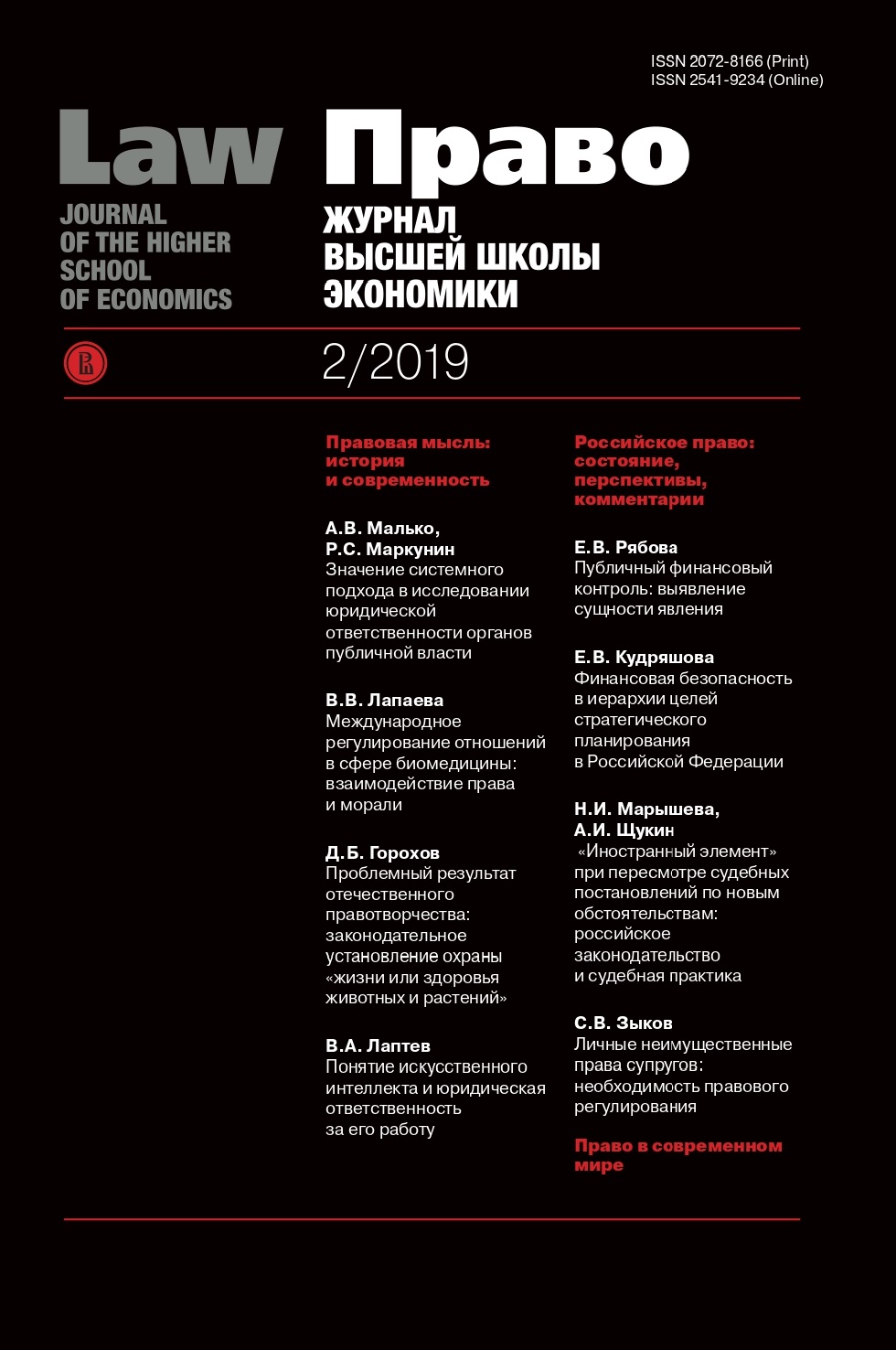
Проблемный результат отечественного правотворчества: законодательное установление охраны «жизни или здоровья животных и растений»
Аннотация
В статье дан результат комплексного исследования новой правовой категории — «жизнь или здоровье животных и растений», присутствующей в нескольких действующих и проектируемых федеральных законах. Цель исследования, проведенного с использованием формально-юридического и системного методов, а также метода моделирования, выяснить, какова корреляция этой категории с законодательством и правовой системой в целом. Доказывается, что исследованные нормы противоречат положениям Конституции и всему остальному законодательству России, более того — фундаментальным основам права, относящего животных и растения не к субъектам, а к объектам правоотношений. Конструкция критикуемых норм такова, что потерпевшими от административного правонарушения и кредиторами по возмещению вреда жизни и здоровью должны признаваться не только люди, но и животные и растения. Анализ судебной практики показывает, что эти нормы не принесут пользы в деле защиты животных от жестокого обращения, а объектов животного мира, растений, леса и лесных ресурсов — от истребления, незаконного использования и вредных последствий хозяйственной деятельности человека, поскольку они не применимы на практике. Обнаружена причина проникновения норм о защите «жизни или здоровья животных и растений» в российское законодательство: неадаптированная имплементация формулировок некоторых международных договоров России без учета особенностей российской правовой системы. Анализ публикаций по теме свидетельствует о попытках научного обоснования сомнительной легитимации, что подтверждает авторскую гипотезу о возможной угрозе деформации российской правовой доктрины. Названы и классифицированы ошибки, ставшие причиной критикуемого состояния отдельных норм федеральных законов. Обоснована необходимость приведения терминологии и содержания отдельных критикуемых норм в соответствие с положениями Конституции России и нормами федеральных законов в сферах охраны здоровья граждан и окружающей среды, природопользования, защиты имущественных прав физических и юридических лиц. В связи с этим даны рекомендации к планированию и согласованности предлагаемой работы на стадии правотворчества, использованию юридической технологии.
Литература
Ageshkina N.A., Korzhov Y.V. (2016) Commentary to the Federal Law of 27.12. 2002 № 184-FZ “On Technical Regulation”. SPS Consultant Plus (in Russian)
Anisimov A.P. (2016) Classification of Animal Rights. Biznes. Obrazovanie. Pravo, no 1, pp. 183-188 (in Russian).
Belyakova A.M. (1986) Civil Liability for Causing Damage. Theory and Practice. Moscow: MGU Press, 149 p. (in Russian)
Bogolyubov S.A. (2010) Law-making in the Environmental Sphere. Moscow: Eksmo, 528 p. (in Russian)
Chetverikov A.O. (2013) National Security of Russia and the Law of the World Trade Organization. Zakony Rossii: opyt, analiz, praktika, no 8, pp. 75-82 (in Russian)
Duyunov V.K. (ed.) Criminal Law of Russia. Moscow: RIOR, 664 p. (in Russian)
Evseev E.F. (2009) On the Correlation of the Definitions “Animal” and “Item” in Civil Law. Zakonodatel'stvo i ekonomika, no 2, pp. 23-26 (in Russian)
Gadzhiev G.A., Voynikanis E.A. (2018) May a Robot be a Subject of Law? (Search for the Regulating Digital Economy). Pravo. Zhurnal Vysshey shkoly ekonomiki, no 4, pp. 24-48 (in Russian)
Gasnikov K.D. (2002) Animals as Object of Civil Rights. Zakonodatel'stvo i ekonomika, no 12, pp. 41-43 (in Russian)
Kashirkina A.A., Morozov A.N. (2014) Russia, the Eurasian Economic Union and the World Trade Organization. Moscow: INFRA-M, 295 p. (in Russian)
Khabrieva T.Ya., Chernogor N.N. (2018) Law in Digital Reality. Zhurnal rossiyskogo prava, no 1, pp. 85-102 (in Russian)
Khabrieva T.Ya., Tikhomirov Yu. A. (eds.) (2015) Concept of Development of Legislation. Moscow: Norma, 544 p. (in Russian)
Khabrieva T.Ya. et al. (2017) Court Practice in Modern Russian Legal System. Moscow: Norma, 432 p. (in Russian)
Khludeneva N.I. (2014) The Defects of Regulating Environmental Protection. Moscow: INFRA-M, 172 p. (in Russian)
Kichigin N.V. (ed.) (2017) Legal Regulation of Recovering Environmental Damage. Moscow: INFRA, 368 p. (in Russian)
Kvanina V.V. (2014) State Control and Legal Responsibility in the Sphere of Technical Regulation. Biznes, Management i pravo. no 1, pp. 35-41 (in Russian)
Laskina N.V. (2013) Comment to the Federal Law of 30.12. 2009 № 384-FZ “Technical Regulating Safety of Buildings and Structures”. SPS Consultant Plus (in Russian)
Lazarev V.V. (ed.) (2003) General Theory of Law and State. Moscow: Yurist, 520 p. (in Russian)
Mikryukov V.A. (2014) Benefits and Burdens of Owning an Animal. Zakonodatel'stvo i ekonomika, no 8. pp. 48-55 (n Russian)
Minina E.L. (2014) Legal Regulating Animal Treatment. Zhurnal rossiyskogo prava, no 12, pp. 80-88 (in Russian)
Mokhov A.A., Kopylov D.E. (2006) Canines as Objects of Civil Rights. Yuridicheskiy mir, no 12, pp. 41-45 (in Russian)
Naumov A.V. (1996) Russian Criminal Law. Moscow: BEK, 560 p. (in Russian)
Nikolyukin S.V., Utkina I.O. (2008) Features of Emergence and the Termination of the Property Right to Neglected and Ownerless Animals: Collisions of Civil Law. Yurist, no 6, pp. 19-27 (in Russian)
Putilo N.V. (ed.) (2017) The Rght of Citizens for Provision of Medicines. Moscow: Norma, 216 p. (in Russian)
Sadikov O.N. (2006) (ed.) Civil Law. Moscow: INFRA. 493 p. (in Russian)
Schupletsova Yu.P. (ed.) (2016) Legal Regulation of Forest Use and Protection under Russian and Foreign Law. Moscow: INFRA-M, 272 p. (in Russian)
Sukhanov E.A. (ed.) (2000) Civil Law. Moscow: BEK, 518 p. (in Russian)
Shakirova D.I. (2018) Legal and Technical Regulating Environmental Protection: Candidate of Juridical Sciences Thesis. Moscow, 185 p. (in Russian)
Valeev M.M. (2003) Things as Objects of Civil Relations. Candidate of Juridical Sciences Thesis. Ekaterinburg, 215 p. (in Russian)
Vaskovsky E.V. (2003) Textbook of Civil Law. Moscow: Statut, 382 p. (in Russian)
Yakovlev V.E. et al. (2017) Legal Capacity: Historical, Sectorial and International Legal Analysis. Moscow: Statut, 434 p. (in Russian)
Zenin I. A. (2007) Civil Law. Moscow: Vyshaya shkola, 567 p. (in Russian)
Zorkin V.D. (ed.) (2014) Modern Constitutionalism. 'Proceedings of Conference to the 20th anniversary of the Constitution of Russia. Moscow: Norma, 480 p. (in Russian)
Copyright (c) 2019 Право. Журнал Высшей школы экономики

Это произведение доступно по лицензии Creative Commons «Attribution-ShareAlike» («Атрибуция — На тех же условиях») 4.0 Всемирная.