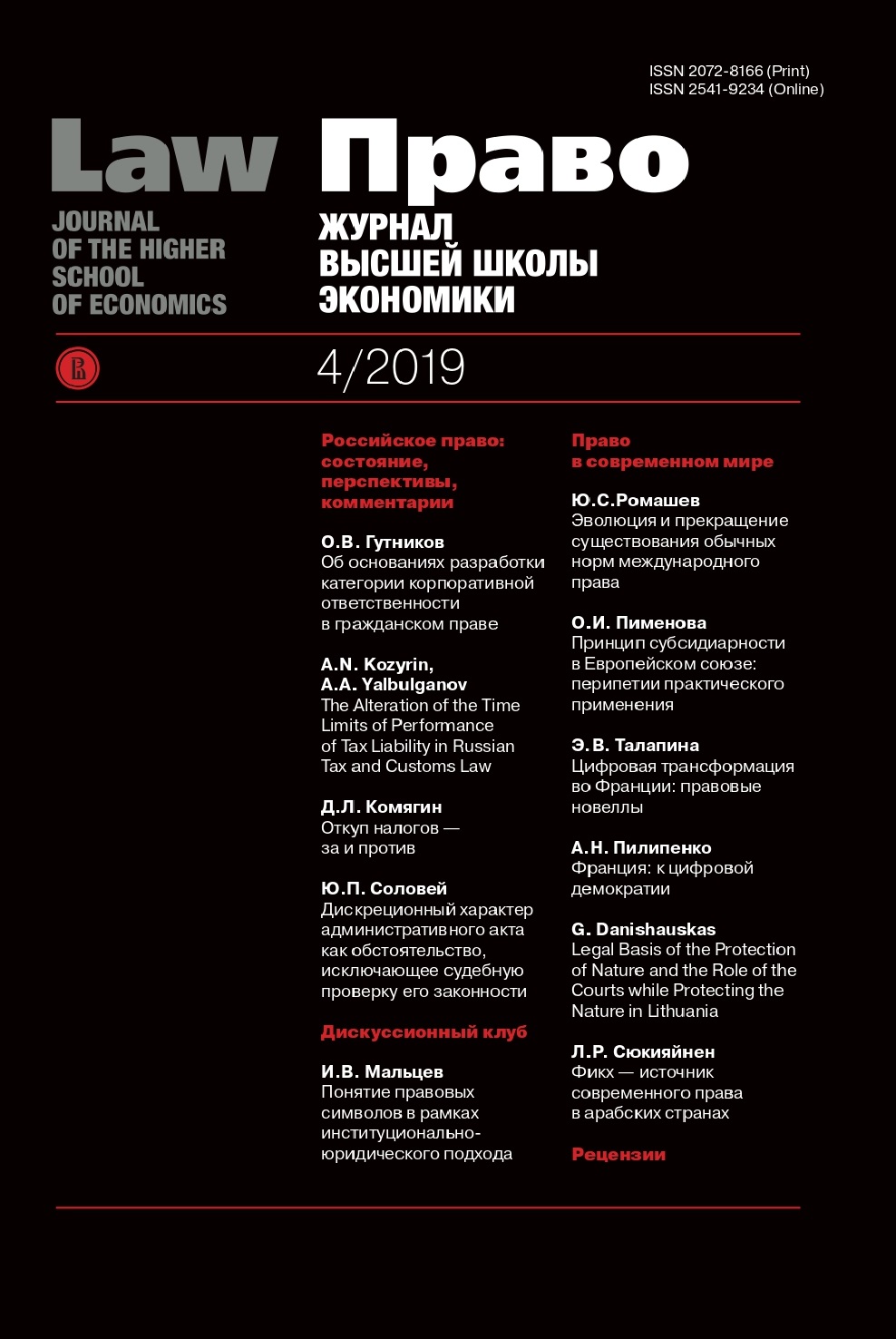
Alteration of Time Limits of Performance of Tax Liability in the Russian Tax and Customs Law
Аннотация
The article analyzes one of the central institutions of Russian tax law — alteration of the time limits for the payment of taxes. The right of the taxpayer to alter the execution of tax obligations, on one hand, demonstrates the desire of the legislator to ensure a balance of public and private interests in the implementation of tax regulation, and on the other hand, must guarantee the full implementation of the fiscal function of tax law. The fulfillment of the constitutional obligation to pay the established-by-law taxes involves the payment of taxes not only in full, but also on time. Alteration of the time limits doesn’t cancel the existing tax obligation and doesn’t create a new tax obligation. Having exercised the right to alter the time limit for fulfilling tax obligations, the taxpayer is able to pay tax at a later date than established by the legislation on taxes and fees, and at the same time not be held liable for violation of tax legislation. In order to maintain a balance of public and private interests in the tax sphere, a taxpayer’s right to alter the time limits for the payment of taxes is compensated by his obligation to pay in established cases a percentage that compensates for the damage caused to the fiscal interests of the state and municipalities in the exercise of this right. The article analyzes the general procedure for exercising the taxpayer’s right to alter the tax payment time limit established in the Tax Code of the Russian Federation (Chapter 9) and the acts of the Federal Tax Service adopted in accordance with it. Special cases of the realization of this right are also considered: when paying indirect taxes on goods imported into the territory of the customs union (in this case, the relevant norms of customs legislation are applied) and when altering the terms of payment of taxes credited to regional and local budgets (in this case, normative legal acts of constituent entities of the Russian Federation and municipalities). The article presents main forms of exercising the taxpayer’s right to alter the terms of tax payment (deferral, installment plan and investment tax credit) and tax and customs authorities with the authority to make appropriate decisions. Particular attention is paid to the issues of protecting the fiscal interests of the state in case of termination of legal relations of altering the terms of payment of taxes (for example, protecting fiscal interests in case of early termination of the investment tax credit agreement).
Литература
Cartou L. (1981) Droit fiscal international et européen. Paris: Dalloz, 280 p.
Cuadrado Ramos J. (2018). Principios de Derecho Fiscal. Madrid: Ra-Ma, 134 p.
Demin A.V. (2010) General theory of tax norms. Moscow: INFRA-M, 266 p. (in Russian)
Grosclaude J., Marchessou P. (2007) Droit fiscal général. Paris: Dalloz, 608 p.
Karaseva M.V. (ed.) (2009) Tax law of the Eastern European countries: general part. Moscow: Wolters Kluver, 336 p. (in Russian)
Ovsyannikov S.V. (2009) Forms and limits of interaction between tax law and civil law. Vestnik V4S RF, no 1, pp. 83-100 (in Russian)
Porohov E.V. (2009) Theory and practice of Kazakhstan tax law: main issues. Almaty: Nalogovy ekspert, 456 p. (in Russian).
Ryabov A.A. (2014) The influence of civil law on tax relations: doctrine, interpretation, practice. Moscow: NORMA, 224 p. (in Russian)
Sadikov O.N. (2011) Civil law conceptions in public law. Zhurnal rossiyskogo prava, no 9, pp. 19-28 (n Russian)
Smolitskaya E.E. (2018) Civil law institutes, terms and notions in the tax law. Moscow: Prospect, 176 p. (in Russian)
Terra B., Wattel P. (2012) European Tax Law. 6th ed. The Hague: Kluwer Law International, 634 p.
Thuronyi V. (2003) Comparative Tax Law. Deventer: Kluwer Law International, 373 p.
Heckly C. (2006) Fiscalité et mondialisation. Paris: LGDJ, 154 p.
Volkova N.N. (2010) Reception of civil law norms in tax legislation. Moscow: Yurlitinform, 160 p. (in Russian)
Yakovlev V.F. (2006) Civil legal method of the regulation of social relations. Moscow: Statut, 240 p. (in Russian)
Copyright (c) 2019 Право. Журнал Высшей школы экономики

Это произведение доступно по лицензии Creative Commons «Attribution-ShareAlike» («Атрибуция — На тех же условиях») 4.0 Всемирная.