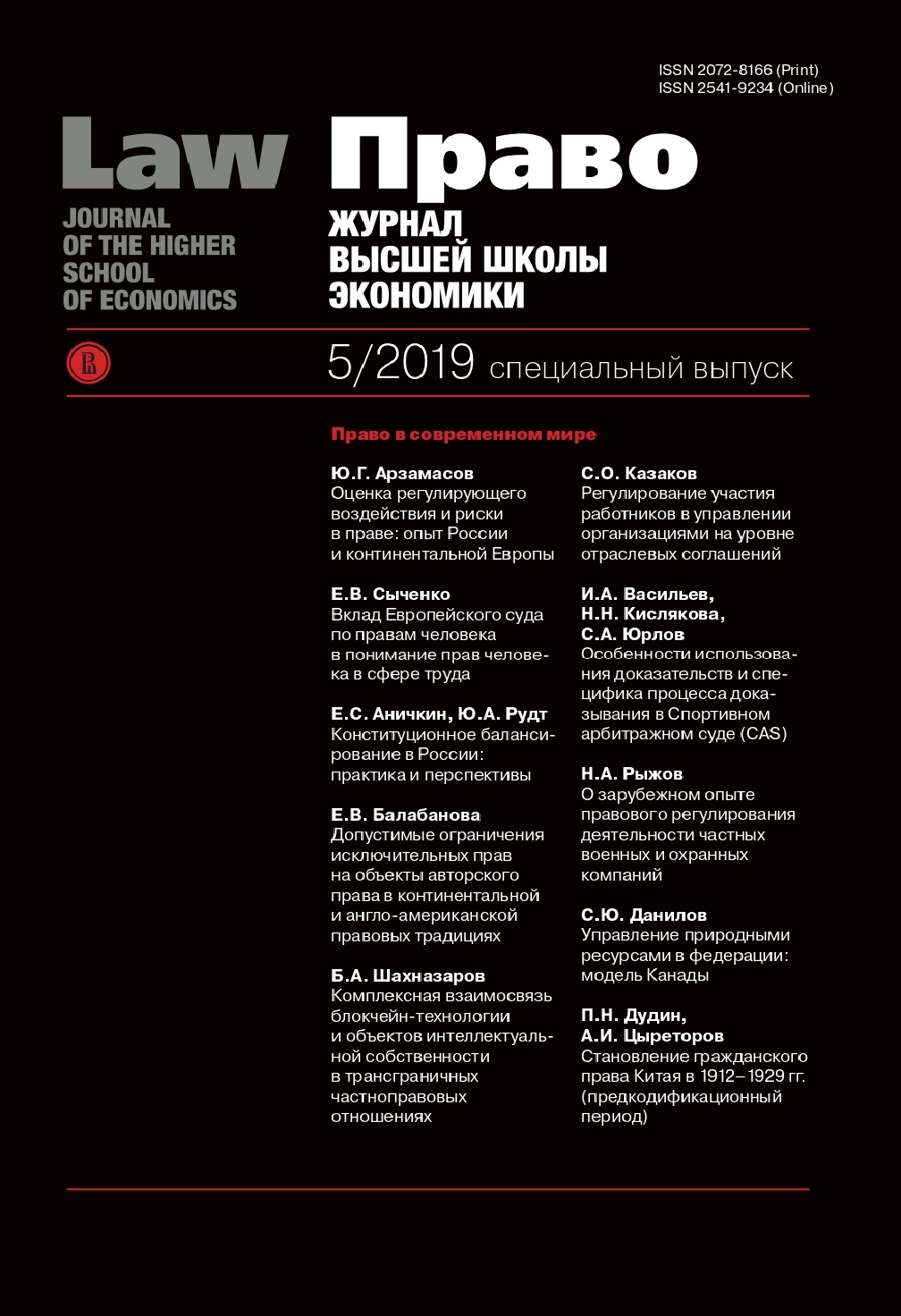
Допустимые ограничения исключительных прав на объекты авторского права в континентальной и англо-американской правовых традициях
DOI:
https://doi.org/10.17323/2072-8166.2019.5.101.120Ключевые слова:
ограничения исключительных авторских прав, защита исключительных прав, ограничительный механизм, трехступенчатый тест, доктрина добросовестного использованияАннотация
Статья посвящена наиболее актуальным проблемам функционирования системы допустимых ограничений авторских прав в различных правопорядках. На основе дифференцированного анализа двух правовых традиций в контексте общих тенденций совершенствования правового регулирования могут быть сформулированы следующие выводы: в странах континентального права формирование ограничительного механизма зависит от таких факторов, как характер действия трехступенчатого теста (прямое или опосредованное), порядок применения трехступенчатого теста (кумулятивное или некумулятивное), сочетание основных оценочных критериев (субъектный состав, соответствие определенной цели, доступность произведения, добросовестность использования), наличие альтернативных инструментов. В странах «общего права» формирование ограничительного механизма зависит от наличия общего правила оценки (в рамках доктрины добросовестного использования общее правило заменяют четыре фактора оценки, в рамках доктрины добросовестного использования общее правило оценки допустимости ограничений заменяет критерий добросовестности), дополнительных статутных и нестатутных оценочных критериев (защита публичного интереса, объем и характер использования, обстоятельства и цель использования, возможность достижения цели иным образом и др.). Автор приходит к выводу, что к обстоятельствам, негативно влияющим на эффективность и адаптивность ограничительного механизма, могут быть отнесены такие факторы, как: отсутствие общего правила или возможности его прямого применения; обязательность кумулятивного применения оценочных критериев; отсутствие дополнительных критериев оценки; наличие закрытого перечня ограничений и чрезмерная конкретизация ограничений; ограничение числа целей использования и объектов авторских прав, подлежащих использованию. В статье также доказывается, что проблема чрезмерно жесткой оценки допустимости ограничений может быть решена путем толкования существующих в национальном законодательстве ограничений, а также использования дополнительных квалифицирующих критериев.
Библиографические ссылки
Bainbridge D.I. (2009) Intellectual Property. Harlow: Pearson Education, 892 p.
Colston C., Middleton K. (2005) Modern Intellectual Property Law. London: Cavendish, 738 p.
Dreier T. (2007) Regulating Competition by Way of Copyright Limitations and Exceptions in Copyright Law. Cheltenham: Edward Elgar, pp. 232-254.
Geiger C. (2013) The social function of the intellectual property rights, or how ethics can influence the shape and use of IP Law. Dinwoodie B. (ed.) Methods and Perspectives in Intellectual Property. Cheltenham: Edward Elgar, 400 p.
Geiger C. (2006) Three-Step Test, Threat to Balanced Copyright Law? International Review of Intellectual Property and Competition Law, no 37, pp. 683-699.
Geiger C., Gervais D., Senftleben M. (2015) Understanding the three-step test. Gervais D. (ed.). International Intellectual Property: a Handbook of Contemporary Research. Cheltenham: Edward Elgar, pp. 167-189.
Geiger C., Hilty R., Griffiths J., Suthersanen U. (2010) Declaration of Balanced Interpretation of the Three-Step Test in Copyright Law. Available at: https://www.jipitec.eu/issues/jipitec-1-2-2010/2621/Declaration-Balanced-Interpretation-Of-The-Three-Step-Test.pdf (accessed: 17-12-2018)
Gervais D. (2005) Towards a New Core International Core International Copyright Norm: the Reverse Three-Step Test. Marquette Intellectual Property Law Review, vol. 9, pp. 1-35.
Guilbault L. (2002) Copyright Limitations and Contracts: An Analysis of the Contractual Overridability of Limitations on Copyright. The Hague: Kluwer Law International, 377 p.
Heins M., Beckles T. (2005) Will Fair Use Survive? Free Expression in the Age of Copyright Control: a policy report. New York: Brennan Center for Justice, 67 p.
Hua J.J. (2014) Toward a More Balanced Approach: Rethinking and Readjusting Copyright Systems in the Digital Network Era. Berlin: Springer, 225 p.
Hugenholtz B., Senftleben M. (2012) Fair Use in Europe. In Search of Flexibilities. Amsterdam Law School Research Paper, no 2012-39. Available at: https://www.ivir.nl/publicaties/download/Fair%20Use%20Report%20PUB.pdf (accessed: 10-12-2018)
Klein B., Moss G., Edwards L. (2015) Understanding Copyright: Intellectual Property in the Digital Age. London: SAGE, 160 p.
Kur A. (2008) Of Oceans, Islands, and Inland Water — How Much Room for Exceptions and Limitations under the Three Step-Test? Richmond Journal of Global Law and Business, no 8, pp. 287-350.
Lee N., Westkamp G., Kur A., Ohly A. (2014) Intellectual Property, Unfair Competition and Publicity: Convergences and Development. Cheltenham: Edward Elgar, 368 p.
Locke J. (2013) Two Treatises of Government. Manchester: Industrial Systems Research, 257 p.
Owen L. (2015) Fair Dealing: a Concept in UK Copyright Law. Learned Publishing, no 3, pp. 229-231.
Patterson L. (1968) Copyright in Historical Perspective. Nashville: Vanderbilt University Press, pp. 202-212.
Patterson L., Lindberg S. (1991) The Nature of Copyright. A Law of User' Rights. Athens: University of Georgia Press, 274 p.
Ricketson S., Ginsburg J. (2006) International Copyright and Neighboring Rights: the Berne Convention and Beyond. Oxford: Oxford University Press, 878 p.
Samuelson P. (2017) Justifications for Limitations and Exceptions. Copyright Law in an Age of Limitations and Exceptions. Cambridge: University Press, pp. 12-59.
Sun H. (2007) Overcoming the Achilles Heel of Copyright Law. Northwestern Journal of Technology & Intellectual Property, vol. 5, pp. 267-331.
Senftleben M. (2013) Comparative Approaches to Fair Use: An Important Impulse for Reforms in EU Copyright Law. Dinwoodie G. (ed.) Methods and Perspectives in intellectual property. Cheltenham: Edward Elgar, 400 p.
Senftleben M. (2004) Copyright, Limitations and the Three-step Test. An Analysis of the Three-step Test in International and EC Copyright Law. The Hague: Kluwer Law International, 340 p.
Suthersanen U. (2005) Human Rights and International Copyright Law. Copyright and Free Speech: Comparative and International Analyses. Oxford: Oxford University Press, 426 p.
Westkamp G. (2007) The Implementation of Directive 2001/29/EC in the Member States. London: Centre for Commercial Law Studies, 482 p.
Загрузки
Опубликован
Выпуск
Раздел
Лицензия
Copyright (c) 2019 Право. Журнал Высшей школы экономики

Это произведение доступно по лицензии Creative Commons «Attribution-ShareAlike» («Атрибуция — На тех же условиях») 4.0 Всемирная.