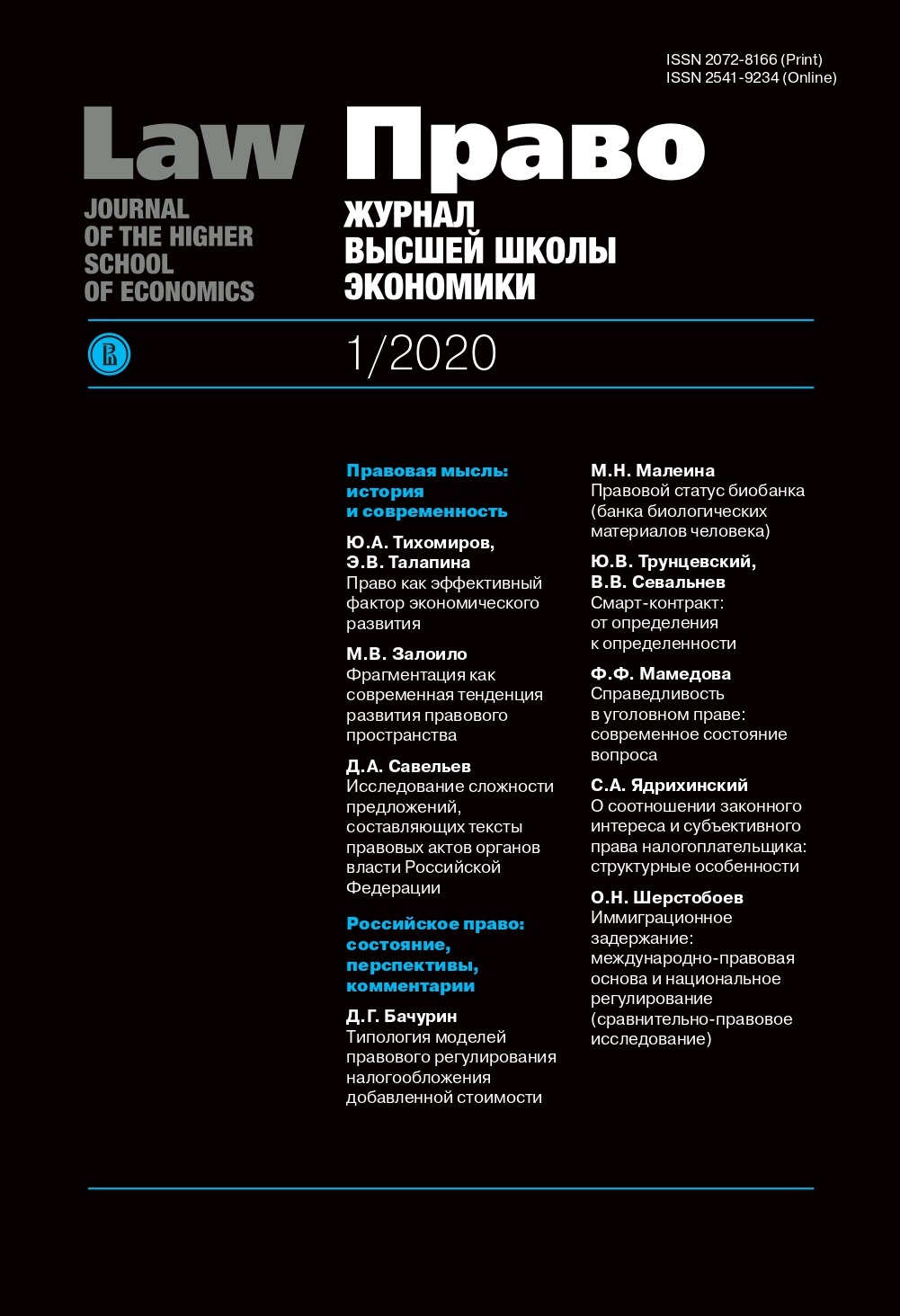
About Ratio of Legitimate Interest and Subjective Rights of a Taxpayer: Structural Features
DOI:
https://doi.org/10.17323/2072-8166.2020.1.169.187Keywords:
legal duty, subjective rights, legitimate interests, taxpayer, tax authority, permission, claim, entitlement, legal securityAbstract
The subject of the research is the concept of «legitimate interest» and «subjective rights» of the taxpayer. The use of these concepts in the legislation on taxes and fees suggests that there is no identity between them. However, it should be recognized that their difference due to the presence of a kinship relationship is not obvious, which causes various kinds of scholar discussions and disputes. As a result of a lack of understanding of the substance of these two permits, both taxpayers and the law enforcement officer cannot fully use their potential. The author uses comparative legal and other methods developed by legal science to identify the distinctive features of legitimate interests in comparison with the subjective rights of the taxpayer. An attempt is being made to refute traditional notions of legitimate interests as «truncated rights» guaranteed «to some extent». It is concluded that the legitimate interests and subjective rights of the taxpayer are equally protected and secured. The difference between them is not in the set of powers, but in the driving mechanism of implementation. Taxpayers ‘ claims, expressed in subjective rights, are endowed with an explicit trait. They are understandable to the obligated party and are legal by virtue of what is contained in the law. This character is unconditional and indisputable. The legitimate interest in view of the wide variability, as a rule, does not have a normative expression and therefore needs to be assessed its legality. Therefore the duty in due course of action, corresponding to the legitimate interest is implicit. It is not formalized for each ad hoc case, which makes it somewhat atypical, and therefore difficult to perceive; but most importantly, it is assumed to, and not excluded, also as it is not excluded itself an obligated person. The content of the tax authority's duty is open and requires taking into account both the taxpayer's claims and other factors that influence the decision-making (factual circumstances, public interests, requirements of justice, etc.). The interest of the taxpayer will acquire legal force (the status of «legitimate») from the moment of its approval, a positive assessment by its competent authority. The view excluding the competence of the requirements of the bearer of legitimate interest and corresponding to this requirement duty of the opposite side of the tax relationship carries the risk of turning the legitimate interests of the taxpayer into a phantom, as, in fact, it gives unlimited opportunities to opponents to violate these interests and obstruct their implementation.
References
Belov V.A. (2007) The object of subjective civil law, the object of civil relations and the object of civil turnover: the content and the ratio of concepts. Rozhkov M.A. (ed.) Objects of the Civil Turnover. Moscow: Statut, pp. 6-77 (in Russian)
Bogatyrev F.O. (2002) Interest in civil law. Zhurnal rossiyskogo prava, no 2, pp. 33-43 (in Russian)
Cherdantsev A.F., Gunin D.I. (2013) Interests are legal, non-legal and illegal. Rossiiskoe pravosudie, no 7, pp. 12-21 (in Russian)
Demin A.V. (2009) Method of tax law: the universal tools and specific features. Finansovoe pravo, no 3, pp. 43-53 (in Russian)
Demin A.V. (2012) Relatively certain means in the system of tax and legal regulation: trends and prospects. Finansovoe pravo, no 1, pp. 6-9 (in Russian)
Demin A.V. (2010) The rules of tax law. Krasnoyarsk: Siberian Federal University, 410 p. (in Russian)
Gruzdev V.V. (2011) Protected by law interest as an object of civil protection. Zakony Rossii: opyt, analiz, praktika, no 10, pp. 92-97 (in Russian)
Korkunov N.M. (1909) Lectures on general theory of law. Saint Petersburg: Martynov, 364 p. (in Russian)
Kuznetsov V.P (2010) On the imaginary provisions of article 22 of Russian Tax Code. Nalogii nalogooblozhenie, no 1, pp. 14-18 (in Russian)
Malko A.V., Subochev V.V. (2014) Legitimate interests in the legal life of a society. Pravovedenie, no 2, pp. 84-98 (in Russian)
Malko A.V., Subochev V.V. (2004) Legitimate interests as a legal category. Saint Petersburg: Yuridicheskii tsentr Press, 359 p. (in Russian)
Maltsev G.V. (1968) Socialist law and individual freedom: theoretical issues. Moscow: Yuridicheskaya literatura, 143 p. (in Russian)
Matuzov N.I. (1972) Personality. Rights. Democracy: theoretical issues of subjective law. Saratov: University press, 292 p. (in Russian)
Motovilovker E. Ya. (2003) Interest as a Substantive Feature of Subjective Right. Pravovedenie, no 4, pp. 52-62 (in Russian)
Pavlova M. S. (2011) Legitimate interest as a subject of judicial protection in cases of challenging decisions, actions (inaction) of authorities. Zakonodatel'stvo i ekonomika, no 3, pp. 45-48 (in Russian)
Romovska Z.V. (1983) Judicial protection of legally protected interest. Vestnik L'vovskogo universiteta, vol. 22, pp. 74-81 (in Russian)
Shershenevich G.F. (1910) General theory of law. Moscow: Bashmakov Brothers, 805 p. (in Russian)
Solovey Y.P. (2019) Discretionary Nature of Administrative Act as a Circumstance Precluding Judicial Review of its Legality. Pravo. Zhurnal Vysshey shkoly ekonomiki, no 4, pp. 72-99 (in Russian)
Subochev V.V., Malko A.V. (2008) Legitimate interests. Moscow: Norma, 496 p. (in Russian)
Vitruk N. V. (1981) Rights of the individual in a socialist society. Moscow: Nauka, 272 p. (in Russian)
Downloads
Published
Issue
Section
License
Copyright (c) 2020 Law. Journal of the Higher School of Economics

This work is licensed under a Creative Commons Attribution-ShareAlike 4.0 International License.