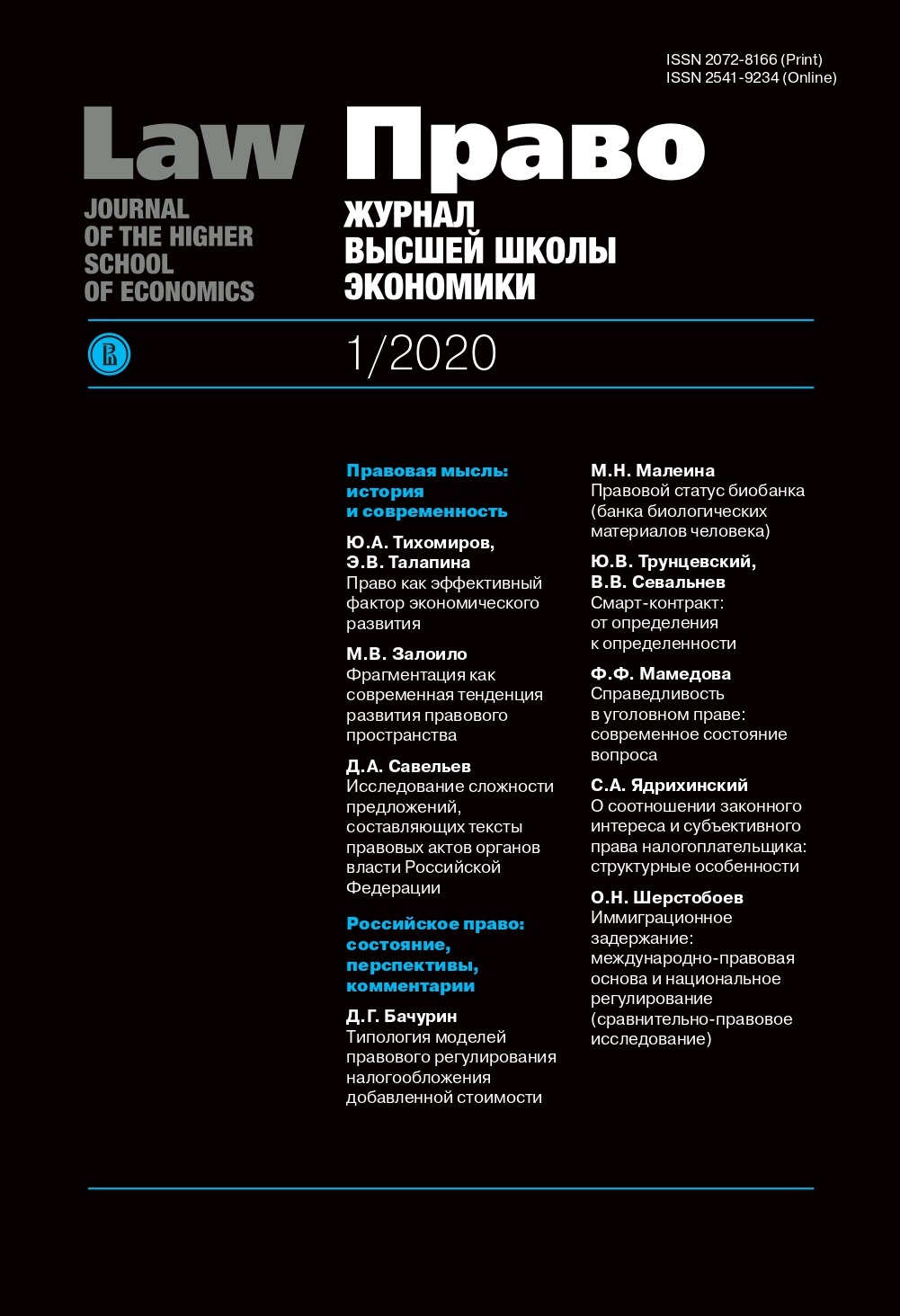
Typology of Models of Legal Regulating Taxation of Added Value
DOI:
https://doi.org/10.17323/2072-8166.2020.1.75.97Keywords:
tax law, VAT, legal mechanism, methodology of taxation of added value, regulatory model, peripheral model, neutral modelAbstract
The article studies ideology of legal regulation of taxation of added value. It forms two main aspects of a research: (1) identification of deep essence of taxation of added value and (2) definition of the place of the Russian model of a legal mechanism of the VAT in variety of national models of taxation of added value. In the work, the typology of legal mechanisms of taxation of added value in which, on the basis of the analysis of the international phenomenology of legal regulation of taxation the main models of a legal mechanism of taxation of added value are allocated, is presented for the first time: Western European model (regulatory); East European model (peripheral); neutral model (imitative); the group of national models of the largest states with pronounced specific features, but each of which approaches one of above-named. In the offered classification, the main thing is the question of legal mechanism of the VAT which in what degree actually developed corresponds to the objective public requirements which are combined with the interests of cost efficiency. The assessment of results of legal regulation of taxation of added value specifies that the regulatory Western European model is applied in the conditions of modern hi-tech production in a paradigm of an indissoluble unification of material and ethical structures of the modern Western European state, their coherence by the basic political and legal ideas, the idea of property and the idea of general welfare. The legal mechanism of taxation of added value operating in restrictions of peripheral East European model (it is possible to refer to it legal regulation of the VAT in Russia), becomes a result the instrument of financial and legal control of the countries with the reformed economy which governments are fond of excessive VAT taxation. The comparative analysis of tax and legal influences of the Western European and East European models demonstrates that until the condition of productive forces does not allow developing social industries, transition to an active legal mechanism of taxation of added value causes to destructive economic and legal transformations constrains development of the country. The study in typology of models of the considered mechanism allows to formulate a conclusion that in the Russian social and economic conditions application of neutral model of legal regulation of the VAT may be most preferable today.
References
Ballard C., Shoven J. (1987) The Value-Added Tax: The Efficiency Cost of Achieving Progressivity by Using Exemptions in Modern Developments in Public Finance. M. Boskin (ed.). Oxford: Blackwell, pp. 109-129.
Baunsgaard T., Keen M. (2005) Tax Revenue and Trade Liberalization. Working Paper. Washington: International Monetary Fund, no 5, pp. 3-23.
Boadway R., Keen M. (2000) Redistribution. Handbook of Income Distribution. A. Atkinson and F. Bourguignon (eds.). Amsterdam: North Holland, pp.677-789.
Emran M., Stiglitz J. (2005) On Selective Indirect Tax Reform in Developing Countries. Journal of Public Economics, vol. 8. pp. 596-603.
Habermas J. (2011) Europa am Scheideweg. Handelsblatt, 17.09, p. 13.
He L., Han P. (2015) Study of the regime and ways of implementing the transition from NAP to VAT in the financial sector of China. World of Modern Science. no. 5, pp. 25-34.
Hossain S. (1995) The Equity Impact of the Value-Added Tax in Bangladesh. International Monetary Fund Staff Papers, vol. 42, pp. 411-430.
Hudson M. (2012) Neoliberal tax and financial policies lead to Russia's impoverishment. World of Changes, no 3, pp. 49-64.
Inozemtsev V.L. (2004) Features of the European Social Model. Sovremennaya Evropa, no 1, pp. 87-99 (in Russian)
Kautsky K. (2013) Economic Development and Social Order. Moscow: Librocom, 200 p. (in Russian)
Kotlikoff L., Summers L. (1987) The Tax Incidence. Handbook of Public Economics. A.Auerbach, ed. Amsterdam: North Holland, vol. 2, pp. 1043-1092.
Malko A.V., Matuzov N.I. (eds.) (2007) Modern Research Methods in Law. Saratov: Ministry of Internal Affairs Institute, 560 p. (in Russian)
Mann M. (2014) Power in the 21st Century. Moscow: Higher School of Economics. 204 p. (in Russian)
Marx K. (1985) Capital. Criticism of Political Economy. Vol. 3. Moscow: Politizdat, 508 p. (in Russian)
Mason P. (2016) Post Capitalism: a Guide to Our Future. Moscow: Ad Marginem, 416 p. (in Russian)
Osipova Yu.M. et al. (eds.) (2007) Economic Theory in the 21st Century. National Economy and Society. Moscow: Economist, 640 p. (in Russian)
Pagan J., Soydemir G., Tijerina-Guajardo J. (2001) The Evolution of VAT Rates and Government Tax Revenue in Mexico. Contemporary Economic Policy, vol. 19, pp. 407-428.
Picketty T. (2015) Capital in the 21st Century. Moscow: Ad Marginem, 592 p. (in Russian)
Weber M. (2011) Protestant Ethics and Spirit of Capitalism. Moscow: Progress, 178 p. (in Russian)
Downloads
Published
Issue
Section
License
Copyright (c) 2020 Law. Journal of the Higher School of Economics

This work is licensed under a Creative Commons Attribution-ShareAlike 4.0 International License.